
The Complete Guide to HPMC in Dry Mix Mortar Systems
Introduction
Modern dry mix mortar technology has evolved far beyond simple cement and sand blending. Today’s high-performance construction materials rely heavily on functional additives capable of controlling hydration kinetics, rheology, water management, workability, and long-term durability.
Among all mortar additives, Hydroxypropyl Methyl Cellulose (HPMC) remains one of the most critical performance-defining materials in cement-based dry mix systems.
Whether in tile adhesive, wall putty, skim coat, EIFS mortar, gypsum plaster, self-leveling compounds, repair mortar, or insulation systems, HPMC directly influences:
- Water retention
- Open time
- Slip resistance
- Sag control
- Pumpability
- Troweling behavior
- Hydration efficiency
- Crack resistance
- Surface smoothness
- Construction stability
However, many formulation engineers still treat HPMC as a simple thickener. In reality, cellulose ether functions as a sophisticated rheology modifier and hydration management system that interacts dynamically with cement particles, fillers, polymers, and environmental conditions.
This guide provides a deep technical explanation of HPMC performance mechanisms inside dry mix mortar systems, with a strong focus on practical formulation engineering and industrial production optimization.
What Is HPMC?
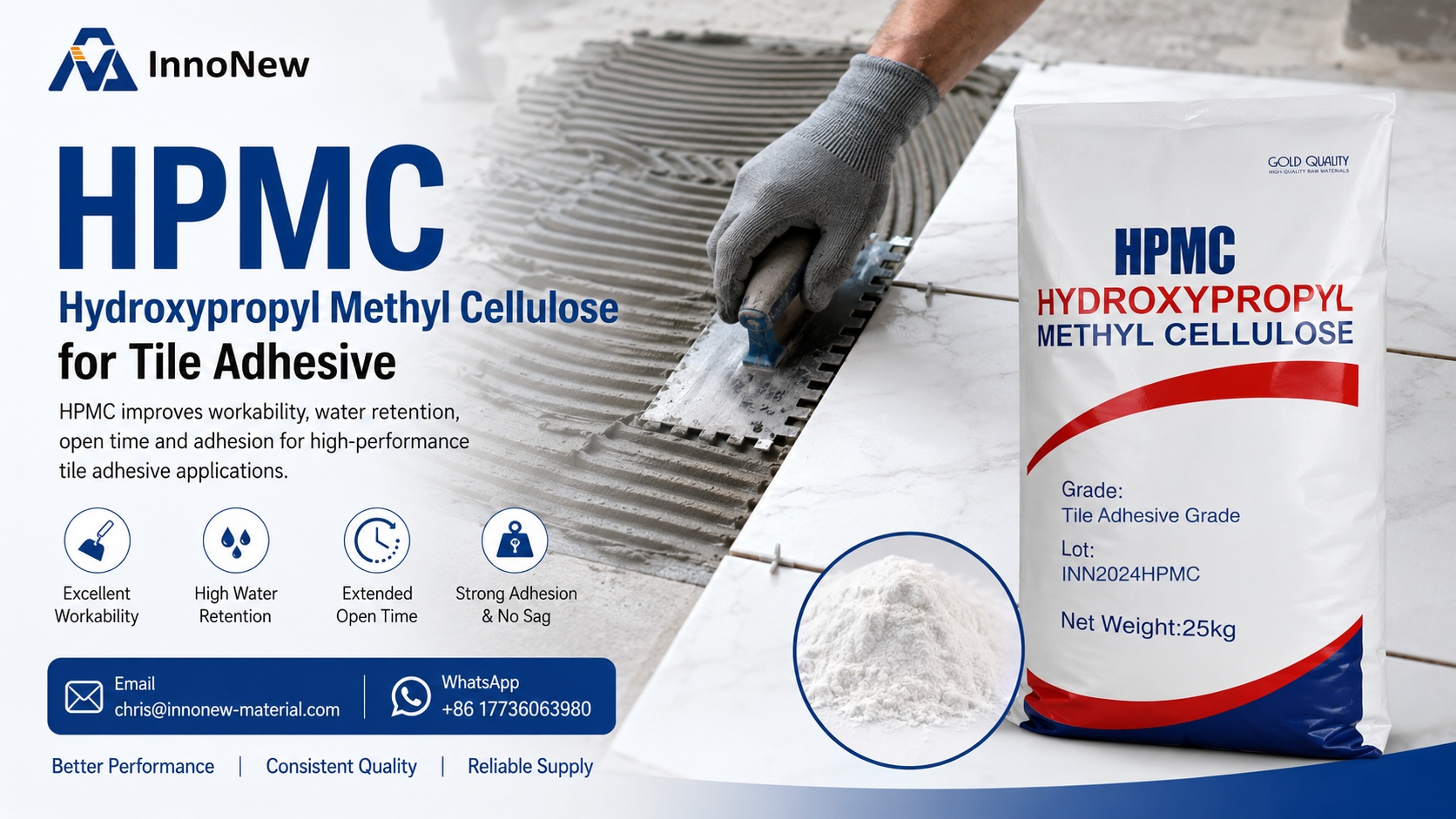
Hydroxypropyl Methyl Cellulose (HPMC) is a non-ionic cellulose ether produced through the etherification of purified cotton cellulose or wood pulp cellulose.
Its molecular structure contains:
- Methoxy groups (-OCH3)
- Hydroxypropoxy groups (-OCH2CHOHCH3)
These substitution groups determine:
- Water solubility
- Gel temperature
- Rheological behavior
- Water retention efficiency
- Compatibility with cement systems
HPMC dissolves in water and forms a three-dimensional polymer network capable of modifying viscosity, stabilizing water distribution, and controlling mortar flow behavior.
Why HPMC Is Essential in Dry Mix Mortar
Without HPMC, cement mortar systems typically suffer from:
- Rapid water loss
- Poor workability
- Short open time
- Low adhesion
- Segregation
- Cracking
- Powdering
- Tile slippage
- Poor sag resistance
HPMC solves these issues simultaneously by controlling the movement and retention of water throughout the hydration process.
Its role extends far beyond thickening.
HPMC acts as:
- Water retention agent
- Rheology modifier
- Air entrainment stabilizer
- Lubrication enhancer
- Anti-sagging agent
- Cement hydration regulator
- Workability improver
HPMC Water Retention Mechanism
Capillary Water Control
The most important function of HPMC is water retention.
Cement-based mortars naturally lose water rapidly through:
- Absorption into porous substrates
- Evaporation
- Cement hydration consumption
When water escapes too quickly:
- Cement hydration becomes incomplete
- Bond strength decreases
- Surface cracking increases
- Open time shortens dramatically
HPMC forms a hydrated polymer film that slows water migration inside the mortar matrix.
This mechanism creates:
- Reduced capillary water movement
- Improved internal moisture distribution
- Extended hydration time
- Stable cement crystal growth
As a result, mortar maintains sufficient moisture for proper hydration and bonding.
Protective Colloidal Layer
HPMC molecules adsorb around cement particles and create a protective colloidal barrier.
This barrier:
- Delays premature water depletion
- Reduces hydration shock
- Improves workability retention
- Stabilizes mortar consistency
The effect becomes especially important in:
- High-temperature climates
- Absorbent substrates
- Thin-bed tile adhesives
- Fast-setting cement systems
Rheology Theory of HPMC in Mortar Systems
Understanding Mortar Rheology
Rheology refers to the flow and deformation behavior of mortar under applied force.
In dry mix systems, proper rheology determines:
- Troweling smoothness
- Pumpability
- Vertical slip resistance
- Application comfort
- Spreadability
- Anti-sagging performance
HPMC modifies rheology through polymer chain entanglement and water structuring.
Pseudoplastic Behavior
HPMC-containing mortars exhibit pseudoplastic or shear-thinning behavior.
This means:
- Mortar viscosity decreases during mixing or troweling
- Viscosity recovers after application
Benefits include:
- Easier application
- Improved leveling
- Better anti-sagging
- Reduced labor fatigue
This balance between flowability and structural stability is one of the reasons HPMC dominates modern mortar technology.
HPMC Viscosity Selection Theory
Selecting the correct viscosity grade is one of the most misunderstood aspects of mortar formulation.
Higher viscosity does not always mean better performance.
Different mortar systems require different rheological balances.
Low Viscosity HPMC
Typical range:
400–40,000 mPa·s
Applications:
- Self-leveling mortar
- Flowable mortar
- Gypsum systems
Characteristics:
- Better flowability
- Lower thickening effect
- Faster wetting
Medium Viscosity HPMC
Typical range:
50,000–100,000 mPa·s
Applications:
- Wall putty
- Cement plaster
- Standard tile adhesive
Characteristics:
- Balanced water retention
- Good workability
- Stable open time
High Viscosity HPMC
Typical range:
150,000–200,000+ mPa·s
Applications:
- Heavy tile adhesive
- EIFS systems
- Thick-bed mortar
Characteristics:
- Strong anti-sagging
- High water retention
- Increased structural stability
Interaction Between HPMC and Cement Hydration
HPMC directly influences cement hydration kinetics.
Hydration Delay Mechanism
HPMC slightly delays hydration by:
- Adsorbing on cement particle surfaces
- Reducing ion diffusion speed
- Controlling water availability
This controlled retardation improves:
- Open time
- Workability retention
- Construction flexibility
However, excessive dosage may cause:
- Slow strength development
- Delayed setting
- Reduced early strength
Proper dosage balance is critical.
Hydration Optimization
A well-designed HPMC system promotes:
- More complete hydration
- Better C-S-H gel formation
- Improved microstructure density
- Reduced shrinkage cracking
This leads to improved long-term mechanical performance.
Open Time Optimization
Open time refers to the period during which mortar maintains effective bonding capability after application.
For tile adhesive systems, insufficient open time causes:
- Hollow bonding
- Tile detachment
- Installation failure
HPMC extends open time by:
- Reducing water evaporation
- Slowing surface drying
- Maintaining adhesive wetting ability
Key influencing factors include:
- HPMC viscosity
- Substitution degree
- Ambient temperature
- Cement type
- Filler particle distribution
Anti-Sagging Mechanism
Vertical tile applications require strong sag resistance.
HPMC improves anti-sagging through:
- Increased yield stress
- Enhanced structural viscosity
- Polymer network stabilization
A properly optimized HPMC system prevents tiles from sliding after installation while maintaining good spreadability.
Balancing anti-sagging and workability is one of the most advanced aspects of tile adhesive formulation.
HPMC Dosage Optimization
Typical dosage:
0.2%–0.6% of dry mortar weight
However, optimal dosage depends on:
- Cement content
- Sand grading
- Filler fineness
- RDP dosage
- Construction climate
- Target application
Under-Dosage Problems
Too little HPMC may cause:
- Poor water retention
- Short open time
- Cracking
- Poor adhesion
- Difficult application
Over-Dosage Problems
Excessive HPMC may result in:
- Sticky mortar
- Reduced strength
- Air entrainment increase
- Delayed setting
- Reduced productivity
Professional formulation design focuses on performance balance rather than maximum viscosity or dosage.
Climate Adaptation Strategy
Environmental conditions dramatically affect mortar behavior.
Hot Climate Formulation
Challenges:
- Rapid evaporation
- Short open time
- Fast skin formation
Optimization:
- Higher water retention HPMC
- Slightly higher viscosity
- Improved hydration control
Cold Climate Formulation
Challenges:
- Slow hydration
- Reduced curing speed
Optimization:
- Lower retardation effect
- Controlled viscosity
- Accelerated hydration balance
High Humidity Conditions
Challenges:
- Slow drying
- Surface tackiness
Optimization:
- Faster hydration balance
- Controlled cellulose dosage
Compatibility with RDP, PCE, and HPS
Modern dry mix mortars contain multiple functional additives.
Compatibility engineering is essential.
HPMC and RDP Compatibility
Redispersible Polymer Powder (RDP) improves:
- Flexibility
- Adhesion
- Impact resistance
HPMC stabilizes polymer dispersion and enhances water distribution.
A balanced HPMC-RDP system creates:
- Improved bonding
- Better deformability
- Enhanced durability
However, excessive cellulose may negatively affect polymer film formation.
HPMC and PCE Compatibility
Polycarboxylate Superplasticizer (PCE) improves mortar flowability and water reduction.
Potential challenges:
- Viscosity collapse
- Air instability
- Segregation
Compatibility depends on:
- PCE molecular structure
- HPMC substitution type
- Cement chemistry
Professional formulation adjustment is often required to stabilize rheology.
HPMC and HPS Synergy
Hydroxypropyl Starch Ether (HPS) enhances:
- Anti-sagging
- Slip resistance
- Structural build-up
HPMC + HPS systems are widely used in premium tile adhesives for large-format tile installation.
The synergy provides:
- Improved vertical hold
- Better trowel feel
- Enhanced application comfort
Formulation Troubleshooting Guide
Problem: Poor Water Retention
Possible Causes:
- Low HPMC dosage
- Incorrect viscosity grade
- Poor cellulose quality
Solutions:
- Increase water retention grade
- Optimize particle distribution
- Adjust formulation balance
Problem: Excessive Stickiness
Possible Causes:
- Overly high viscosity
- Excessive cellulose dosage
Solutions:
- Reduce viscosity grade
- Optimize polymer ratio
- Improve filler grading
Problem: Tile Slippage
Possible Causes:
- Low structural viscosity
- Poor rheology balance
Solutions:
- Increase anti-sagging performance
- Introduce HPS synergy
- Adjust sand grading
Problem: Short Open Time
Possible Causes:
- High temperature
- Rapid water absorption
- Incompatible additives
Solutions:
- Improve water retention
- Adjust retardation balance
- Optimize polymer interaction
Future Trends in HPMC Technology
The future of cellulose ether technology is moving toward:
- Ultra-low dosage efficiency
- Smart rheology control
- AI-assisted formulation optimization
- Low-carbon mortar systems
- Improved compatibility engineering
- Climate-adaptive additives
Advanced mortar manufacturers increasingly focus on:
- Construction efficiency
- Long-term durability
- Sustainability
- Worker application comfort
- Automated production stability
HPMC suppliers must therefore provide not only materials, but also formulation engineering support and application-specific optimization.
Conclusion
HPMC is no longer simply a thickener for dry mix mortar systems.
It is a multifunctional performance-engineering additive that governs:
- Water management
- Rheology
- Cement hydration
- Workability
- Open time
- Anti-sagging behavior
- Construction stability
- System compatibility
Understanding the interaction between HPMC, cement chemistry, polymers, fillers, and environmental conditions is essential for developing high-performance mortar formulations.
As dry mix mortar technology continues to evolve, advanced cellulose ether engineering will remain a key competitive factor for manufacturers seeking premium construction performance and long-term market differentiation.
FAQ
What does HPMC do in dry mix mortar?
HPMC acts as a water retention agent, rheology modifier, and workability enhancer in dry mix mortar systems. It improves open time, adhesion, anti-sagging performance, and construction stability.
How does HPMC improve water retention?
HPMC forms a hydrated polymer network that slows water migration and evaporation, allowing more complete cement hydration and improved mortar performance.
Which viscosity HPMC is best for tile adhesive?
Medium to high viscosity HPMC grades are commonly used in tile adhesive systems depending on anti-sagging and open time requirements.
Can HPMC affect cement hydration?
Yes. HPMC slightly delays hydration by controlling water distribution and ion diffusion, which improves workability retention and application performance.
Is HPMC compatible with PCE superplasticizer?
Yes, but compatibility depends on molecular structure, dosage balance, and cement chemistry. Proper formulation optimization is necessary to maintain stable rheology.
Why is HPMC important in hot climate mortar applications?
In hot climates, HPMC helps reduce rapid water evaporation, extends open time, and stabilizes workability under high-temperature conditions.