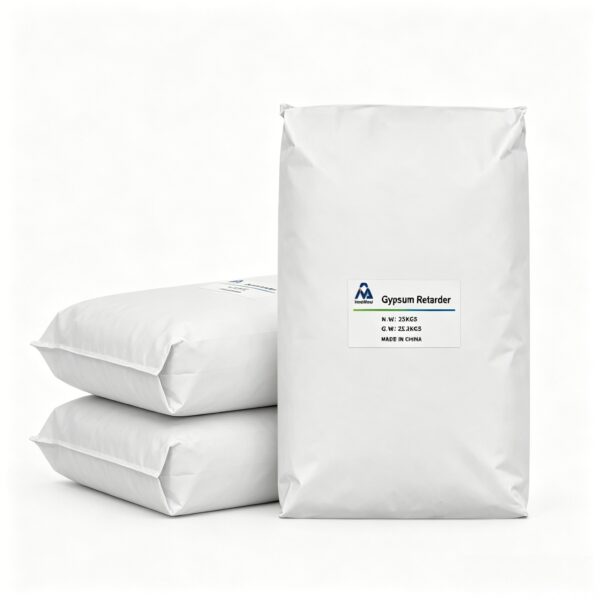
Gypsum Retarder for Gypsum Plaster and Gypsum-Based Construction Materials
Extend Setting Time Without Sacrificing Strength
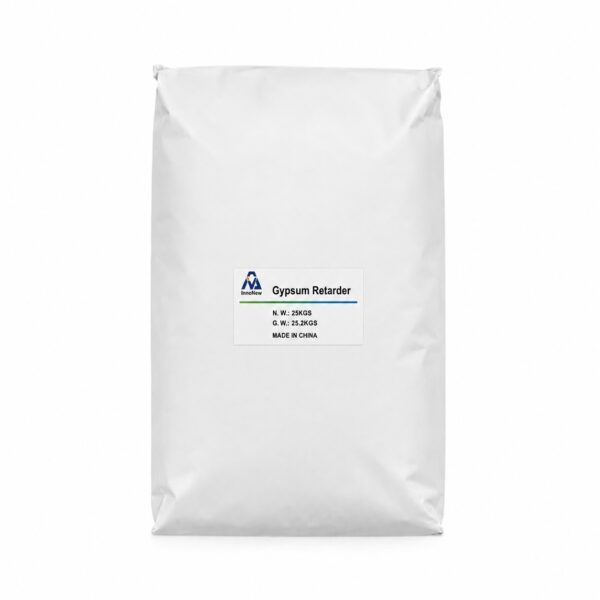
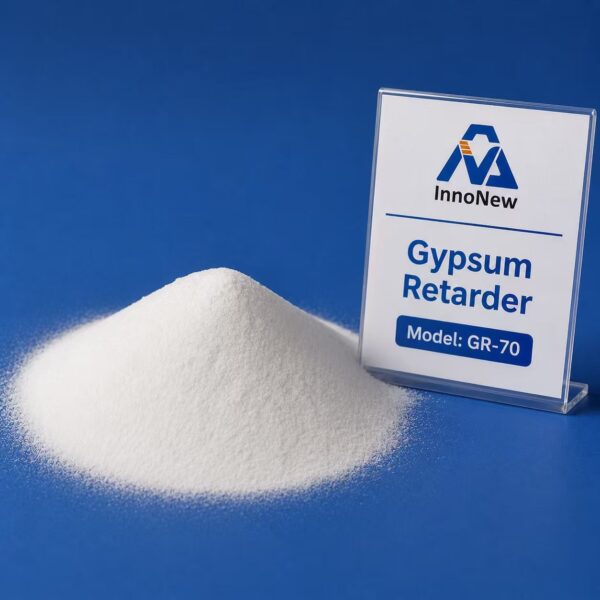
InnoNew® Gypsum Retarder is a high-performance additive designed to control the setting behavior of gypsum-based materials. It effectively prolongs working time, improves application flexibility, and enhances process stability in gypsum plaster, gypsum putty, gypsum self-leveling compounds, and prefabricated gypsum products.
Suitable for:
- Gypsum Plaster
- Machine Applied Gypsum
- Gypsum Putty
- Gypsum Joint Compound
- Gypsum Self-Leveling
- Gypsum Blocks
- Gypsum Board Manufacturing
What Is Gypsum Retarder?
Gypsum retarder is a functional additive used to delay the hydration reaction of calcium sulfate hemihydrate (CaSO₄·½H₂O) during gypsum setting. By regulating crystal nucleation and growth, the retarder extends workable time and improves construction efficiency.
Benefits include:
- Extended open time
- Improved workability
- Better surface finishing
- Reduced material waste
- Enhanced production efficiency
- Increased transportation flexibility
- Consistent product quality
- Improved construction productivity
How Gypsum Retarder Works
Understanding the Hydration Mechanism of Gypsum
When gypsum hemihydrate is mixed with water, a hydration reaction begins immediately.
During this process, calcium sulfate hemihydrate converts into calcium sulfate dihydrate, forming an interlocking crystal network responsible for setting and hardening.
Without proper control, rapid crystal growth can lead to:
- Insufficient working time
- Poor finishing quality
- Increased material waste
- Difficult machine application
Gypsum retarders temporarily slow crystal nucleation and crystal growth, extending workable time while allowing the hydration process to continue normally. As a result, the final hardened gypsum retains excellent strength and dimensional stability.
Key Benefits of InnoNew Gypsum Retarder
Accurate Setting Time Control
Our gypsum retarder allows formulators to precisely adjust:
- Initial Setting Time
- Final Setting Time
- Open Time
- Construction Window
This flexibility helps manufacturers tailor formulations for different climates, raw materials, and project requirements.
Excellent Compatibility
InnoNew Gypsum Retarder demonstrates excellent compatibility with commonly used dry mix mortar and gypsum additives:
Compatible With
- Hydroxypropyl Methyl Cellulose (HPMC)
- Hydroxyethyl Methyl Cellulose (HEMC)
- Starch Ether
- Polycarboxylate Ether (PCE)
- Redispersible Polymer Powder (RDP)
- Defoamer
- Cellulose Ether Systems
Low Dosage Efficiency
Typical dosage:
0.02%–0.30%
depending on:
- Gypsum purity
- Ambient temperature
- Humidity conditions
- Desired setting time
- Formula composition
The low addition rate helps reduce formulation costs while delivering effective setting control.
Stable Performance
Suitable for:
- Hot climates
- Humid environments
- Automated production lines
Applications of Gypsum Retarder
Gypsum Plaster
Gypsum plaster systems require sufficient working time to allow proper application, leveling, and finishing. InnoNew Gypsum Retarder extends open time without negatively affecting final strength development. Contractors benefit from improved workability, smoother application, and higher productivity, particularly in large wall and ceiling finishing projects.
Machine Applied Gypsum
Machine-applied gypsum formulations demand consistent pumpability and spraying performance. Rapid setting can lead to equipment blockage and application defects. Our gypsum retarder maintains stable rheological properties during pumping and spraying, enabling continuous operation and improved construction efficiency.
Gypsum Putty
In gypsum putty formulations, controlled setting time is essential for achieving smooth spreading and superior surface quality. InnoNew Gypsum Retarder improves application flexibility, minimizes premature hardening, and supports consistent finishing results for interior wall systems.
Gypsum Joint Compound
Joint compounds used in drywall systems require adequate working time for filling, taping, and finishing operations. Our retarder enhances workability, improves finishing quality, and helps applicators achieve smooth, crack-free surfaces.
Gypsum Self-Leveling Compound
Self-leveling gypsum systems require a balance between flowability and setting control. InnoNew Gypsum Retarder provides sufficient flow time, allowing materials to spread evenly and develop smooth surfaces while maintaining dimensional stability after hardening.
Gypsum Blocks and Gypsum Panels
Manufacturers of gypsum blocks, panels, and prefabricated gypsum products benefit from improved process stability and production consistency. Controlled setting behavior helps optimize molding operations, reduce defects, and improve product quality.
Gypsum Board Manufacturing
In gypsum board production, precise setting control is critical for maintaining continuous manufacturing efficiency. Our gypsum retarder supports stable production processes, consistent board quality, and optimized production speed.
Technical Specification
|
Item |
Specification | ||
| Model | GR-50 | GR-60 | GR-70 |
|
Appearance |
White or Light Yellow Powder Powder |
||
| Moisture Content | ≤5% | ≤5% | ≤5% |
| pH Value | 6-8 | 6-86-8 | |
| Bulk density, g/L | 600±100 | 600±100 | 600±100 |
| Active Content | ≥50 | ≥60 |
≥70 |
Recommended Dosage
| Model | Recommended dosage | Advantage |
| GR-50 | 0.1%~0.3% | Economical and practical, easy to use, easy to mix evenly. |
| GR-60 | 0.05%~0.2% | Efficient retarding effect, moderate cost performance |
| GR-70 | 0.01%~0.1% | Excellent retarding effect with low dosage |
Why Use Gypsum Retarder in Modern Construction?
Modern construction projects increasingly demand:
- Longer transportation distances
- Larger application areas
- Mechanized construction methods
- Improved labor efficiency
- Consistent production quality
As a result, gypsum retarders have become essential additives in gypsum formulation technology.
Key advantages include:
- Better process control
- Increased construction efficiency
- Reduced material waste
- Improved surface quality
- Consistent product performance
- Enhanced manufacturing stability
For manufacturers and contractors alike, setting-time management is no longer optional—it is a critical factor in product quality and project success.
Why Choose InnoNew Gypsum Retarder?
Professional Construction Chemical Supplier
Stable Quality
Strict quality control ensures consistent performance from batch to batch.
Technical Formulation Support
Professional formulation assistance for gypsum plaster, putty, self-leveling, and board manufacturing applications.
OEM & Private Label Service
Flexible packaging and branding solutions for distributors and importers.
Fast Delivery
Reliable production capacity and global logistics support.
Global Export Experience
Serving customers across Asia, the Middle East, Africa, Europe, and Latin America.
FAQ
Q1: What is Gypsum Retarder and how does it work?
Q2: How much gypsum retarder should be added?
Q3: Does gypsum retarder impact product strength?
Q4: Can it be mixed with HPMC? What’s the difference from cement retarder?
Q5: Is it suitable for machine-applied gypsum and gypsum board production? How to store it?
Q6: What is the difference between gypsum retarder and cement retarder?
Gypsum retarders are specifically designed to regulate gypsum hydration mechanisms, while cement retarders target cement hydration reactions.
Q7: How does gypsum retarder extend setting time?
It slows gypsum crystal nucleation and growth during hydration, delaying the formation of the hardened crystal network.
Q8: Is gypsum retarder suitable for machine-applied gypsum?
Yes. It helps maintain pumpability and spraying performance during machine application.
Q9: Can gypsum retarder be used in gypsum board manufacturing?
Yes. It is widely used to control setting behavior and improve production stability in gypsum board manufacturing.
Q10: What factors affect dosage?
Key factors include gypsum purity, temperature, humidity, formulation design, and desired setting time.