
Redispersible Polymer Powder RDP for Tile Adhesive
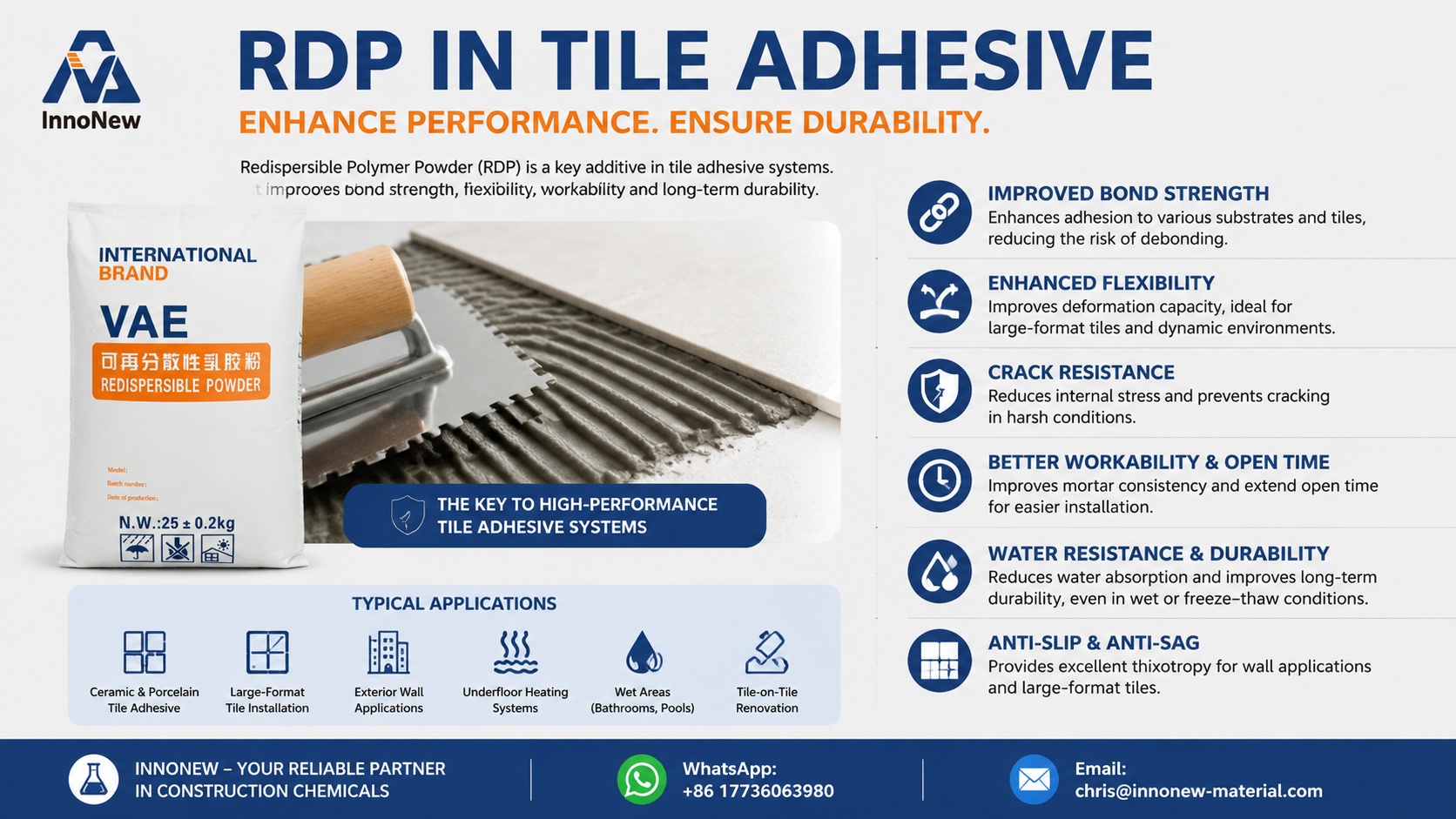
Modern tile installation systems have shifted from traditional cement-sand mortars to high-performance polymer-modified tile adhesives, driven by the increasing complexity of modern construction requirements.
Large-format porcelain tiles, ultra-low absorption ceramic tiles, external façade systems, underfloor heating substrates, and high-moisture environments have significantly raised performance expectations for tile bonding systems.
Traditional cement-based mortars provide sufficient compressive strength but fail in critical performance areas such as:
- Bond strength retention under stress
- Flexibility and deformation resistance
- Crack resistance under thermal movement
- Long-term water and freeze–thaw durability
- Installation stability for large-format tiles
To overcome these limitations, Redispersible Polymer Powder (RDP) has become one of the most important functional additives in modern tile adhesive systems.
RDP is widely used to achieve EN 12004 C1, C2, S1, and S2 performance classifications, enabling high durability and long-term installation reliability.
InnoNew Material’s Redispersible Latex Powder plays a critical role in improving performance and durability in Modern Construction Chemical Materials . One of the most widely used polymer additives in the building industry is Redispersible Polymer Powder (RDP). This functional material is essential in dry mix mortars, tile adhesives, self-leveling compounds, and wall putty formulations.
Redispersible Polymer Powder significantly enhances adhesion, flexibility, and water resistance of cement-based materials, making it an indispensable component in many construction applications.
What is Redispersible Polymer Powder?
Redispersible Polymer Powder (RDP), also known as redispersible latex powder, is a free-flowing organic polymer powder produced by spray drying polymer emulsions such as VAE (Vinyl Acetate Ethylene). When mixed with water, the powder can redisperse and form a stable polymer emulsion again. This unique property allows RDP to improve the mechanical performance and bonding strength of cement-based systems. Because of its excellent compatibility with cement, gypsum, and lime, RDP is widely used in dry mix construction materials.
Core Characteristics of RDP:
- Free-flowing white powder
- Redispersible in water
- Film-forming polymer binder
- Compatible with cement-based systems
- Stable in alkaline environments
Key Properties of RDP (VAE) Powder
High-quality Redispersible Polymer Powder offers several outstanding properties:
Excellent Adhesion
RDP improves bonding strength between mortar and various substrates such as concrete, bricks, and insulation boards.
Improved Flexibility
It enhances flexibility and reduces cracking caused by shrinkage or thermal stress.
Water Resistance
RDP improves the water resistance of mortar systems, helping extend the service life of construction materials.
Workability Enhancement
The powder improves mortar consistency and workability, making application easier for construction workers.
Impact Resistance
RDP enhances toughness and impact resistance, especially in tile adhesive and repair mortars.
Main Applications of Redispersible Polymer Powder
Due to its excellent performance, RDP is widely used in many dry mix mortar systems.
Tile Adhesives
RDP improves adhesion strength, slip resistance, and flexibility, which are critical for ceramic tile installation.
External Thermal Insulation Systems (ETICS)
It enhances bonding strength and durability in insulation mortar systems.
Wall Putty and Skim Coat
RDP improves smoothness, adhesion, and crack resistance of interior and exterior wall coatings.
Self-Leveling Mortar
The polymer powder enhances flowability and mechanical strength in flooring systems.
Repair Mortar
RDP increases adhesion and durability when repairing damaged concrete surfaces.
Why RDP is Essential in Tile Adhesive Systems
In modern tile adhesive formulations, performance is no longer defined only by cement strength. Instead, it depends on a hybrid inorganic–organic composite system:
Cement Hydration System
+ Polymer Film Network (RDP)
= High-Performance Tile Adhesive
This dual-phase structure is what allows modern adhesives to outperform conventional mortars.
Working Mechanism of RDP in Tile Adhesive
The performance of RDP can be understood through four key stages:
1. Cement Hydration Phase
After mixing with water, cement hydrates and forms:
- C-S-H gel (primary strength phase)
- Calcium hydroxide crystals
- Rigid mineral matrix
This provides compressive strength but limited flexibility.
2. Polymer Redispersion Phase
RDP particles disperse evenly throughout the fresh mortar, forming a uniform polymer distribution within the cement slurry.
3. Film Formation Phase
As water evaporates and hydration progresses, polymer particles coalesce into a continuous flexible polymer film.
This film:
- Bridges micro-cracks
- Enhances internal cohesion
- Improves bonding interface with substrate and tile
- Reduces stress concentration points
4. Composite Reinforcement Phase
The final hardened structure becomes a polymer-reinforced cement matrix, delivering:
- Higher adhesion strength
- Improved deformation resistance
- Enhanced durability under environmental stress
Key Performance Benefits of RDP in Tile Adhesive
1. Enhanced Bond Strength
RDP significantly increases tensile adhesion strength, especially on:
- Concrete substrates
- Low-absorption porcelain tiles
- Smooth or dense surfaces
This is critical for preventing tile debonding and hollowing issues.
2. Improved Flexibility and Deformation Resistance
Polymer film formation allows the adhesive to absorb movement caused by:
- Thermal expansion
- Structural vibration
- Substrate shrinkage
This makes it essential for large-format tile installation systems.
3. Superior Crack Resistance
RDP improves internal stress distribution and reduces micro-crack formation in hardened mortar.
This is particularly important in:
- Exterior wall applications
- Underfloor heating systems
- High temperature / humidity environments
4. Extended Open Time and Workability
RDP enhances fresh mortar rheology by:
- Improving spreadability
- Increasing open time
- Reducing premature drying
This improves on-site installation efficiency.
5. Improved Water Resistance and Durability
The polymer film reduces water penetration channels inside the mortar, improving:
- Water resistance
- Freeze–thaw stability
- Long-term durability
6. Anti-Slip and Anti-Sag Performance
RDP improves cohesion and thixotropy, making tile adhesives suitable for:
- Vertical wall applications
- Heavy large-format tiles
- High-thickness bedding systems
RDP Dosage in Tile Adhesive Formulation
Typical dosage depends on performance class:
| Adhesive Type | RDP Content |
|---|---|
| C1 Standard Tile Adhesive | 1.5% – 2.5% |
| C2 High-Performance Adhesive | 2.5% – 4.0% |
| Flexible S1 System | 3.0% – 5.0% |
| High Deformation S2 System | 4.0% – 6.0% |
Higher polymer content generally improves flexibility and adhesion but must be balanced with cost and setting time.
Synergy with Other Additives
Hydroxypropyl Methylcellulose (HPMC)
- Precise water retention control
- Smoother mortar workability
- Excellent anti-sag performance for vertical tile installation
PCE Superplasticizer
- Optimize mortar flow without sacrificing consistency
- Significant water reduction rate
- Boost hardened mortar density and final bonding strength
Anti-foaming agents
- Eliminate excess entrapped air inside mortar matrix
- Further enhance finished product density
- Ensure uniform bond strength between tiles and substrates
Application Scope of RDP in Tile Adhesive
RDP is suitable for:
- Ceramic tile adhesives
- Porcelain tile adhesives
- Large-format slab adhesives
- Exterior wall tile systems
- Tile-on-tile renovation systems
- Wet area installations (bathrooms, kitchens, pools)
- Underfloor heating tile systems
Conclusion
Redispersible Polymer Powder (RDP) is not simply an additive—it is a core performance engineering material in modern tile adhesive systems.
By forming a flexible polymer network within the cement matrix, RDP transforms brittle cement mortar into a high-performance, deformation-resistant, durable composite system.
Its role is critical in achieving modern construction standards such as EN 12004 C2, S1, and S2 classifications, especially for:
- Large-format tiles
- High-stress environments
- Exterior façade systems
- Long-life infrastructure projects
As tile formats continue to grow and installation environments become more demanding, RDP remains one of the most essential materials in advanced dry-mix mortar technology.
FAQ
1. What is the main function of RDP in tile adhesive?
RDP improves adhesion strength, flexibility, crack resistance, and durability by forming a polymer film within the cement matrix.
2. Why is RDP necessary in modern tile adhesives?
Because cement alone cannot provide sufficient deformation resistance and long-term bonding stability for modern tile systems.
3. Can tile adhesive work without RDP?
Yes, but performance will be limited to low-grade applications with reduced flexibility and durability.
4. What is the difference between RDP and latex liquid?
RDP is a dry powder form that is easier to transport and store, while latex is liquid polymer dispersion used in wet systems.