
How to Reduce Fluid Loss in Drilling Fluids
Why Fluid Loss Is a Critical Problem
Fluid loss is one of the most common and costly issues in drilling operations.
When drilling fluid invades the formation, it leads to:
- Formation damage
- Wellbore instability
- Reduced drilling efficiency
- Increased operational cost
👉 Effective filtration control is essential to maintain drilling performance and protect reservoir integrity.
What Causes Fluid Loss in Drilling?
1. High Formation Permeability
- Porous formations allow rapid fluid invasion
- Requires strong filter cake formation
2. Poor Drilling Fluid Design
- Lack of proper filtration additives
- Imbalanced particle size distribution
3. Inadequate Rheology Control
- Low viscosity → poor suspension
- Weak gel strength → unstable system
4. Thermal Degradation of Additives
- High temperatures break down polymers
- Reduces filtration performance
Mechanism of Fluid Loss Control
Fluid loss is controlled by forming a thin, impermeable filter cake on the wellbore wall.
Key Factors:
- Particle packing efficiency
- Polymer network formation
- Fluid viscosity & gel strength
✔ Goal:
Minimize filtrate invasion while maintaining flowability
Top 5 Proven Methods to Reduce Fluid Loss
1. Use High-Performance Fluid Loss Additives
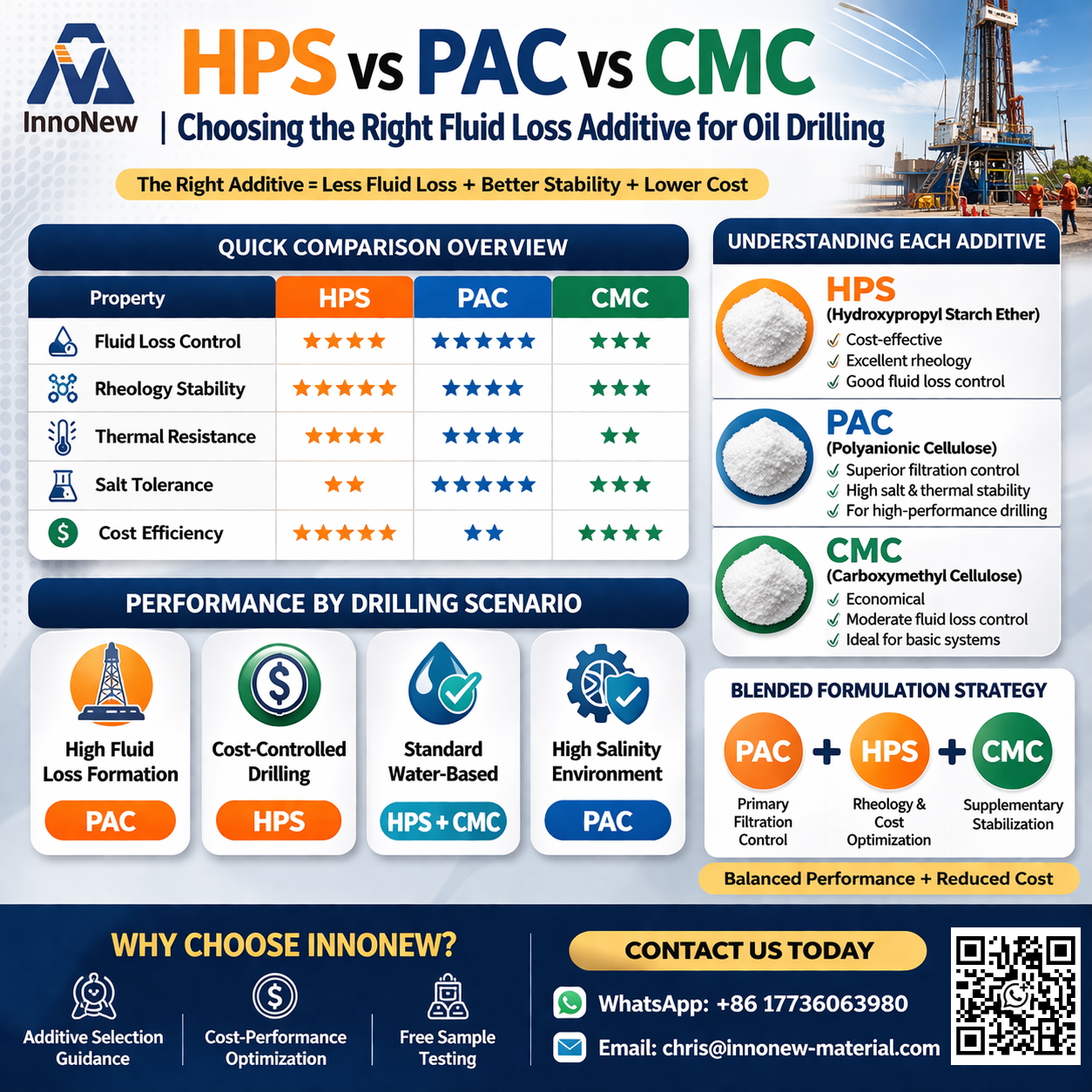
Hydroxypropyl Starch Ether (HPS)
- Builds effective filter cake
- Improves rheology stability
- Cost-effective solution
PAC (Polyanionic Cellulose)
- Superior filtration control
- High salt resistance
CMC (Carboxymethyl Cellulose)
- Moderate performance
- Budget-friendly option
✔ Best practice:
Combine HPS + PAC for optimal performance-cost balance
2. Optimize Particle Size Distribution
- Use fine + coarse particles
- Improve packing density
- Reduce permeability
3. Improve Rheology Properties
- Increase yield point
- Enhance gel strength
- Maintain suspension stability
4. Control Solid Content
- Avoid excessive solids
- Maintain proper fluid density
- Prevent filter cake thickening
5. Use Blended Additive Systems
✔ Example system:
- PAC → primary filtration control
- HPS → rheology & stability
- Bentonite → base structure
Recommended Formulation Strategy
Standard Water-Based Drilling Fluid
- HPS: 0.2% – 0.5%
- PAC: 0.1% – 0.3%
- Bentonite: as required
✔ Result:
- Reduced fluid loss
- Stable rheology
- Improved drilling efficiency
Common Field Problems & Solutions
| Problem | Cause | Solution |
|---|---|---|
| High filtration rate | Weak filter cake | Add HPS + PAC |
| Thick filter cake | Poor particle gradation | Optimize solids |
| Fluid instability | Poor rheology | Improve polymer system |
| High cost | Overuse of PAC | Replace with HPS |
Advanced Insight
Modern drilling fluid design emphasizes:
- Multi-polymer systems
- Rheology + filtration integration
- Cost-performance optimization
👉 HPS is increasingly used as a key balancing additive in these systems.
FAQ
1. What is fluid loss in drilling?
It is the loss of drilling fluid into the formation.
2. How can fluid loss be reduced?
By using filtration additives, optimizing rheology, and improving particle distribution.
3. What is the best additive for fluid loss control?
PAC offers top performance, while HPS provides cost-effective balance.
4. Can HPS replace PAC?
Partially. It is often used in combination.
5. Why is filter cake important?
It prevents fluid invasion and stabilizes the wellbore.
Call to Action
Looking to optimize your drilling fluid performance?
We provide:
- Additive selection & formulation design
- Cost optimization strategies
- Free sample testing
📩 Email: chris@innonew-material.com
📱 WhatsApp: +86 17736063980