+86-17736063980 ✉️ chris@innonew-material.com
Masonry dry mortar formulation system engineering with HPMC, RDP, starch ether and defoamer for block construction performance optimization

Masonry Dry Mortar Formulation Guide: Materials, Mix Design, Performance Optimization & Industrial Applications

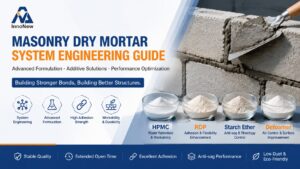
Masonry Dry Mortar Formulation Guide: Materials, Mix Design, Performance Optimization & Industrial Applications Introduction: From “Mortar Mix” to “Material System Engineering” Traditional masonry mortar design is often treated as a fixed ratio problem: Cement + Sand + Water = Mortar However, modern dry-mix masonry mortar is no longer a simple mixture. It is a: Multiphase […]
Masonry Dry Mortar Formulation Guide: Materials, Mix Design, Performance Optimization & Industrial Applications Read More »

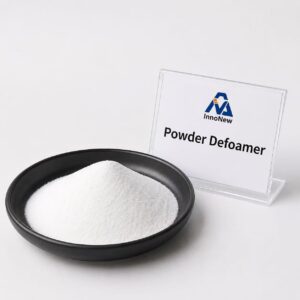
Powder Defoamer for Concrete & Water-Based Industrial Coatings | High Efficiency Anti-Foam Powder Additive

Why Does Tile Adhesive Produce Air Bubbles? Understanding Foam Formation, Air Void Structure, and Performance Implications

Why Does Tile Adhesive Produce Air Bubbles? Understanding Foam Formation, Air Void Structure, and Performance Implications Introduction Air bubbles in tile adhesives are more than cosmetic defects—they fundamentally influence density, adhesion, rheology, and durability. Traditional approaches often focus on removing bubbles, but engineering the air void structure is the key to high-performance adhesives. This article

Why Does Tile Adhesive Produce Air Bubbles? Understanding Foam Formation, Air Void Structure, and Performance Implications Read More »

Powder Defoamer for Concrete & Water-Based Industrial Coatings | High Efficiency Anti-Foam Powder Additive

Powder Defoamer in Dry Mix Mortars: Mechanisms, Formulation, and Performance Optimization

Powder Defoamer in Dry Mix Mortars: Mechanisms, Formulation, and Performance Optimization Introduction In dry mix mortar systems, foam generation during mixing is a critical issue that affects density, mechanical strength, adhesion, and surface finish. Even trace amounts of entrained air (0.5–2% by volume) can reduce compressive strength by up to 10% and lead to surface

Powder Defoamer in Dry Mix Mortars: Mechanisms, Formulation, and Performance Optimization Read More »

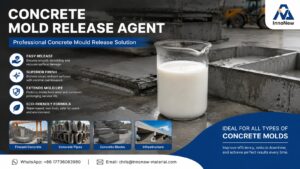
Complete Guide to Concrete Mold Release Agents: Types, Mechanisms, and Best Practices for High-Performance Demolding 1. Introduction In modern concrete manufacturing, mold release agents play a critical role in ensuring efficient demolding, high-quality surface finish, and mold durability. Without a properly selected and correctly applied release agent, manufacturers often face issues such as concrete sticking, surface defects, discoloration, and increased mold maintenance costs. Water-based concrete mold release agents, especially high-concentration emulsions, have become the mainstream solution in precast concrete, pipe, block, and PHC pile production due to their environmental advantages, flexible dilution ratios, and stable demolding performance. This guide provides a structured technical overview of water-based mold release systems, focusing on application practices, dilution optimization, and performance control. 2. What Is a Water-Based Concrete Mold Release Agent? A water-based concrete mold release agent is a chemically formulated emulsion designed to form a thin, stable barrier film between concrete and mold surfaces, preventing adhesion during the hydration and curing process. Key characteristics: Milky white emulsion appearance Water-based, low VOC system High-concentration formulation Flexible dilution ratio: 1:6 to 1:15 Compatible with steel, plastic, and FRP molds This type of system allows manufacturers to optimize performance and cost by adjusting dilution based on production requirements. 3. Types of Concrete Mold Release Agents 3.1 Oil-Based Systems Traditional mineral oil-based agents provide strong lubrication but often cause: Higher VOC emissions Mold residue buildup Environmental compliance issues 3.2 Water-Based Systems (Modern Standard) Water-based formulations offer: Cleaner mold surfaces Improved environmental compliance Better surface finish consistency Reduced long-term mold maintenance cost 3.3 High-Concentration Water-Based Systems Advanced emulsions designed for flexible dilution (1:6–1:15), allowing: Customized performance control Reduced transportation and storage cost Adaptation to different mold types and products 4. Mechanisms of Action Water-based concrete mold release agents operate through a combination of physical and chemical mechanisms: 4.1 Physical Barrier Formation A uniform micro-film is formed on the mold surface, isolating cement paste from direct contact. 4.2 Lubrication Effect The film reduces interfacial friction during demolding, lowering mechanical resistance. 4.3 Surface Conditioning Effect Minimizes air voids, honeycombing, and surface discoloration by stabilizing the interface. 4.4 Interfacial Chemical Interaction Mild interaction with calcium compounds in cement paste reduces adhesion strength at the micro-level. 5. How to Choose the Right Dilution Ratio One of the key advantages of high-concentration systems is adjustable dilution. Proper selection directly impacts surface quality and cost efficiency. Recommended dilution ranges: 1:6 Dilution Architectural precast elements Complex molds Exposed concrete surfaces Highest surface quality requirement 1:10 Dilution Standard precast components Balanced performance and cost 1:12 Dilution Concrete pipes Curbstones Medium complexity molds 1:15 Dilution High-volume production lines Smooth steel molds Cost-optimized applications Important principle: Higher dilution does not always mean better performance. The optimal ratio depends on mold type, concrete mix design, and surface quality requirements. 6. Mold Surface Preparation Proper mold preparation is essential for stable demolding performance. Key steps: Remove residual cement and oil contamination Ensure dry and clean mold surface Treat used molds to eliminate buildup layers Match cleaning intensity with mold material type Mold types: Steel molds: require precise film control Plastic molds: lower adhesion but sensitive to over-application Wooden molds: higher absorption, require stronger coating 7. Application Best Practices Application methods: Spraying (preferred): ensures uniform thin film Brushing: suitable for edges and complex geometries Rolling: used in small-scale operations Key principle: A uniform thin film is more important than excessive application. Over-application may lead to surface defects or waste. Application control factors: Mold roughness Dilution ratio Ambient temperature Concrete mix characteristics 8. Drying and Casting Considerations Proper timing between application and concrete casting is critical. Allow short flash-off time after application Avoid immediate casting if excessive moisture remains Adjust drying time in high humidity or low temperature environments Ensure consistent film formation before pouring concrete 9. Common Problems and Troubleshooting Problem Cause Solution Concrete sticking Over-dilution or poor coverage Adjust ratio, improve spraying uniformity Air bubbles on surface Uneven film or trapped air Optimize spray technique Surface discoloration Mold contamination Clean mold thoroughly Residue buildup Insufficient maintenance Increase cleaning frequency 10. Applications in Concrete Products Water-based mold release agents are widely used in: Precast concrete elements Concrete pipes PHC and PC spun piles Concrete blocks Wall panels Railway sleepers Each application requires optimized dilution and application control depending on mold geometry and production speed. 11. Maintenance and Storage Recommendations Store in sealed containers Avoid direct sunlight and freezing conditions Stir gently before use if stored long-term Use clean water for dilution to ensure stability Maintain consistent batch mixing procedures 12. FAQ Q1: What dilution ratio should I use? It depends on mold type and product requirements, ranging from 1:6 to 1:15. Q2: Can tap water be used for dilution? Yes, but clean water is recommended to ensure emulsion stability. Q3: Why does concrete still stick after using release agent? Common causes include improper dilution, uneven spraying, or contaminated molds. Q4: Is more release agent better? No. Excessive application may cause surface defects. Q5: Can it be used for PHC piles? Yes, it is widely applied in PHC and PC spun pile manufacturing. 13. Conclusion Water-based concrete mold release agents, especially high-concentration systems with flexible dilution ratios, represent a modern, efficient, and environmentally friendly solution for concrete manufacturing. Proper selection of dilution ratio, correct application methods, and adequate mold preparation are key to achieving optimal demolding performance and high-quality concrete surfaces.

Complete Guide to Concrete Mold Release Agents | Water-Based High-Performance Demolding Solution

Complete Guide to Concrete Mold Release Agents: Types, Mechanisms, and Best Practices for High-Performance Demolding Introduction In modern concrete manufacturing, mold release agents play a critical role in ensuring efficient demolding, high-quality surface finish, and mold durability. Without a properly selected and correctly applied release agent, manufacturers often face issues such as concrete sticking, surface

Complete Guide to Concrete Mold Release Agents | Water-Based High-Performance Demolding Solution Read More »

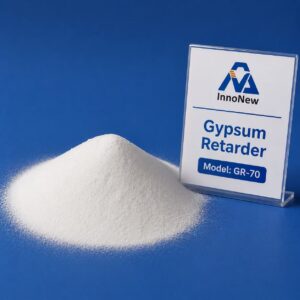
Gypsum Retarder Powder for plaster and gypsum construction, high efficiency setting retarder

Optimizing Gypsum Setting Performance: Advanced Retarder Strategies for Industrial Production and Construction Applications

Optimizing Gypsum Setting Performance: Advanced Retarder Strategies for Industrial Production and Construction Applications Introduction Gypsum-based materials have become indispensable in modern construction due to their ease of application, dimensional stability, smooth surface finish, and environmental advantages. From gypsum plaster and joint compounds to gypsum boards and self-leveling systems, gypsum products are widely used in residential,

Optimizing Gypsum Setting Performance: Advanced Retarder Strategies for Industrial Production and Construction Applications Read More »

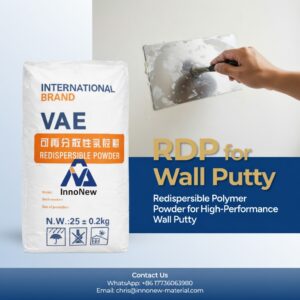
- High adhesion RDP additive for wall putty

Anti-Crack Wall Putty System Solution | Engineering Formulation & Performance Analysis

Anti-Crack Wall Putty System Solution: Engineering Formulation & Performance Analysis Introduction Wall cracking remains one of the most common quality issues in residential, commercial, and industrial construction projects worldwide. While cracks may initially appear as minor cosmetic defects, they often indicate deeper problems related to material shrinkage, thermal movement, substrate deformation, moisture variation, and poor

Anti-Crack Wall Putty System Solution | Engineering Formulation & Performance Analysis Read More »

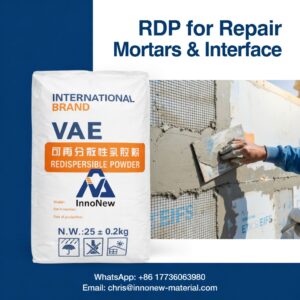
RDP redispersible polymer powder for repair mortar, construction additive

HPMC, RDP, and the Interfacial Transition Zone (ITZ): The Hidden Key to Mortar Bond Strength

Why Bond Strength Is More Complex Than Most People Think In the drymix mortar industry, bond strength is often treated as a direct result of cement quality or polymer dosage. When adhesion performance falls short, the common response is to increase cement content, add more Redispersible Polymer Powder (RDP), or modify the binder system. While

HPMC, RDP, and the Interfacial Transition Zone (ITZ): The Hidden Key to Mortar Bond Strength Read More »

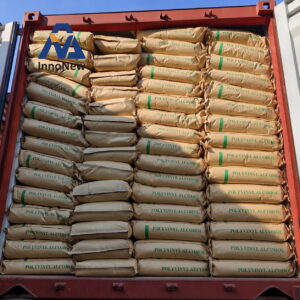
Polyvinyl Alcohol PVA powder, professional manufacturer bulk factory supply

The Complete Guide to PVA Grades: 0588, 1788, 2088, 2488 and 2688

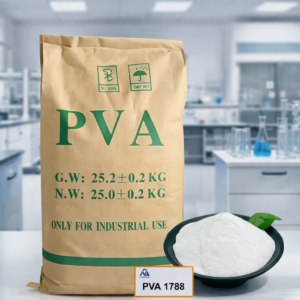
The Complete Guide to PVA Grades: 0588, 1788, 2088, 2488 and 2688 Introduction Polyvinyl Alcohol (PVA) is a water-soluble polymer with diverse industrial applications, from adhesives to construction chemicals, textiles, paper coatings, and ceramics. Selecting the correct PVA grade is critical for ensuring optimal performance, production efficiency, and end-product quality. In this guide, we analyze

The Complete Guide to PVA Grades: 0588, 1788, 2088, 2488 and 2688 Read More »

Concrete Admixture PCE Superplasticizer Powder

Top 7 Construction Chemicals Used in Concrete | Functions & Applications Guide

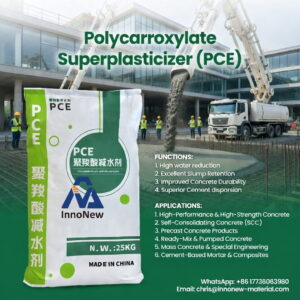
PCE superplasticizer is a high-performance water-reducing agent that provides excellent slump retention, high fluidity, and strong strength enhancement. It reduces water consumption, improves workability, prevents segregation, and helps produce high-strength, durable, and self-compacting concrete with lower cement content.

Top 7 Construction Chemicals Used in Concrete | Functions & Applications Guide Read More »

Polyvinyl Alcohol PVA 1788 powder for textile sizing and construction applications

What Are Construction Chemicals? Complete Guide to Types, Functions and Applications

What Are Construction Chemicals? A Complete Industry Guide Construction chemicals are specialized materials used to improve the performance, durability, and workability of construction systems such as concrete, mortar, and building materials. With the rapid development of modern construction technology, these chemicals have become essential for achieving high strength, long-term durability, and efficient construction processes. At

What Are Construction Chemicals? Complete Guide to Types, Functions and Applications Read More »

Scroll to Top