
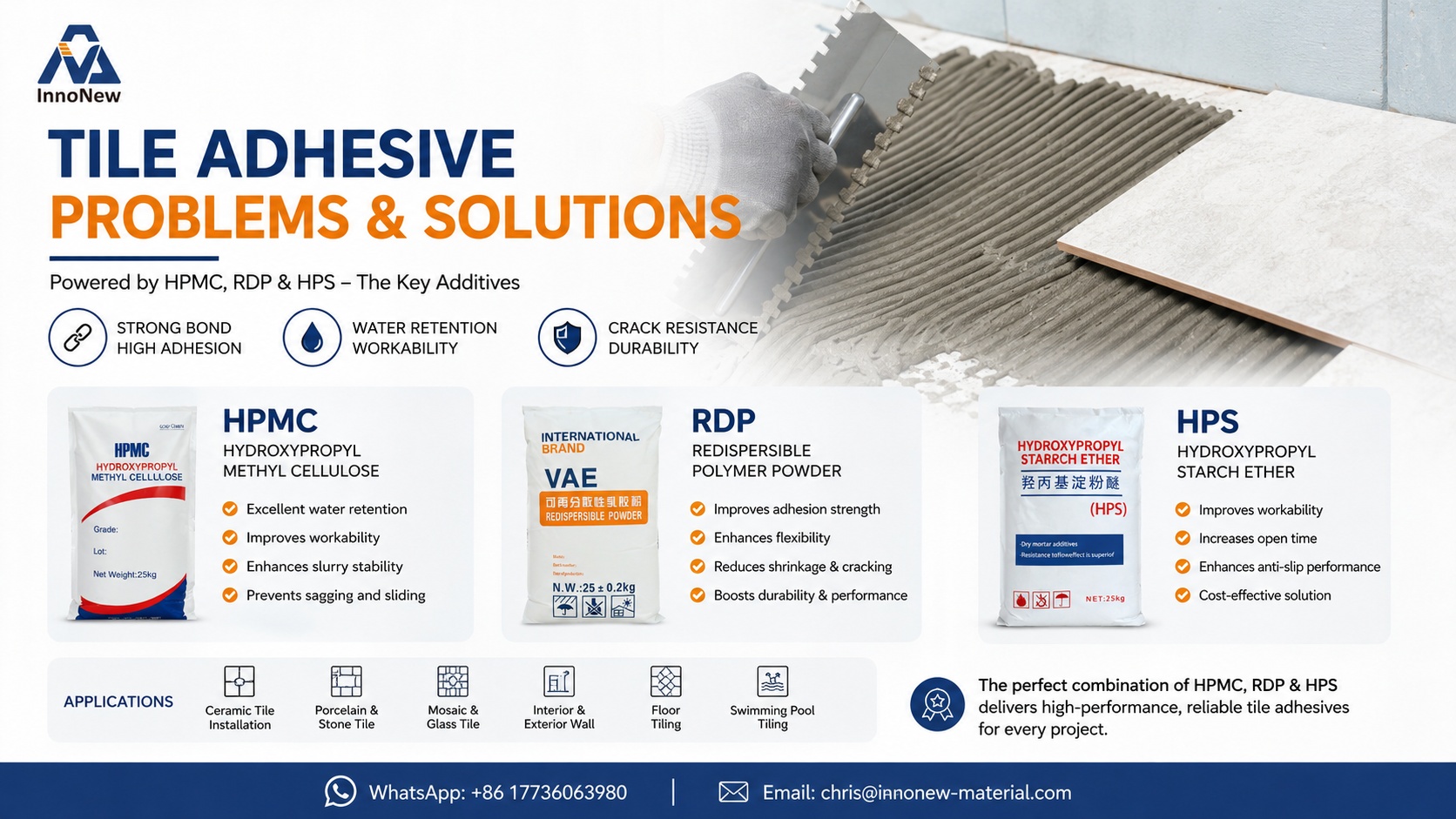
Tile Adhesive Failure Analysis by Bond Failure Mode: Engineering Insights for High-Performance Installations
Introduction
Tile adhesive failure is not a single phenomenon—it is a series of complex mechanical and chemical interactions between the adhesive, the tile, and the substrate. Understanding bond failure modes is critical for manufacturers, engineers, and contractors who aim to design high-performance adhesives, optimize installation procedures, and minimize costly repair work.
Unlike conventional “problem-solution” guides, this analysis focuses on mechanistic failure types, linking them to formulation parameters, polymer modification, and installation practices. By classifying and analyzing failures at the bond interface, stakeholders can achieve predictive and reliable tile installations.
1. Cohesive Failure Within the Adhesive Layer
Description
Cohesive failure occurs when the fracture propagates inside the adhesive itself, rather than at the interface with the tile or substrate.
Root Causes
- Low polymer content (RDP or acrylic dispersion)
- High water-cement ratio
- Excess filler (limestone, quartz) reducing matrix integrity
- Inadequate curing conditions
Mechanism
The internal tensile or shear stress exceeds the adhesive’s intrinsic strength before a proper mechanical and chemical bond develops.
Engineering Solutions
- Optimize polymer-modified formulations (1–4% RDP)
- Control water addition and w/c ratio
- Use HPMC or HEMC to improve workability and water retention
- Ensure curing temperature and humidity are controlled
2. Adhesive-Substrate Interface Failure
Description
Failure occurs between the adhesive and substrate, leaving adhesive attached to the tile but detached from the substrate.
Root Causes
- Weak or contaminated substrate (dust, laitance, oils)
- Insufficient surface roughness for mechanical anchoring
- Substrate moisture imbalance
- Non-compliance with EN 12004 C2TES adhesion requirements
Mechanism
Adhesive fails to develop chemical bonding with the substrate; stress concentration at uneven surfaces accelerates failure.
Engineering Solutions
- Proper substrate preparation: grinding, cleaning, priming
- Use adhesion-promoting primers
- Adjust polymer type and content to enhance substrate bonding
- Conduct pull-off adhesion tests to verify compliance
3. Tile-Adhesive Interface Failure
Description
Failure occurs between the adhesive and tile back, often observed with low-porosity porcelain or polished tiles.
Root Causes
- Non-absorbent tile surfaces limiting mechanical interlocking
- Insufficient wetting of the tile back
- Rapid adhesive skinning or insufficient open time
- Excessive tiling pressure causing adhesive expulsion
Mechanism
Bonding relies primarily on polymer film formation. In low-absorption tiles, insufficient polymer coverage reduces adhesive strength, creating debonding risk.
Engineering Solutions
- Increase polymer content (RDP, redispersible powder)
- Use longer open-time cellulose ethers (HPMC/HEMC)
- Apply back-buttering for large tiles
- Conduct small-scale tape peel or shear tests for new tile types
4. Mixed-Mode Failure
Description
A combination of adhesive layer and interface failure, typically observed in large-format tiles or high-stress areas.
Root Causes
- High tile mass generating combined shear and tensile stress
- Uneven adhesive layer thickness
- Differential shrinkage between adhesive and substrate
- Inadequate polymer elasticity
Mechanism
Mixed-mode failure occurs when adhesive cannot simultaneously accommodate internal tensile stress and interface shear stress. Stress is concentrated in weak zones of the adhesive and along interfaces.
Engineering Solutions
- Use flexible polymer-modified adhesives (C2TES1, C2TES2)
- Ensure uniform layer thickness via correct trowel size
- Optimize HPMC and RDP balance for flexibility and bond strength
- Pre-test on mock-ups for large-format installations
5. Edge Lifting and Corner Failure
Description
Localized detachment at tile edges or corners, often appearing as “micro-hollowing” beneath the tile.
Root Causes
- High bending or flexural stress on tiles
- Poor edge coverage due to trowel technique
- Rapid moisture loss leading to adhesive skinning
- Substrate movement under thermal or mechanical load
Mechanism
Tensile stress at corners exceeds adhesive shear strength. Polymer elasticity and substrate compliance determine crack propagation.
Engineering Solutions
- Extend open time via HPMC/HEMC
- Ensure proper trowel application and back-buttering
- Employ flexible adhesives (C2TES series)
- Conduct corner adhesion tests under simulated load
6. Failure Induced by Differential Curing
Description
Cracking or debonding caused by uneven hydration or drying, particularly on substrates with variable moisture content.
Root Causes
- Thick adhesive layers
- Substrate with high porosity variance
- Rapid environmental drying
- Inconsistent water retention additive distribution
Mechanism
Differential shrinkage generates internal tensile stresses that exceed bond strength, leading to cohesive or mixed-mode failure.
Engineering Solutions
- Use water-retentive cellulose ethers (HPMC/HEMC)
- Maintain uniform adhesive thickness
- Monitor substrate moisture before installation
- Conduct moisture mapping on large floors
7. High-Temperature or Thermal Stress Failure
Description
Debonding due to thermal expansion mismatch between tile, adhesive, and substrate.
Root Causes
- Low polymer modification (low elasticity)
- Rigid cementitious matrix
- Large-format tiles exposed to sunlight or heated floors
Mechanism
Thermal cycles induce cyclic stress. Without sufficient adhesive elasticity, interface or cohesive failure occurs.
Engineering Solutions
- High-elasticity adhesive formulations (C2TES2)
- Increase RDP dosage for flexibility
- Proper expansion joint placement
- Monitor substrate temperature during installation
8. Moisture-Related Bond Failure
Description
Bond loss due to excess water in the substrate, improper curing, or high ambient humidity.
Root Causes
- Wet substrates exceeding adhesive tolerance
- Adhesive not designed for high moisture applications
- Early rain exposure on exterior walls
Mechanism
Excess water dilutes the polymer matrix, reduces cohesion, and weakens interface adhesion.
Engineering Solutions
- Pre-test substrate moisture levels
- Use moisture-tolerant adhesive grades
- Extend open time using HPMC additives
- Avoid installation under extreme moisture conditions
9. Mechanical Shock or Impact-Induced Failure
Description
Tile detachment or micro-cracking caused by impact loads shortly after installation.
Root Causes
- Premature loading before adhesive curing
- Low impact resistance due to insufficient polymer
- Thin adhesive layers on large tiles
Mechanism
Shear or tensile stresses exceed early-age adhesive strength. Cohesive or interface failure occurs depending on the weakest zone.
Engineering Solutions
- Use high-polymer content adhesive
- Ensure sufficient curing time (per EN12004)
- Apply correct adhesive thickness
10. Chemical or Environmental Degradation Failure
Description
Loss of bond due to alkali, sulfate, or freeze-thaw exposure.
Root Causes
- Poor chemical resistance of polymer
- Incompatible substrate or tile chemistry
- Outdoor exposure without protective coating
Mechanism
Chemical attack weakens polymer network or cement matrix, reducing adhesive cohesion and adhesion.
Engineering Solutions
- Use chemically resistant polymer-modified adhesives
- Apply protective coatings or sealants
- Avoid incompatible substrate-tile combinations
Modern Testing and Predictive Diagnostics
To verify performance and predict failure modes:
- Pull-Off Adhesion Tests (ASTM C1583 / EN 1348)
- Shear and Peel Tests
- Thermal Cycling Simulation
- Moisture Mapping and Water Retention Analysis
- Rheology Testing for Flow and Sag Resistance
These methods allow engineers to anticipate potential bond failure modes and optimize both formulation and installation procedures.
Conclusion
Bond failure mode analysis provides a systematic framework to understand why tile adhesives fail. By classifying failures as cohesive, adhesive-substrate, tile-adhesive interface, mixed-mode, thermal, or moisture-induced, manufacturers and contractors can implement targeted solutions.
Modern adhesives combining HPMC, RDP, and starch ether with precise formulation control offer predictable performance under diverse site conditions, reducing installation risks and long-term maintenance costs.
FAQ
1. What is the difference between cohesive and adhesive-substrate failure?
Answer:
Cohesive failure occurs within the adhesive layer itself, indicating insufficient internal strength of the adhesive. Adhesive-substrate failure occurs at the interface between the adhesive and substrate, often due to poor surface preparation, contamination, or inadequate mechanical anchoring.
2. How can bond failure modes be predicted during formulation?
Answer:
Predictive analysis involves rheology testing, adhesion strength evaluation, water retention measurement, and simulation of environmental conditions (thermal cycles, moisture exposure). Proper selection of HPMC, RDP, and starch ether, along with EN12004-compliant formulation, reduces risk of specific bond failures.
3. Why do large-format tiles have higher failure risk?
Answer:
Large-format tiles generate higher internal stress due to bending, differential thermal expansion, and weight. Mixed-mode failures are common if adhesive flexibility, coverage, or polymer content is inadequate. Back-buttering and flexible C2TES1 or C2TES2 adhesives are recommended.
4. Can environmental conditions cause bond failures even with high-quality adhesives?
Answer:
Yes. Excessive moisture, rapid drying, thermal cycles, or chemical exposure can compromise bond integrity. Even premium adhesives can fail if environmental conditions are not managed, highlighting the importance of installation best practices.
5. How do polymers like RDP and HPMC influence bond failure modes?
Answer:
RDP improves adhesion strength and flexibility, reducing cohesive and interface failures. HPMC controls water retention and open time, preventing premature skinning and differential curing. Starch ether enhances anti-sag performance, supporting proper coverage and minimizing hollow areas.
6. How is mixed-mode failure different from cohesive or interface failure?
Answer:
Mixed-mode failure combines features of both cohesive (within the adhesive) and interface (adhesive-tile or adhesive-substrate) failures. It often occurs under high-stress conditions such as large-format tiles, where tensile and shear forces simultaneously exceed adhesive performance limits.
7. What testing methods are used to identify potential bond failures?
Answer:
- Pull-off adhesion tests (ASTM C1583 / EN 1348)
- Shear and peel tests
- Thermal cycling simulation
- Moisture retention and mapping analysis
- Rheology testing for flow, sag, and workability
These methods allow early detection of weak spots in formulations and installation practices.