
Advanced Cementitious Grout Mix Design, Mechanism & Optimization Principles
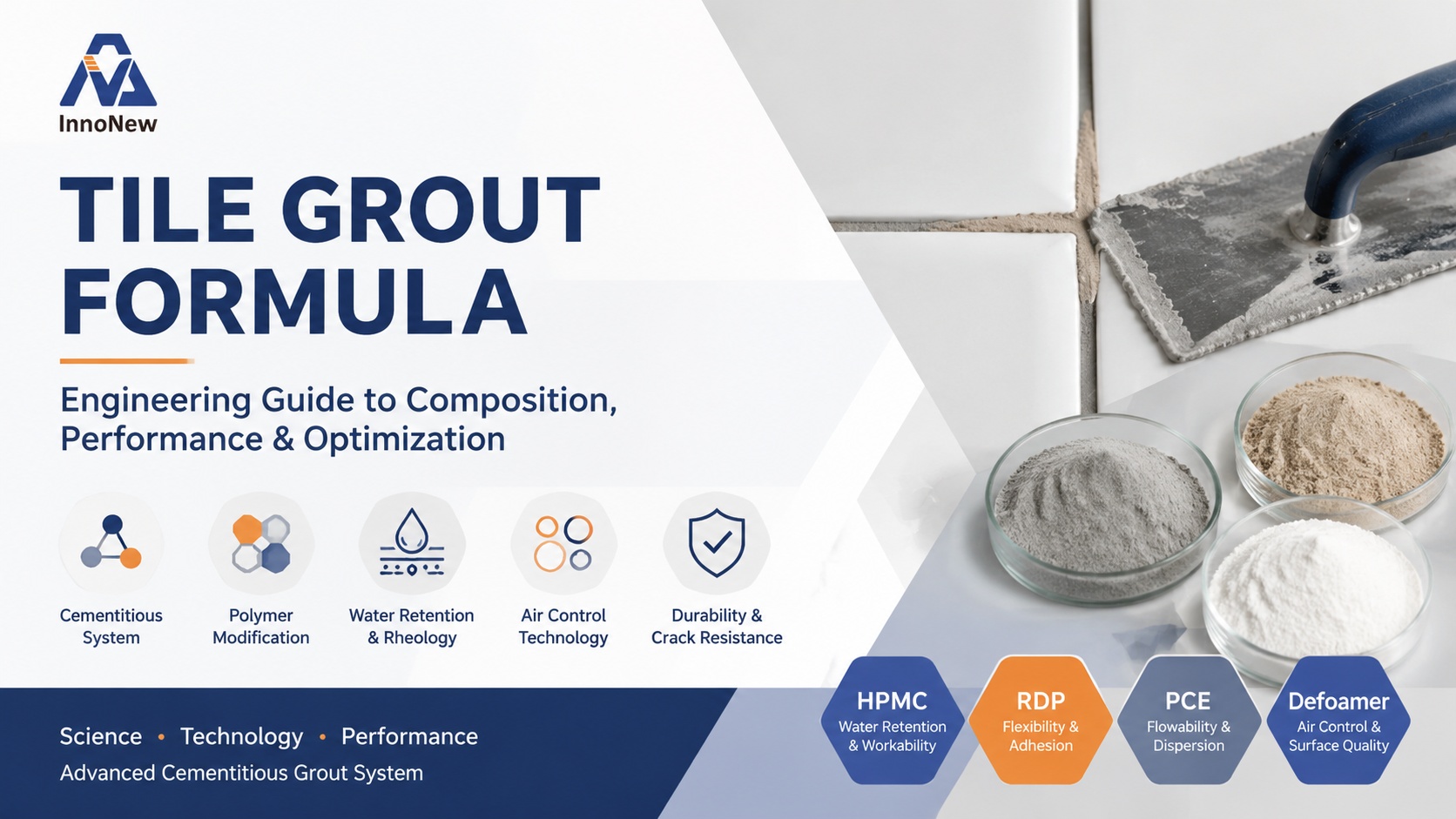
1. Introduction: Why Tile Grout is a Multi-Phase Engineering System
Tile grout is often underestimated as a simple filler material. In modern construction chemistry, it is a multi-phase composite system involving:
- Hydraulic binder phase (cement hydration system)
- Granular skeleton (graded fillers)
- Polymer modification phase
- Water retention and rheology control system
- Air void regulation system
Unlike traditional cement mortar, grout operates in thin joint geometry (1–5 mm), which creates unique challenges:
- Rapid water loss to substrates
- High shrinkage stress concentration
- Color instability due to hydration irregularity
- Crack propagation in constrained geometry
Therefore, grout formulation is not a “recipe problem”, but a micro-structure engineering problem.
2. Functional Requirements of Modern Tile Grout
A high-performance grout must simultaneously achieve:
2.1 Mechanical performance
- Compressive strength
- Flexural strength
- Adhesion strength to tile edges
2.2 Dimensional stability
- Low shrinkage
- Crack resistance under restraint
2.3 Durability
- Water resistance
- Freeze-thaw resistance (cold regions)
- Efflorescence control
2.4 Construction performance
- Workability and spreadability
- Anti-sag in vertical joints
- Open time control
These requirements are often conflicting, making formulation optimization critical.
3. Cementitious Grout System Architecture
A typical industrial grout system consists of four interacting subsystems:
3.1 Binder Phase (Cement System)
Usually:
- Ordinary Portland Cement (OPC)
- White cement (for decorative grout systems)
Key engineering considerations:
- C3A content affects setting speed
- Particle fineness affects hydration rate
- Alkali content influences efflorescence risk
Cement is not just “strength provider”, but the reaction engine of the system.
3.2 Filler Skeleton System
Fillers define:
- Packing density
- Shrinkage behavior
- Surface smoothness
Common materials:
- Calcium carbonate (fine grade)
- Quartz sand (graded system)
Engineering principle:
Maximum packing density = minimum shrinkage deformation
Well-designed grading reduces:
- Void ratio
- Water demand
- Micro-crack initiation points
3.3 Polymer Modification System
Polymer phase creates a secondary binding network after hydration.
Key functions:
- Crack bridging
- Flexibility enhancement
- Adhesion improvement
- Water resistance improvement
Mechanism:
- Polymer particles coalesce into continuous film during curing
- Film interacts with cement hydrates (C-S-H gel)
This transforms grout from brittle to semi-ductile composite material.
3.4 Rheology & Water Management System
Critical because grout joints are narrow and highly water-sensitive.
Key functions:
- Water retention balance
- Viscosity control
- Anti-segregation behavior
Without proper control:
- Surface powdering occurs
- Incomplete hydration occurs
- Color inconsistency increases
3.5 Air Void Regulation System
Air is a hidden but critical factor.
Excess air leads to:
- Reduced strength
- Surface pinholes
- Color instability
Too little air leads to:
- Poor workability
- Difficult spreading
Therefore, grout is a controlled air-void composite system, not a “zero-air system”.
4. Standard Tile Grout Formula Framework
Below is a generalized industrial reference model:
Dry mix composition:
- Cement: 25–40%
- Graded fillers: 55–70%
- Polymer binder: 1–4%
- Rheology modifiers: 0.1–0.5%
- Air control agents: 0.05–0.3%
- Pigments (optional): 0–2%
Three performance grades:
Economy Grade
- Higher filler content
- Basic cement system
- Limited flexibility
Standard Grade
- Balanced polymer modification
- Controlled shrinkage
- Indoor application optimized
High Performance Flexible Grout
- High polymer network formation
- Enhanced crack resistance
- Suitable for large-format tiles and exterior systems
5. Key Engineering Mechanisms in Tile Grout
5.1 Shrinkage Control Mechanism
Shrinkage occurs due to:
- Water evaporation
- Cement hydration consumption
- Capillary tension
Mitigation strategy:
- Dense particle packing
- Polymer film elasticity
- Controlled hydration kinetics
5.2 Crack Resistance Mechanism
Cracks originate from:
- Stress concentration in joints
- Thermal expansion mismatch
Resistance is achieved by:
- Polymer bridging networks
- Micro-void stress dispersion
- Reduced modulus mismatch
5.3 Efflorescence Formation Mechanism
Efflorescence occurs when:
- Soluble salts migrate to surface
- Water transport is not controlled
Key controlling factors:
- Cement alkali content
- Water retention rate
- Pore structure connectivity
5.4 Color Stability Mechanism
Color variation is caused by:
- Uneven hydration
- Water loss gradient
- Pigment dispersion instability
Stable color requires:
- Controlled hydration uniformity
- Reduced capillary flow variation
6. Common Failure Modes and Engineering Solutions
6.1 Cracking in grout joints
Cause:
- High shrinkage stress
Solution principle:
- Reduce modulus
- Improve flexibility network
6.2 Powdering / weak surface
Cause:
- Incomplete hydration or water loss
Solution:
- Improve water retention balance
6.3 Pinholes and surface defects
Cause:
- Entrapped air bubbles
Solution:
- Optimize air void distribution
6.4 Color inconsistency
Cause:
- Water gradient + hydration variation
Solution:
- Improve uniform curing conditions
7. System-Level Optimization Principle
Modern grout formulation is governed by one core principle:
“Balance between hydration kinetics, particle packing, polymer network formation, and air void control.”
Any improvement in one property will affect others.
Example:
- Increasing polymer improves flexibility
- But may reduce early strength
- Increasing water retention improves curing
- But may increase shrinkage risk if not balanced
This is a multi-variable optimization system, not a linear recipe.
8. Conclusion: Tile Grout as an Engineering Composite Material
Tile grout should be understood as:
A hybrid cement-polymer composite system with controlled microstructure, designed for constrained geometry performance.
Future development trends include:
- Lower shrinkage systems
- Higher flexibility polymer networks
- Nano-structured filler grading
- Carbon-reduced cement systems
9. FAQ
Q1: What is the basic composition of tile grout?
Tile grout is mainly composed of cement, graded fillers, polymer modifiers, and functional additives. It is a multi-phase cementitious composite system designed for strength, stability, and workability.
Q2: Why does tile grout crack?
Cracking is mainly caused by shrinkage stress, poor particle packing, and low flexibility of the hardened matrix. It occurs when internal stress exceeds material deformation capacity.
Q3: What is the function of polymer in grout?
Polymer improves flexibility, adhesion, and crack resistance by forming a continuous film within the cement matrix after curing.
Q4: What causes efflorescence in grout?
Efflorescence is caused by water transporting soluble salts to the surface during evaporation, leaving crystalline deposits after drying.
Q5: How does particle grading affect grout performance?
Proper particle grading improves packing density, reduces voids, and enhances strength and dimensional stability of the grout system.
Final Takeaway
Tile grout formulation is not about “mixing ingredients”, but about:
- Microstructure control
- Stress management
- Hydration kinetics engineering
- Composite material design