
Real Stone Paint Additives System: Technical Guide to HPMC, HEC, MHEC, RDP & PCE in Exterior Coating Formulations
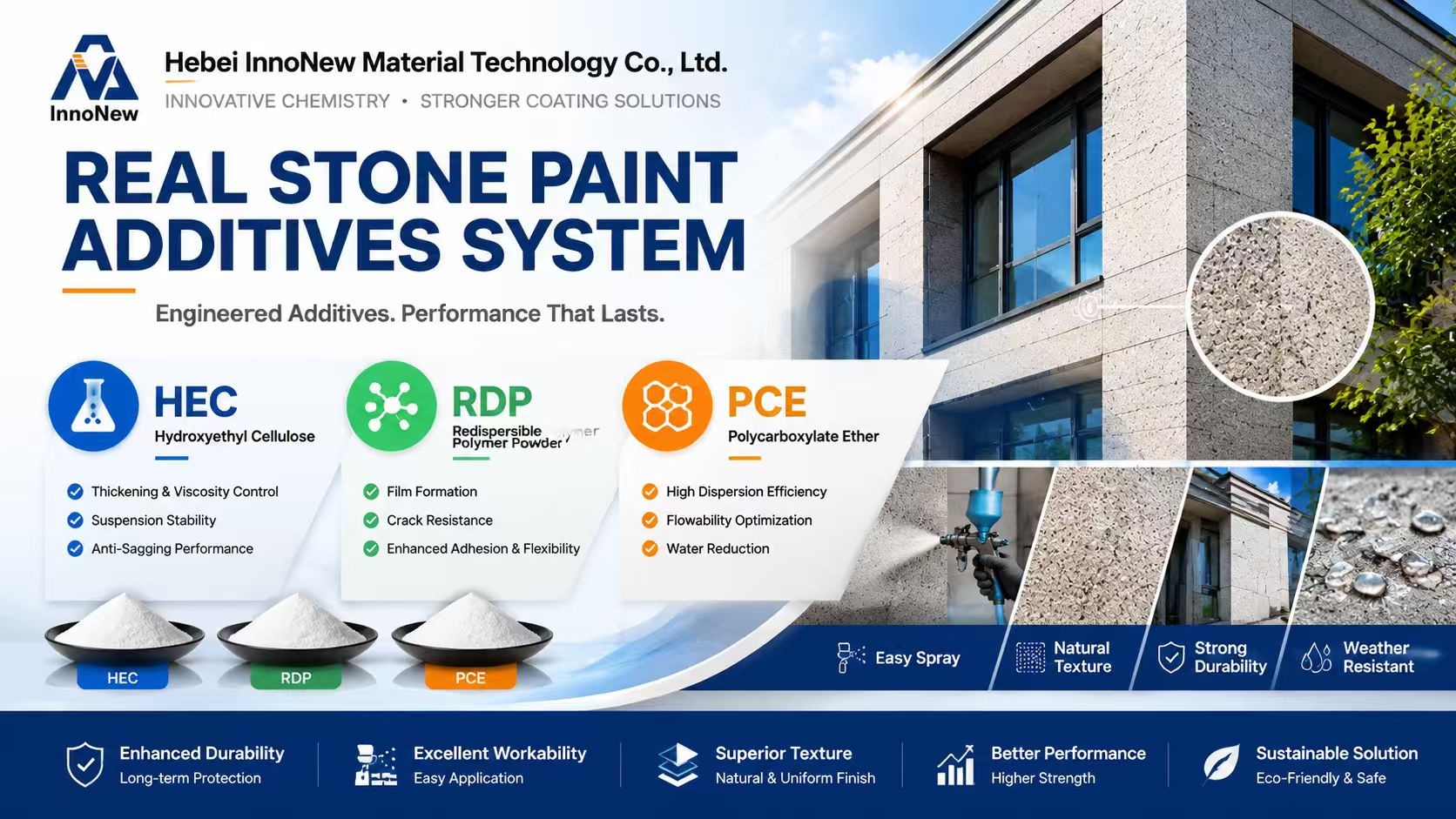
Introduction: Engineering Nature of Real Stone Paint Systems
Real stone paint (also known as exterior textured stone coating) is a high-solids, multi-phase dispersion system composed of:
- Mineral aggregates (quartz sand, colored sand)
- Inorganic binders (cement or silicate systems)
- Polymer binders (RDP or acrylic emulsions)
- Functional additives (cellulose ethers, dispersants, rheology modifiers)
Unlike conventional decorative coatings, real stone paint behaves as a non-Newtonian suspension system, where performance is governed by:
- Particle suspension stability
- Shear-dependent viscosity behavior
- Film formation after water evaporation and polymer coalescence
The main technical challenge is maintaining a stable dispersion of high-density mineral particles (2.6–2.7 g/cm³) in a water-based medium without sedimentation or phase separation.
2. Functional Role of Additives in System Engineering
Additives in real stone paint are not auxiliary components; they form the rheological and structural control network of the entire system.
They are responsible for three critical functions:
2.1 Rheology Engineering
- Controls viscosity under static and dynamic shear
- Prevents sagging during vertical application
- Ensures spray atomization stability
2.2 Suspension Stabilization
- Prevents sedimentation of heavy mineral aggregates
- Maintains uniform particle distribution
- Ensures consistent texture formation
2.3 Film Formation & Mechanical Performance
- Enhances adhesion to cementitious substrates
- Improves crack resistance
- Increases weathering durability
3. Cellulose Ether System: HPMC, HEC, MHEC
Cellulose ethers act as the primary rheology framework in real stone paint systems.
3.1 HPMC (Hydroxypropyl Methyl Cellulose)
Technical Function:
- Water retention regulator
- Open-time extender
- Hydration control agent
Mechanism:
HPMC forms a hydrated polymer network that slows water migration, allowing controlled film formation in cementitious or mineral systems.
Engineering Value:
- Prevents flash drying on substrate surface
- Improves working window during spray application
- Enhances early-stage stability of coating film
3.2 HEC (Hydroxyethyl Cellulose)
Technical Function:
- Primary thickening agent
- Suspension stabilizer for high-density fillers
- Shear-thinning rheology modifier
Mechanism:
HEC creates a three-dimensional hydrogen-bonded network that traps mineral particles in suspension, preventing gravitational settling.
Engineering Value:
- Critical for anti-sedimentation performance
- Enables stable high-solid formulations (≥70% solids)
- Improves spray consistency and atomization control
3.3 MHEC (Methyl Hydroxyethyl Cellulose)
Technical Function:
- Hybrid rheology modifier combining HPMC + HEC behavior
- Enhanced anti-sagging performance
- Improved temperature stability
Engineering Value:
- Preferred in high-end exterior coatings
- Provides balanced viscosity + workability + stability
- Reduces formulation sensitivity to climate variation
4. RDP (Redispersible Polymer Powder): Structural Integrity Modifier
RDP is the mechanical performance backbone of real stone paint systems.
4.1 Film Formation Mechanism
Upon water evaporation, RDP particles coalesce into a continuous polymer film that:
- Binds mineral aggregates
- Bridges microcracks
- Enhances substrate adhesion
4.2 Performance Contributions
- Adhesion strength improvement to cement base
- Increased flexibility and deformation tolerance
- Improved crack resistance under thermal cycling
- Enhanced freeze–thaw durability
4.3 System-Level Function
RDP transforms brittle mineral coatings into a polymer-reinforced composite coating system, significantly improving long-term durability.
5. PCE (Polycarboxylate Ether): Dispersion & Flow Optimization
Although primarily used in concrete systems, PCE Superplasticizer Powder plays an advanced role in high-performance stone coatings.
5.1 Dispersion Mechanism
PCE acts via steric hindrance, dispersing:
- Pigments
- Fillers
- Fine mineral particles
This prevents flocculation and improves color uniformity.
5.2 Rheology Optimization
- Reduces water demand
- Improves spray atomization
- Enhances leveling without collapse of texture structure
5.3 High-Solid System Enablement
PCE enables stable formulation design at:
- Lower water content
- Higher filler loading
- Improved viscosity efficiency
6. Supporting Functional Additives
HPS (Hydroxypropyl Starch Ether)
- Improves thixotropy
- Enhances anti-sagging behavior
- Stabilizes wet film structure
Defoamer
- Eliminates entrapped air
- Prevents pinhole defects
- Improves surface uniformity
Dispersants / Wetting Agents
- Improve pigment wetting
- Prevent agglomeration
- Enhance color consistency
7. System Formulation Engineering Model
Dry-Type Structural System:
- HPMC / HEC / MHEC → rheology framework
- RDP → polymer reinforcement
- HPS → anti-sagging control
- Mineral fillers → structural body
Water-Based Dispersion System:
- HEC → main thickener
- PCE → dispersion + flow control
- RDP → film formation
- Auxiliary additives → surface quality optimization
8. Performance Matrix
| Performance Parameter | Key Additive System |
|---|---|
| Anti-sagging | HEC + HPS |
| Spray stability | HEC + PCE |
| Adhesion strength | RDP |
| Crack resistance | RDP + cellulose ether |
| Water retention | HPMC |
| Pigment dispersion | PCE |
9. Engineering Challenges in Real Stone Paint Systems
9.1 Sedimentation of heavy aggregates
Root cause: insufficient yield stress
Solution: optimized HEC network
9.2 Spray instability and clogging
Root cause: poor rheology balance
Solution: PCE + cellulose ether synergy
9.3 Cracking after curing
Root cause: brittle inorganic matrix
Solution: RDP reinforcement
9.4 Poor substrate adhesion
Root cause: insufficient polymer film formation
Solution: RDP dosage optimization
10. Conclusion
Real stone paint is a structured composite coating system, not a simple decorative material.
Its performance is governed by the synergy of three functional additive systems:
- Cellulose ethers (HPMC, HEC, MHEC) → rheology and stability control
- RDP polymers → mechanical strength and durability
- PCE dispersants → dispersion and application optimization
A properly designed additive system directly determines:
- Construction efficiency
- Surface texture quality
- Long-term durability
FAQ
Q1: Why is HEC critical in real stone paint formulations?
HEC provides high yield stress and shear-thinning behavior, which is essential for suspending heavy mineral aggregates and preventing sedimentation in high-solid systems.
Q2: What is the difference between HPMC and HEC in stone paint systems?
HPMC mainly controls water retention and open time, while HEC provides stronger thickening and suspension stability for mineral fillers.
Q3: Why is RDP necessary in real stone paint?
RDP forms a polymer film after drying, which improves adhesion, flexibility, and crack resistance, transforming brittle mineral coatings into durable composite systems.
Q4: Can PCE be used in coatings instead of concrete only?
Yes. In high-solid coating systems, PCE improves pigment dispersion, reduces water demand, and enhances sprayability and leveling performance.
Q5: What causes sedimentation in real stone paint?
Sedimentation is mainly caused by insufficient rheological structure. It can be controlled using HEC or MHEC to build a stable suspension network.
Q6: How does RDP improve crack resistance?
RDP forms a flexible polymer phase within the rigid mineral matrix, allowing stress distribution and preventing microcrack propagation.
Q7: What is the ideal additive system for exterior stone coatings?
A balanced system includes HEC/MHEC for rheology, RDP for durability, and PCE for dispersion and application performance.