
A Technical Whitepaper on Admixture Synergy in Modern Concrete Engineering (Ready Mix, Pumping, Precast, Pile & Segment Applications)
1. Executive Summary
Modern concrete engineering is no longer governed solely by cement chemistry. Instead, it is controlled by a multi-polymer admixture system that determines:
- fresh concrete rheology (flowability + stability)
- transport behavior (pumpability + slump retention)
- hardened structure performance (durability + crack resistance)
This whitepaper focuses on three key polymer systems:
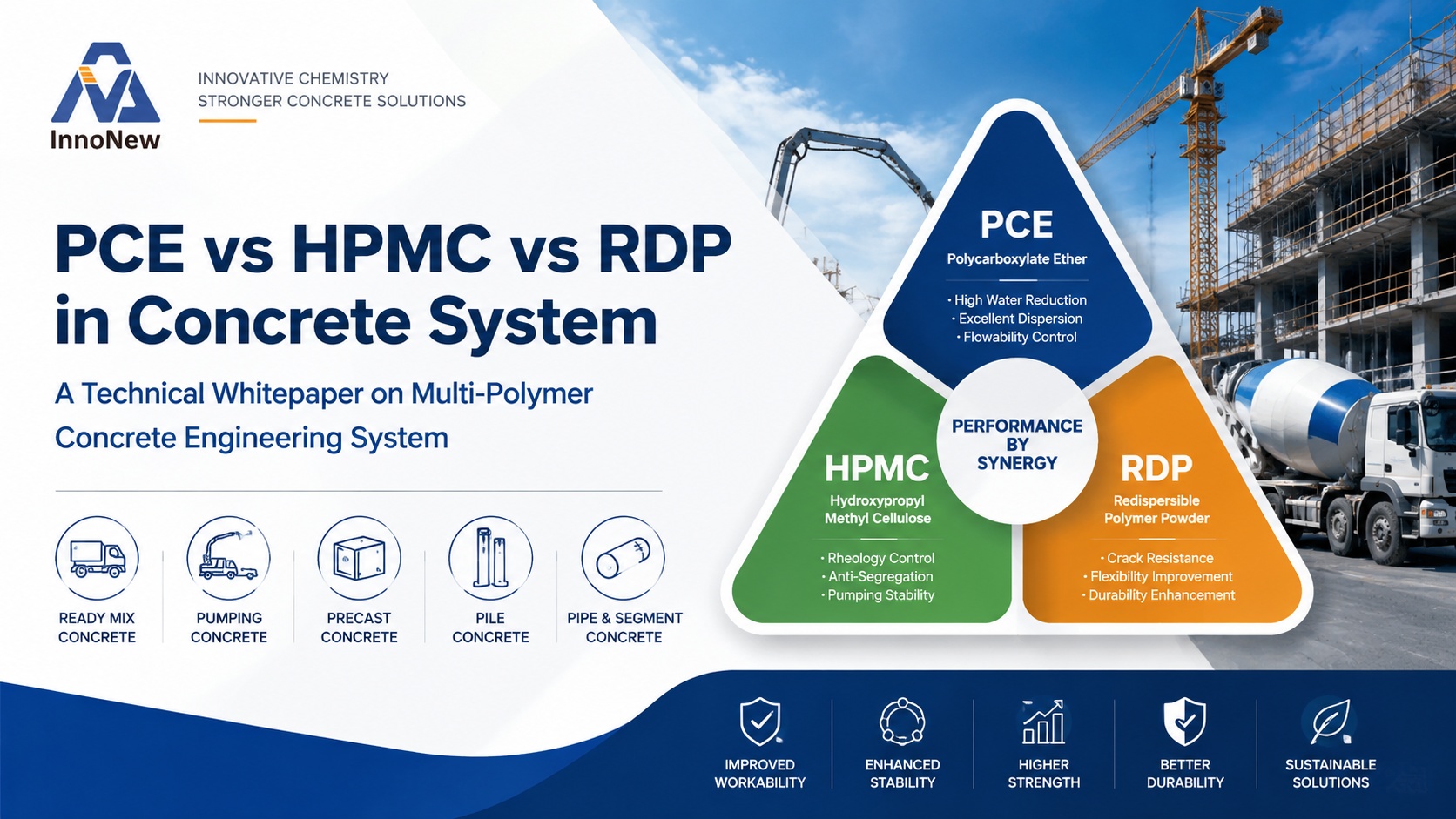
- PCE (Polycarboxylate Ether) → dispersion + water reduction + flow control
- HPMC (Hydroxypropyl Methyl Cellulose) → rheology stabilization + anti-segregation
- RDP (Redispersible Polymer Powder) → flexibility + adhesion + crack resistance
Together, they define the performance boundaries of modern high-performance concrete systems.
2. Why Concrete Systems Fail in Real Engineering Practice
Across Southeast Asia construction markets (Myanmar, Thailand, Vietnam, Indonesia), concrete failure is rarely caused by cement quality alone.
Instead, failures are driven by system instability under real field conditions:
2.1 Transport-Related Instability
- slump loss during 30–120 min delivery
- pump pressure fluctuation
- vibration-induced segregation
2.2 Material Compatibility Failure
- cement source variation (C3A fluctuation)
- fly ash / slag inconsistency
- admixture incompatibility
2.3 Rheology Collapse
- loss of cohesion under high flow
- bleeding and water separation
- blockage in pumping pipelines
2.4 Structural Performance Failure
- early shrinkage cracking
- surface defects in precast
- durability reduction in humid environments
3. Functional Roles of Core Admixtures
3.1 PCE – Polycarboxylate Ether Superplasticizer
Engineering Role:
Primary dispersion + water reduction + flow stabilization system
Mechanism:
- steric hindrance dispersion of cement particles
- adsorption control on clinker phases
- controlled hydration kinetics
Performance Effects:
- 25–45% water reduction
- high early flowability
- adjustable slump retention (molecular design dependent)
Field Problems Solved:
- slump loss in long-distance transport
- unstable pump pressure
- low workability in low w/c systems
3.2 HPMC – Hydroxypropyl Methyl Cellulose
Engineering Role:
Rheology controller + anti-segregation structural stabilizer
Mechanism:
- formation of hydrated polymer network in pore solution
- viscosity modulation of fresh concrete phase
- stabilization of fine particle suspension
Performance Effects:
- improved cohesion
- reduced bleeding
- enhanced lubrication layer stability in pumping systems
Field Problems Solved:
- pipeline blockage
- segregation in high-flow concrete
- instability in vertical pumping systems
3.3 RDP – Redispersible Polymer Powder
Engineering Role:
Hardened phase reinforcement + microcrack control system
Mechanism:
- polymer film formation during hydration
- stress redistribution within cement matrix
- improved interfacial bonding strength
Performance Effects:
- increased flexural strength
- improved crack resistance
- enhanced long-term durability
Field Problems Solved:
- precast cracking during demoulding
- tunnel segment shrinkage cracks
- durability loss in aggressive environments
4. System-Level Comparison Matrix
| Property | PCE | HPMC | RDP |
|---|---|---|---|
| Phase | Fresh concrete | Fresh concrete | Hardened concrete |
| Function | Flow + water reduction | Stability + viscosity control | Flexibility + reinforcement |
| Key Risk if absent | Poor workability | Segregation + blockage | Cracking + brittleness |
| Dominant effect | Dispersion | Rheology control | Structural toughness |
5. Real Engineering Case Studies (Myanmar & Thailand)
Case Study 1 — Myanmar Ready Mix Concrete Slump Loss (Yangon High-Rise Project)
Project Background:
High-rise residential building (Yangon central district)
Problem:
- Initial slump at batching plant: 190 mm
- Arrival at site after 75 minutes: < 130 mm
- Pumping inconsistency causing construction delay
Root Cause Analysis:
- high ambient temperature (>35°C)
- rapid PCE adsorption on cement phases
- lack of slump retention molecular structure
- inconsistent local cement C3A content
Engineering Solution:
- replaced standard PCE with slump-retaining modified PCE system
- optimized dosage curve (non-linear dispersion control)
- improved cement-admixture compatibility
Result:
- slump retention extended from 60 min → 120 min
- pump stability significantly improved
- eliminated on-site water addition practice
Case Study 2 — Thailand Pumping Concrete Blockage (Bangkok High-Rise Project)
Project Background:
120m vertical pumping system for commercial tower
Problem:
- pipeline blockage every 2–3 days
- unstable pump pressure (high fluctuation)
- frequent downtime for pipe cleaning
Root Cause Analysis:
- insufficient cohesion in fresh concrete matrix
- poor lubrication layer formation
- particle segregation under pressure gradient
- absence of rheology stabilizer
Engineering Solution:
- PCE + HPMC dual system formulation
- optimized fine aggregate distribution
- improved paste cohesion structure
Result:
- blockage incidents reduced by over 80%
- pump pressure stabilized across vertical height
- continuous pumping length increased by ~35%
Case Study 3 — Thailand Precast Concrete Surface Defects (Industrial Panel Factory)
Problem:
- surface voids (bug holes)
- inconsistent finish quality
- rejection rate ~12%
Root Cause:
- entrapped air during vibration
- unstable rheology during casting
- insufficient microbubble release
Solution:
- PCE optimization + controlled viscosity balance
- integrated defoamer system
- improved flow-air separation behavior
Result:
- defect rate reduced to ~3%
- improved A-grade panel yield
- reduced post-treatment cost significantly
Case Study 4 — Myanmar PHC Spun Pile Segregation Issue
Problem:
- internal voids after centrifugal casting
- inconsistent compressive strength
- microcracking after steam curing
Root Cause:
- excessive water reduction without cohesion control
- particle separation under high centrifugal force
- shrinkage stress concentration
Solution:
- high-performance PCE system with cohesion control
- improved particle suspension stability
- hydration kinetics adjustment
Result:
- improved density uniformity
- crack rate reduced by ~40%
- better early strength consistency
6. Engineering Insight: Why These Failures Are Systemic
Across all cases, failure is not single-factor. It comes from:
1. Flow vs Stability Conflict
High flow concrete always risks segregation without rheology control.
2. Water Reduction vs Workability Conflict
Lower water improves strength but destabilizes fresh phase.
3. Early Strength vs Crack Resistance Conflict
Faster hydration increases internal stress accumulation.
These are thermodynamic and rheological contradictions, not simple material issues.
7. Admixture System Engineering Logic
Modern concrete performance requires three-layer control system:
Layer 1 — PCE (Hydraulic Phase Control)
- controls dispersion
- controls water demand
- controls flow behavior
Layer 2 — HPMC (Rheology Stabilization Layer)
- controls segregation
- stabilizes pumping
- maintains suspension uniformity
Layer 3 — RDP (Structural Reinforcement Layer)
- controls cracking
- improves toughness
- enhances durability
8. FAQ
Q1: What is the main difference between PCE, HPMC, and RDP?
- PCE → controls flow and water reduction in fresh concrete
- HPMC → stabilizes rheology and prevents segregation
- RDP → improves hardened concrete flexibility and crack resistance
They operate at different lifecycle stages.
Q2: Why does slump loss still happen even with high-performance PCE?
Because slump loss is not only a dosage issue, but a system issue:
- cement mineral variability (C3A fluctuation)
- temperature acceleration of hydration
- lack of retention molecular structure
- incompatible SCM materials
Q3: Can PCE be used alone in pumping concrete?
Yes, but in high-rise or long-distance pumping systems, PCE alone often leads to:
- unstable lubrication layer
- segregation under pressure
- pipeline blockage risk
HPMC is often required for rheology stabilization.
Q4: Why is HPMC important in concrete if PCE already improves flow?
Because flow ≠ stability.
- PCE increases flowability
- HPMC ensures cohesion under movement
Without HPMC:
- high flow concrete becomes unstable during pumping
Q5: What causes segregation in precast concrete?
Main reasons:
- excessive fluidity without viscosity control
- vibration-induced particle separation
- insufficient fine particle suspension
- lack of rheology modifier
Q6: What is the role of RDP in concrete systems?
RDP is a hardened-phase modifier that:
- forms polymer film inside cement matrix
- improves flexibility
- reduces microcracking
- enhances durability in aggressive environments
Q7: Why is three-layer system design necessary?
Because concrete performance spans three phases:
- Fresh phase → PCE controls flow
- Transition phase → HPMC controls stability
- Hardened phase → RDP controls durability
No single additive can control all three effectively.
9. Conclusion
PCE, HPMC, and RDP are not independent additives. They form a multi-scale engineering system:
- PCE defines how concrete moves
- HPMC defines how concrete behaves
- RDP defines how concrete survives
In modern Ready Mix, Pumping, Precast, and Pile systems, performance is no longer a material problem — it is a system design problem.