
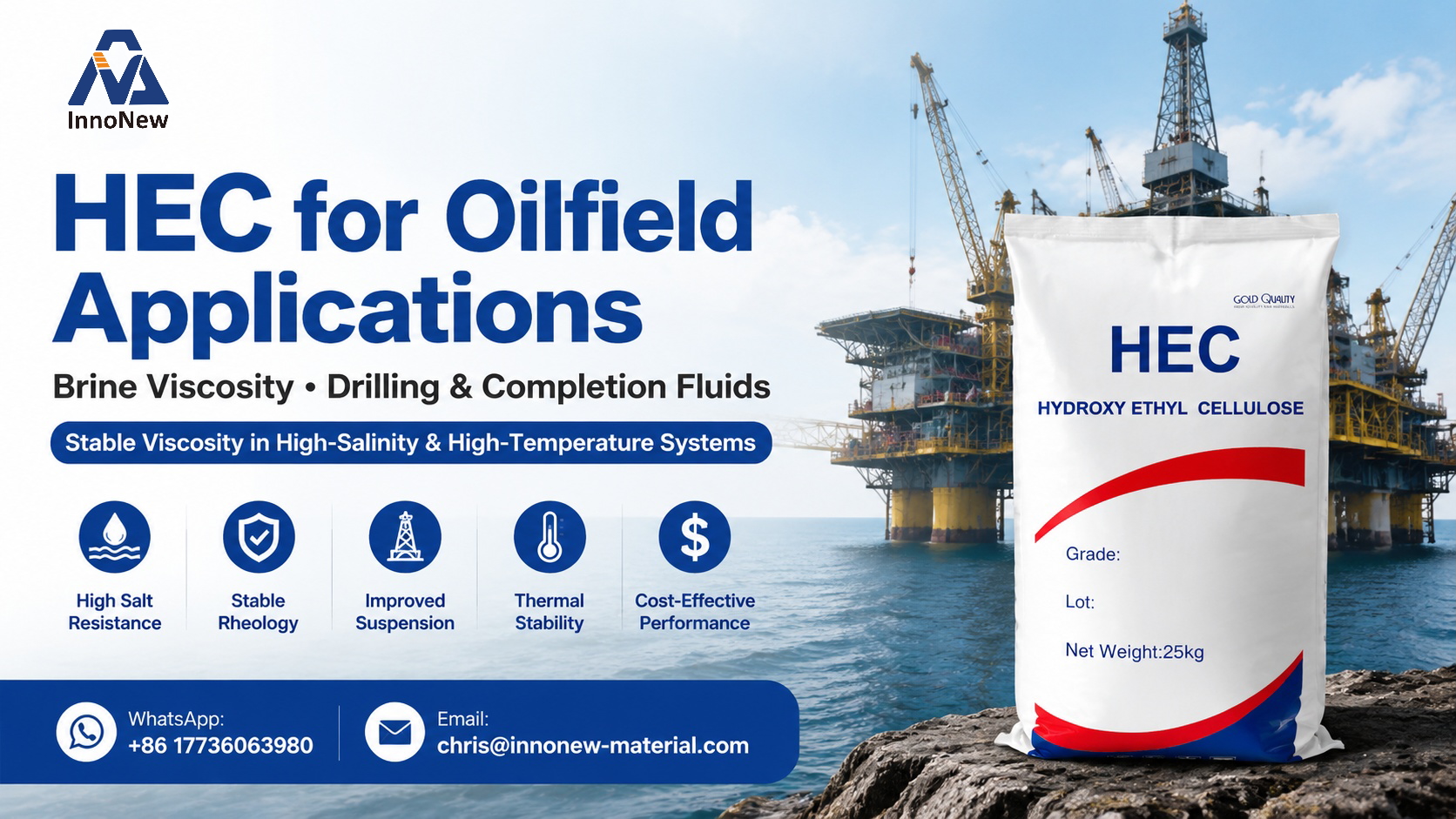
HEC for Oilfield Applications (Brine Vis, Drilling & Completion Fluids)
1. Introduction: Challenges in Oilfield Fluid Systems
Oilfield drilling and completion operations require fluids that maintain stable rheological properties under extreme conditions, including high salinity, high temperature, and high shear environments.
In brine-based systems, conventional polymers often suffer from:
- viscosity degradation due to ionic interference
- poor suspension of drill solids
- unstable rheology under shear stress
- reduced performance in high-density fluids
These challenges make it necessary to use specially engineered polymers such as Hydroxyethyl Cellulose (HEC) designed for oilfield applications.
2. What is Brine Vis HEC?
InnoNew® Brine Vis HEC (Brine Viscosity HEC) is a modified grade of Hydroxyethyl Cellulose designed for high-salinity oilfield environments.
It is a non-ionic, water-soluble polymer that maintains viscosity stability in electrolyte-rich systems such as:
- Sodium Chloride (NaCl) brines
- Potassium Chloride (KCl) drilling fluids
- Calcium Chloride (CaCl₂) completion fluids
- Seawater-based offshore drilling systems
Unlike ionic polymers, Brine Vis HEC is not affected by charge interactions, making it highly stable in salt-rich environments.
3. Mechanism of HEC in Brine Systems
The performance of HEC in oilfield brine systems is based on its molecular structure and hydration behavior.
3.1 Non-ionic Polymer Stability
HEC does not carry ionic charges, which prevents interaction with dissolved salts. This ensures stable rheology even in high ionic strength environments.
3.2 Hydrogen Bonding Hydration
HEC forms hydrogen bonds with water molecules, creating a hydrated polymer network that increases viscosity and suspension capacity.
3.3 Molar Substitution Effect (MS)
Higher MS values improve:
- hydration efficiency
- solubility in saline systems
- resistance to electrolyte interference
This combination allows HEC to perform reliably in complex drilling environments.
4. Functions of HEC in Oilfield Applications
4.1 Drilling Fluids (Water-Based Mud Systems)
HEC is used to:
- increase viscosity for effective cuttings transport
- improve hole cleaning efficiency
- stabilize borehole conditions
4.2 Completion Fluids
In completion operations, HEC helps:
- minimize formation damage
- suspend solids in brine systems
- maintain clean wellbore conditions
4.3 Workover Fluids
HEC provides:
- temporary wellbore stability
- controlled rheology for intervention operations
- improved fluid carrying capacity
4.4 Brine-Based Oilfield Systems
HEC is particularly effective in:
- saturated NaCl drilling fluids
- KCl inhibition systems
- offshore seawater drilling environments
5. HEC vs PAC vs Xanthan Gum
| Property | HEC | PAC | Xanthan Gum |
|---|---|---|---|
| Salt Resistance | High | Very High | Very High |
| Viscosity Stability | High | High | Very High |
| Fluid Loss Control | Medium | Very High | High |
| Thermal Stability | Medium | High | High |
| Cost Efficiency | High | Medium | Low |
| Primary Function | Viscosifier | Filtration control | Rheology modifier |
Key Insight:
HEC is primarily used as a cost-effective viscosifier, while PAC and Xanthan are more specialized for filtration control and high-performance rheology systems.
6. Technical Specifications (Oilfield Grade HEC)
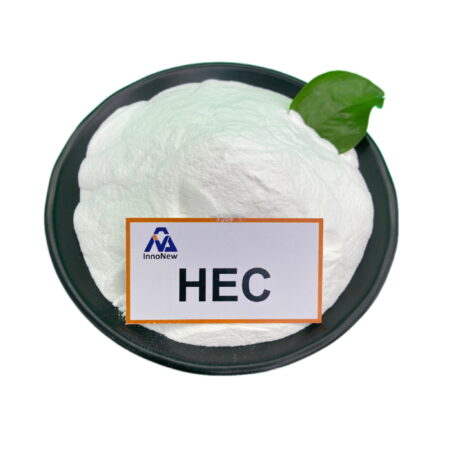
- Appearance: White or off-white powder
- Ionic Nature: Non-ionic
- Moisture Content: ≤ 5%
- pH (1% solution): 6.0 – 8.5
- Viscosity Range: 100,000 cps or customizable grades available
- Molar Substitution (MS): 1.5 – 2.5
- Solubility: cold water dispersible
- Brine Compatibility: NaCl / KCl / CaCl₂ systems
7. Recommended Dosage and Mixing Procedure
Typical Dosage:
0.2% – 1.0% depending on drilling system design
Mixing Method:
- Pre-dispersed in fresh water
- Slowly added under strong agitation
- Avoid rapid addition to prevent agglomeration
- Fully hydrated before brine incorporation
8. System Compatibility
HEC demonstrates compatibility with:
- Bentonite clay systems
- PAC and modified starch
- Xanthan gum systems
- High-salinity brine fluids
- Common oilfield additives
This allows flexible formulation in complex drilling environments.
9. Oilfield Application Scope
HEC is widely used in:
- Offshore drilling operations
- Horizontal directional drilling (HDD)
- Deep well drilling systems
- Geothermal drilling
- Oil & gas completion operations
10. Conclusion
Hydroxyethyl Cellulose (HEC) plays a critical role in oilfield drilling and completion fluid systems, particularly in brine-based environments.
Brine Vis HEC provides:
- stable viscosity in high-salinity systems
- improved suspension and carrying capacity
- cost-effective performance compared to specialty polymers
It is a key component in modern water-based oilfield fluid formulations.
FAQ
Q1: What is Brine Vis HEC used for in oilfield applications?
Brine Vis HEC is used as a viscosifier in drilling and completion fluids, especially in high-salinity brine systems such as NaCl and KCl-based muds.
Q2: Why is HEC suitable for brine drilling fluids?
HEC is a non-ionic polymer, meaning it does not interact with salts, allowing it to maintain stable viscosity in high ionic strength environments.
Q3: How does HEC compare with PAC in drilling fluids?
HEC mainly provides viscosity, while PAC is more effective for fluid loss control and filtration stability. Both are often used together in formulations.
Q4: Can HEC replace Xanthan Gum in oilfield systems?
HEC cannot fully replace Xanthan Gum in high-performance systems, but it can be a cost-effective alternative in moderate drilling conditions.
Q5: What is the typical dosage of HEC in drilling fluids?
Typical usage ranges from 0.2% to 1.0%, depending on required viscosity and fluid design.
Q6: Is HEC stable in seawater drilling systems?
Yes, oilfield-grade HEC performs well in seawater-based drilling fluids due to its non-ionic structure.
Q7: What is the main advantage of Brine Vis HEC?
Its main advantage is stable viscosity performance in high-salinity brine systems combined with cost efficiency compared to specialty polymers.