
PVA for Wall Putty | Polyvinyl Alcohol in Dry Mix Mortar Additives Guide
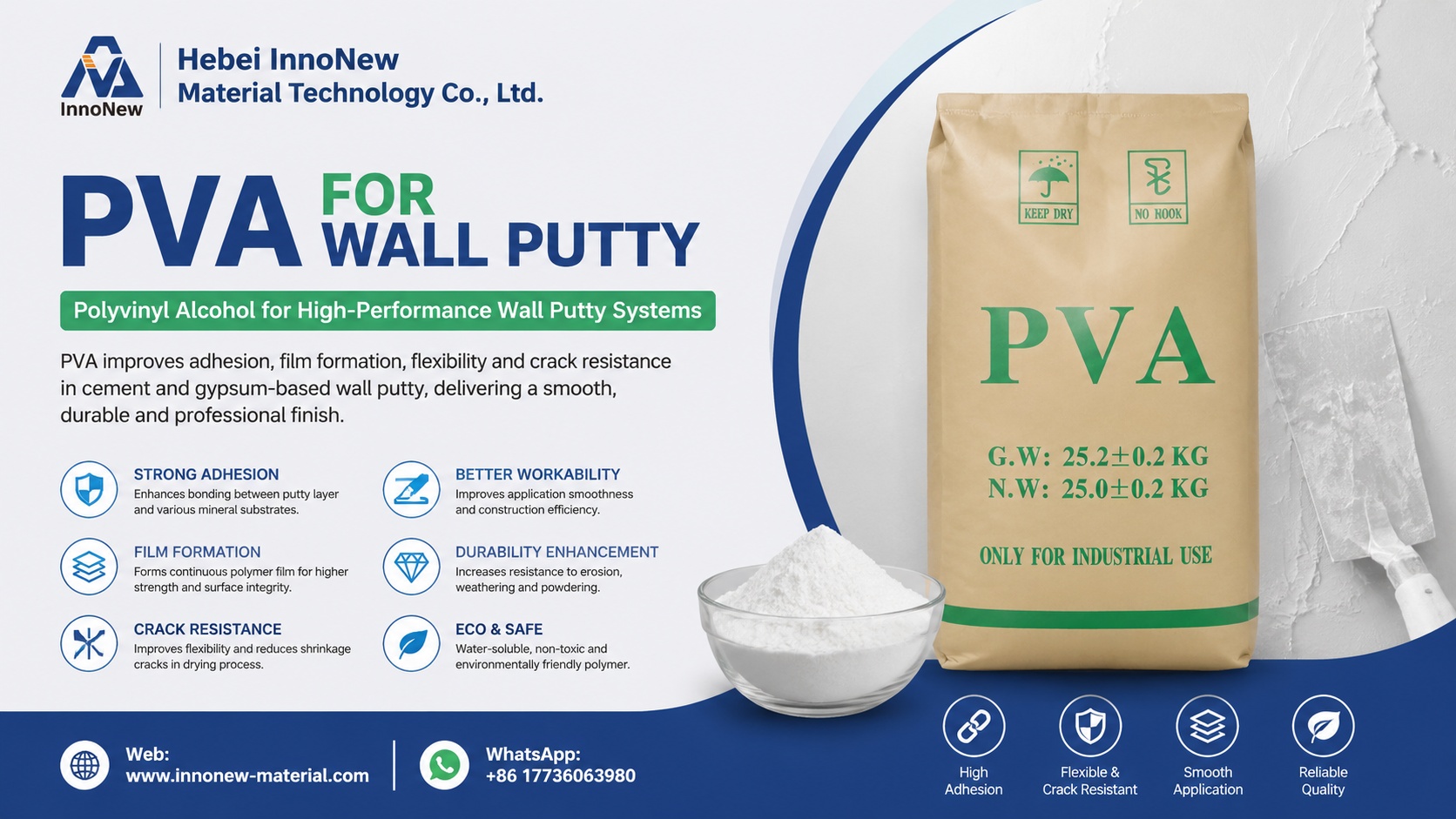
1. What is PVA in Wall Putty Systems?
Polyvinyl Alcohol (PVA) is a water-soluble synthetic polymer widely used in construction chemical systems as a film-forming and bonding enhancement additive.
In wall putty formulations, PVA is primarily used to improve:
- Substrate adhesion strength
- Film integrity after drying
- Flexibility and crack resistance
- Cohesion between cementitious particles
Unlike cellulose ethers (HPMC/HEC), which mainly control water retention and rheology, PVA functions as a polymeric bonding modifier that enhances the mechanical integrity of the final film layer.
2. Functional Role of PVA in Wall Putty
PVA plays a critical role in modern high-performance wall finishing systems, especially in interior skim coat and cement-based putty applications.
2.1 Film Formation Enhancement
PVA forms a continuous polymer film during drying, improving surface density and structural cohesion.
2.2 Adhesion Improvement
It enhances bonding between:
- Putty and concrete substrate
- Putty and primer/paint layer
- Mineral fillers and binder phase
2.3 Flexibility & Crack Resistance
PVA introduces elastic behavior into rigid cement systems, reducing micro-crack propagation.
2.4 Dust Control & Surface Strength
Improves surface hardness and reduces powdering after sanding.
3. Technical Advantages of PVA in Wall Putty
3.1 Strong Substrate Adhesion
PVA significantly increases bonding strength on:
- Concrete walls
- Cement plaster surfaces
- AAC blocks
3.2 Improved Workability Synergy
When used with HPMC, PVA improves:
- Smooth application
- Extended open time stability
- Uniform surface leveling
3.3 Crack Resistance Performance
PVA forms flexible polymer bridges inside the cement matrix, reducing shrinkage stress concentration.
3.4 Enhanced Durability
Improves long-term resistance against:
- Powdering
- Surface erosion
- Minor thermal movement
3.5 Compatibility with Dry Mix Systems
PVA works effectively with:
- HPMC (rheology control)
- RDP (elastic bonding system)
- Starch ether (anti-sag)
4. Applications of PVA in Wall Putty Systems
4.1 Interior Wall Putty
- Smooth finishing surface
- High whiteness compatibility
- Reduced sanding effort
- Excellent paint base layer
4.2 Exterior Wall Putty
- Improved weather resistance
- Better crack control under thermal expansion
- Enhanced durability under UV exposure
4.3 Cement-Based Wall Putty
- Strong mechanical reinforcement
- Improved bonding on rough substrates
- Reduced shrinkage deformation
4.4 Gypsum-Based Putty
- Better film uniformity
- Reduced surface defects
- Improved smoothness and leveling
4.5 High-End Decorative Wall Systems
- Microcement systems
- Decorative skim coats
- Smooth architectural finishing layers
5. Synergistic Formulation System
In advanced dry mix mortar systems, PVA is rarely used alone. It is part of a polymer additive system:
Typical system architecture:
- PVA → film formation + adhesion
- HPMC → water retention + workability
- RDP → flexibility + bonding strength
- Defoamer → air control
- Calcium carbonate → filler skeleton
This system creates a balanced performance between:
- Workability
- Adhesion
- Crack resistance
- Surface finish quality
6. Technical Data Sheet (PVA 2488 Grade)
Product: Polyvinyl Alcohol PVA 2488
| Item | Specification |
|---|---|
| Chemical Name | Polyvinyl Alcohol |
| Grade | 2488 |
| Hydrolysis Degree | 87–89% |
| Viscosity (4% solution) | 45–55 mPa·s |
| Molecular Weight | Medium-high |
| Appearance | White powder (80-120 mesh) |
| Solubility | Water soluble (Hot water preferred) |
| Film Property | Flexible, transparent film |
| Application | Wall putty, dry mix mortar, adhesives |
Key Performance Characteristics:
- Balanced hydrolysis for construction compatibility
- Good film-forming ability
- Strong adhesion to mineral substrates
- Suitable for blended polymer systems
7. Why PVA Improves Wall Putty Performance
The core mechanism is based on polymer film bridging theory:
- PVA dissolves in mixing water
- During drying, polymer chains coalesce
- A continuous film network forms
- This network binds cement and fillers
- Final structure becomes denser and tougher
This is fundamentally different from inorganic cement hydration—it introduces a polymer reinforcement phase.
8. FAQ
Q1: Is PVA necessary in wall putty formulation?
PVA is not mandatory, but it significantly improves adhesion and surface durability in high-end systems.
Q2: What is the difference between PVA and HPMC?
HPMC controls water retention and workability, while PVA improves film strength and adhesion.
Q3: Can PVA replace RDP?
No. PVA and RDP serve different roles; RDP provides elastomeric flexibility while PVA provides film bonding.
Q4: What is the recommended dosage of PVA?
Typically 0.3%–1.5% depending on formulation design and performance requirements.
Q5: Is PVA suitable for exterior wall applications?
Yes, but it is often combined with RDP for improved weather resistance.
Q6: Does PVA affect drying time?
Slightly, due to film formation, but it improves final surface integrity.
9. CTA – Industrial Supply & Technical Support
For high-performance PVA (Polyvinyl Alcohol) and construction-grade polymer additives, Hebei InnoNew Material Technology Co., Ltd. provides stable-quality materials for global dry-mix mortar manufacturers.
We support:
- Wall putty formulation optimization
- Polymer system design (PVA + HPMC + RDP)
- Customized viscosity and hydrolysis grades
- OEM packaging for global markets
📩 Email: chris@innonew-material.com
🌐 Website: www.innonew-material.com