
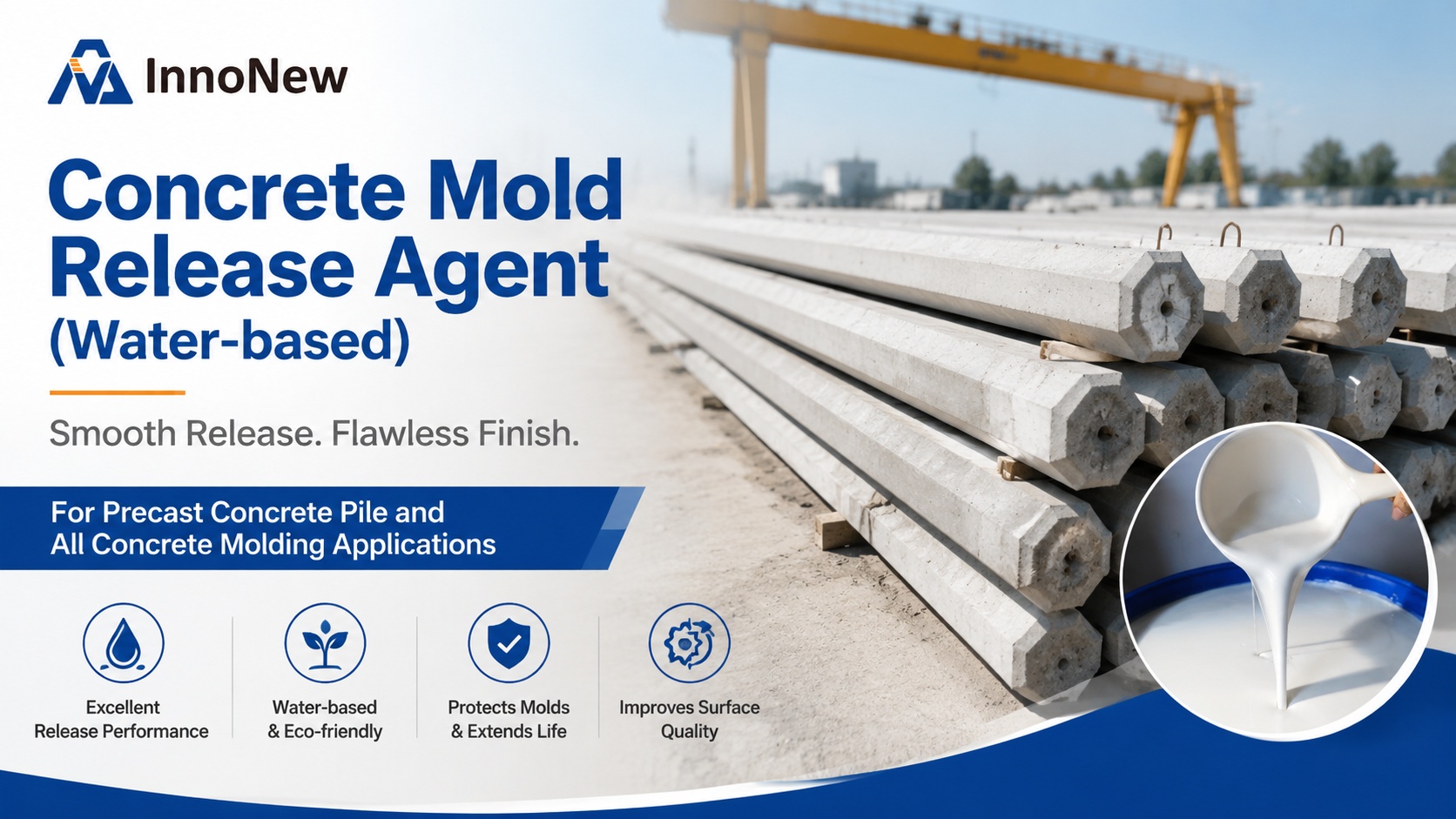
1. Introduction: Role of Release Agents in Precast Engineering Systems
In precast concrete production, mold release agents are not auxiliary materials—they are a critical interface control technology between:
Hydrating cement matrix ↔ Precision formwork system
Unlike cast-in-place concrete, precast systems operate under:
- Controlled curing conditions
- Reusable high-value molds
- Strict dimensional tolerances
- High aesthetic surface requirements
Therefore, the release agent functions as a surface engineering layer, not just a demolding lubricant.
2. Engineering Function in Precast Concrete Systems
In precast manufacturing, mold release agents serve three engineering roles:
2.1 Interfacial Bond Suppression Mechanism
During cement hydration, calcium silicate hydrate (C-S-H) bonds strongly adhere to steel or plywood molds.
The release agent creates a low surface energy barrier film, preventing:
- Chemical bonding
- Mechanical interlocking
- Capillary penetration of cement paste
2.2 Surface Defect Control Layer (Bugholes Reduction System)
Bugholes (air voids) in precast elements are caused by:
- Entrapped air at mold interface
- Excess release agent pooling
- Inadequate vibration transmission
Proper application forms a micro-uniform film, allowing:
- Controlled air release
- Reduced surface tension trapping
- Improved compaction efficiency
2.3 Formwork Lifecycle Protection System
Precast molds (especially steel/aluminum) are capital assets.
Release agent reduces:
- Cement paste adhesion cycles
- Surface corrosion acceleration
- Mechanical cleaning abrasion
Result:
Extended mold lifespan + reduced maintenance cost per cycle
3. Application in Precast Production Lines
3.1 Steel Mold Precast System
Steel formwork is the most common in precast plants.
Key requirements:
- Ultra-thin film formation
- No oil residue accumulation
- Stable release over repeated cycles
Engineering behavior:
Steel has near-zero absorption → release performance depends entirely on film uniformity, not penetration.
3.2 Plywood Mold Precast System
Used in flexible or architectural precast.
Key challenges:
- Porosity variation
- Moisture absorption
- Surface roughness transfer
Technical requirement:
Release agent must achieve:
- Controlled penetration sealing
- Stable boundary film formation
- Prevention of cement paste absorption into wood pores
3.3 Architectural Precast Concrete
Used for:
- Curtain wall panels
- Decorative façade systems
- Exposed concrete structures
Quality standard:
- Class A surface finish (architectural grade)
- No discoloration or oil shadowing
- Uniform light reflectance
Critical sensitivity:
Even slight over-application causes:
- Tone variation (“oil staining effect”)
- Surface gloss inconsistency
- Reduced coating adhesion performance
4. Key Engineering Parameters Affecting Performance
4.1 Film Thickness Control
Precast quality is highly sensitive to film thickness.
| Condition | Result |
|---|---|
| Too thick film | surface staining, bugholes |
| Too thin film | sticking, demolding resistance |
| Uniform micro-film | optimal release + smooth surface |
4.2 Surface Energy Interaction
Release performance depends on:
- Mold surface energy (steel vs wood vs plastic)
- Concrete mix viscosity (PCE content)
- Curing temperature profile
4.3 Vibration Interaction Behavior
During compaction:
- Excess release agent disrupts vibration energy transfer
- Proper film allows air migration without trapping
This directly impacts:
Surface densification quality
5. Common Precast Surface Defects & Technical Causes
5.1 Bugholes (Surface Voids)
Root causes:
- Excess release agent accumulation
- Poor vibration synchronization
- Air entrapment at interface
5.2 Surface Staining / Oil Marks
Root causes:
- Over-application
- Non-uniform spraying pattern
- Incompatible mold surface contamination
5.3 Edge Chipping After Demolding
Root causes:
- Insufficient release layer
- Early demolding stress concentration
- Formwork adhesion points
5.4 Patchy Surface Texture
Root causes:
- Uneven coverage
- Dry spots on mold surface
- Inconsistent spraying pressure
6. Industrial Best Practice: Precast Application Standard
6.1 Surface Preparation Standard
Before application:
- Remove cement laitance
- Remove oil contamination
- Ensure dry mold surface
6.2 Application Method Standard
Preferred methods:
- Low-pressure spray system (industry standard)
- Micro-fine atomization nozzles
Avoid:
- Heavy brushing
- Flood coating
- Repeated over-layering
6.3 Timing Control Principle
Apply:
Just before concrete pouring cycle begins
Avoid:
- Long exposure before casting (dust contamination risk)
- Re-application without cleaning
7. Quality Control Indicators in Precast Plants
Professional precast factories evaluate release agent performance using:
- Surface air void ratio (visual grading)
- Demolding force consistency
- Mold cleanliness after stripping
- Surface reflectivity uniformity
- Reuse cycle stability
8. Engineering Insight: Why Precast Industry Requires Specialized Release Technology
Precast systems differ from general construction because:
- High repeat cycle molds amplify small defects
- Surface defects are not repairable at scale
- Aesthetic grading directly affects commercial value
- Automation requires consistent release behavior
Therefore:
Release agent is part of the precast production system, not a consumable auxiliary.
9. FAQ
Q1: Why is mold release agent critical in precast concrete?
Because precast systems require consistent surface quality and repeatable demolding cycles.
Q2: What causes bugholes in precast concrete surfaces?
Mainly trapped air due to excess release agent or improper vibration interaction.
Q3: Can release agent affect concrete strength?
Indirectly no, but poor application can affect surface compaction quality.
Q4: What is the ideal application method in precast factories?
Low-pressure uniform spraying with micro-film control.
Q5: Why does over-application cause surface defects?
Because excess oil interferes with air release and vibration energy transfer.
Q6: Is steel formwork different from plywood in release behavior?
Yes, steel relies on film uniformity; plywood also involves penetration behavior.
Q7: How to improve surface finish quality in precast plants?
Control three factors: film thickness, vibration system, and mold cleanliness.