
HPMC for Tile Adhesive | Water Retention & Open Time Solution
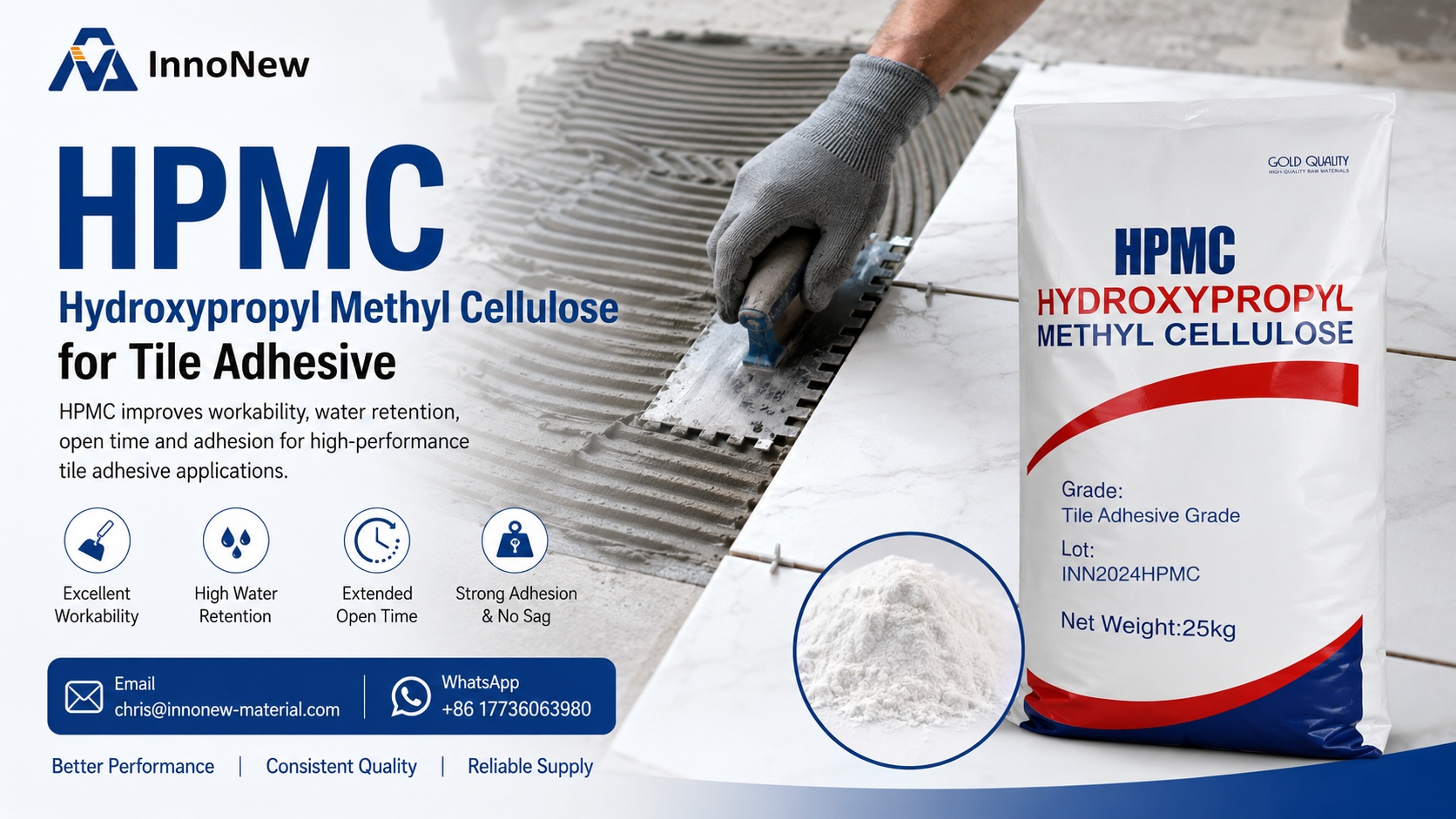
Modern tile adhesive systems require stable water retention, optimized open time, and balanced rheology performance to achieve reliable installation quality and long-term bonding durability.
Hydroxypropyl Methyl Cellulose (HPMC) is one of the most important functional additives used in cement-based tile adhesive formulations. As a high-performance cellulose ether, HPMC improves water retention, enhances workability, stabilizes mortar rheology, and supports proper cement hydration during application.
At InnoNew, our construction-grade HPMC is specially engineered for modern dry mix mortar systems, helping tile adhesive manufacturers achieve better consistency, improved anti-slip behavior, and stable construction performance under both standard and tropical climate conditions.
Why Water Retention Matters in Tile Adhesive
In tile adhesive systems, proper water management directly affects:
- Cement hydration
- Bonding strength
- Open time
- Workability
- Application stability
Rapid water loss may lead to:
- Poor bonding
- Reduced open time
- Weak hydration
- Cracking risk
- Difficult application
HPMC helps regulate water migration within the mortar system, ensuring sufficient moisture remains available for proper cement hydration and stable construction performance.
This is especially important for:
- Large-format tile installation
- Porcelain tile systems
- High-temperature environments
- Highly absorbent substrates
How HPMC Improves Tile Adhesive Performance
Water Retention Enhancement
One of the primary functions of HPMC is improving water retention within cementitious tile adhesive formulations.
Benefits include:
- Reduced premature drying
- Better cement hydration
- Improved bonding reliability
- Enhanced consistency stability
- Reduced cracking risk
Stable water retention is critical for achieving long-term adhesion performance.
Open Time Optimization
HPMC significantly improves tile adhesive open time by slowing water evaporation and stabilizing hydration behavior.
Extended open time allows:
- Easier tile adjustment
- Better installation flexibility
- Improved worker efficiency
- Reduced material waste
This becomes increasingly important in hot-weather construction conditions.
Rheology & Workability Control
HPMC contributes to balanced mortar rheology and smoother application behavior.
Advantages include:
- Better troweling performance
- Improved spreadability
- Stable consistency
- Enhanced application feel
- Better sag resistance
Its rheological behavior helps maintain a balance between flowability and structural stability.
Anti-Slip & Vertical Stability
In wall tile applications, HPMC improves anti-slip behavior and vertical application stability.
This helps:
- Reduce tile slipping
- Improve tile positioning
- Enhance installation precision
- Increase construction efficiency
HPMC vs Other Tile Adhesive Additives
Different additives perform different functions within tile adhesive systems.
| Additive | Primary Function |
|---|---|
| HPMC | Water retention & open time |
| RDP | Adhesion & flexibility |
| HPS | Rheology & anti-sagging |
| PCE | Flowability & water reduction |
Balanced interaction between these additives is essential for achieving high-performance tile adhesive formulations.
Synergy Between HPMC and RDP
HPMC and Redispersible Polymer Powder (RDP) are commonly used together in modern tile adhesive systems.
HPMC contributes:
- Water retention
- Open time
- Rheology control
- Workability stability
RDP contributes:
- Bond strength
- Flexibility
- Crack resistance
- Durability
Together, they create a more balanced and durable mortar system suitable for demanding construction environments.
Recommended for C1 & C2 Tile Adhesive Systems
Our HPMC is suitable for:
- C1 tile adhesive
- C2 tile adhesive
- Flexible tile adhesive
- Porcelain tile adhesive
- Large-format tile systems
- Wall tile adhesive
It is especially effective in formulations requiring:
- Extended open time
- Stable workability
- Better water retention
- Improved anti-slip performance
- Reliable construction consistency
Optimized for Tropical Climate Construction
Tile adhesive systems used in tropical climates face challenges such as:
- High temperature
- High humidity
- Rapid water evaporation
- Fast surface drying
InnoNew HPMC solutions are optimized for tropical climate applications commonly found in:
- Saudi Arabia
- Iran
- Turkey
- Dubai
- Vietnam
Key advantages include:
- Stable viscosity retention
- Better open time under heat
- Consistent water retention
- Improved workability stability
- Reliable on-site performance
This helps dry mix mortar manufacturers maintain stable product quality under demanding environmental conditions.
Technical Specifications
| Item | Specification |
|---|---|
| Appearance | White to Off-White Powder |
| Chemical Type | Non-Ionic Cellulose Ether |
| Viscosity | 400 – 200,000 mPa.s |
| Moisture Content | ≤ 5% |
| pH Value | 6.0 – 8.5 |
| Methoxy Content | 19% – 30% |
| Hydroxypropyl Content | 4% – 12% |
| Gel Temperature | 60 – 90°C |
Packaging & Storage
- 25 kg kraft paper bag with PE inner liner
- Store in cool and dry conditions
- Protect from moisture exposure
- Shelf life: 12 months under sealed storage conditions
Why Choose InnoNew HPMC for Tile Adhesive
InnoNew specializes in high-performance construction chemical additives for modern dry mix mortar systems.
Our advantages include:
- Stable viscosity control
- Excellent batch consistency
- Strong compatibility with RDP and HPS
- Professional formulation support
- Customized grades for tropical climates
- Reliable export supply for global markets
We focus on helping tile adhesive manufacturers improve formulation stability, construction efficiency, and long-term product performance.
FAQ
What viscosity grades are available for Tile Adhesive?
We offer construction-grade HPMC with viscosity grades ranging from 50,000 to 100,000 mPa·s, optimized for tile adhesive applications.
How does HPMC improve open time?
By reducing water evaporation and stabilizing hydration, HPMC extends workable time during tile installation.
Is customized viscosity available?
A: Yes. We provide tailored viscosity grades and specifications to meet specific tile adhesive formulations and regional climate requirements.
What gel temperature is suitable for hot climate applications?
A: We recommend HPMC with a gel temperature of 50–60°C to maintain consistent performance and water retention in high-temperature environments. Even MHEC with a gel temperature 60–90°C
What is the difference between HPMC and RDP?
HPMC: Water retention & thickening agent → improves workability and open time.
RDP: Polymer binder → boosts adhesion, flexibility and durability.