
PP Fiber for Mortar & Plaster: The Science of Crack Control in Cement-Based Rendering Systems
Understanding how polypropylene fiber reduces plastic shrinkage, drying shrinkage, and microcrack propagation in modern mortar and plaster applications.
Introduction
Cracking in mortar and plaster layers remains one of the most persistent quality challenges in construction worldwide. Whether in cement plaster, rendering mortar, dry-mix mortar, repair mortars, or EIFS base coats, early-stage cracks compromise structural durability, aesthetic performance, and increase maintenance costs.
Most cracks in mortar and plaster are not caused by structural loads, but by early-age shrinkage and stress development. Polypropylene (PP) fiber provides a solution not by increasing compressive strength, but by forming a three-dimensional micro-reinforcement network that controls crack formation and propagation.
Why Mortar and Plaster Crack
Understanding the root causes of cracking is essential for designing effective reinforcement strategies.
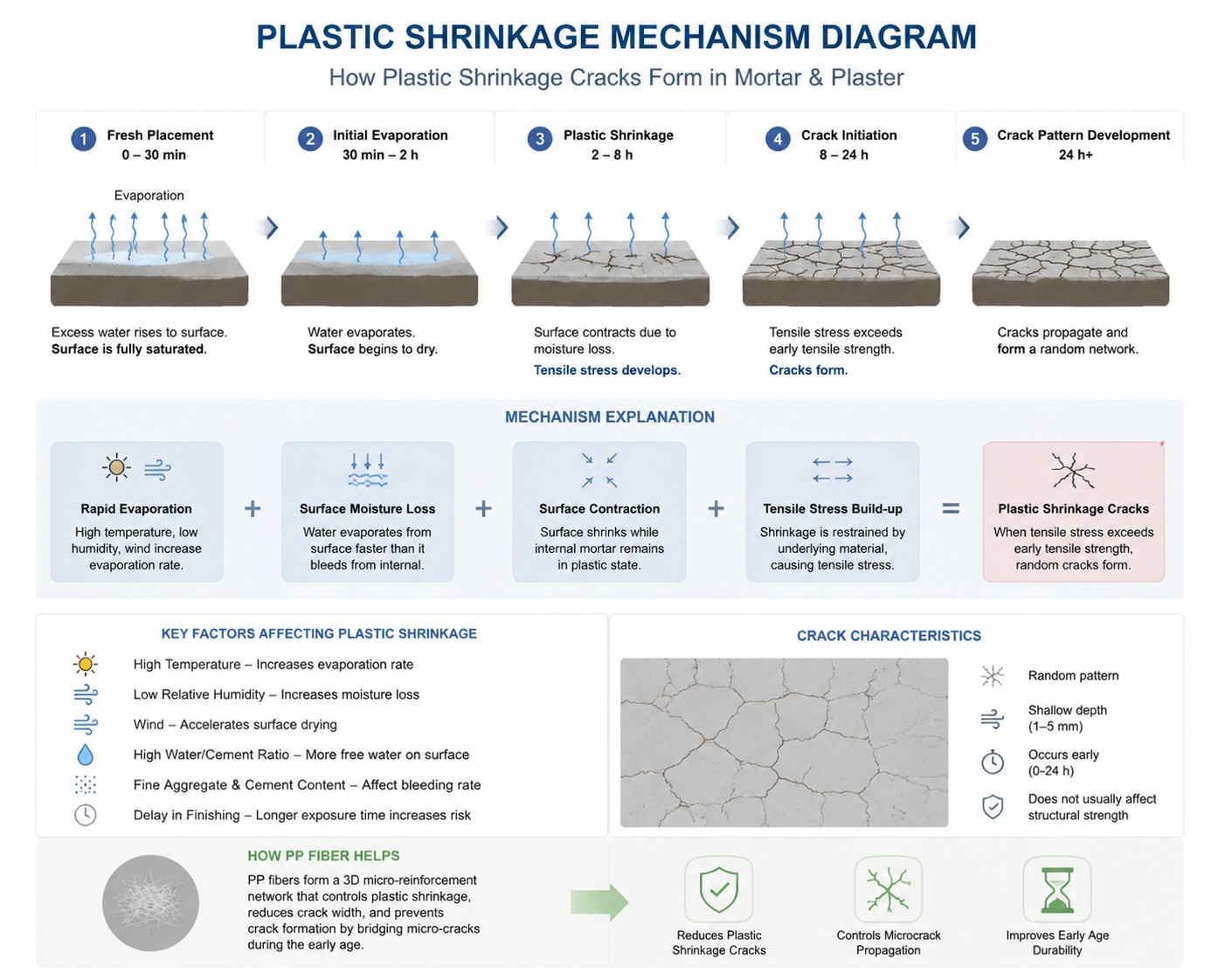
1. Plastic Shrinkage Cracking (0–24h)
- Mechanism: Rapid water evaporation from the surface causes the surface layer to shrink faster than the interior, resulting in tensile stress.
- Result: A network of micro-cracks appears randomly across the plaster or mortar surface.
- Impact: Weakens surface integrity and may lead to early delamination.
- Visualization: Microcracks forming during the plastic stage.
2. Drying Shrinkage Cracking (7–90 days)
- Mechanism: Continuous water loss from hydration products causes volume reduction.
- Result: Linear or network cracks, particularly near openings, edges, and corners.
- Impact: Reduced long-term durability and increased susceptibility to moisture ingress.
3. Thermal Stress Cracking
- Cause: Differential thermal expansion/contraction due to hydration heat and ambient temperature fluctuations.
- Impact: Microcracks at high-heat areas, joints, or external facades.
4. Differential Movement Between Materials
- Examples: Brick + Mortar, AAC Block + Plaster, Concrete + Rendering.
- Result: Interface cracks due to incompatible deformation.
- Impact: Compromised adhesion and increased repair costs.
How PP Fiber Controls Crack Formation
PP fiber reduces cracking through multi-stage mechanisms, addressing both early-age and long-term challenges.
Stage 1: Reducing Plastic Shrinkage Cracks
When uniformly dispersed, millions of PP microfibers form micro-bridges across the cement matrix, restricting volumetric shrinkage. Studies indicate that proper fiber dosage can reduce plastic shrinkage crack area by 50–90%.
Stage 2: Arresting Microcrack Propagation
Fibers spanning microcracks share tensile stresses, reducing stress concentration and slowing crack propagation. This mechanism enhances the cohesive integrity of the mortar without altering standard mix strength.
Stage 3: Improving Impact Resistance and Toughness
Traditional mortars are brittle and prone to spalling under impact. PP fiber enhances ductility and energy absorption, making mortars more resilient, especially in:
- Exterior rendering systems
- Industrial floor repairs
- EIFS base coats
Performance Benefits of PP Fiber in Mortar and Plaster
| Benefit | Description |
|---|---|
| Crack Reduction | Limits both plastic and drying shrinkage cracks; reduces early-stage microcracks. |
| Improved Durability | Extends mortar service life and reduces maintenance frequency. |
| Enhanced Toughness | Improves impact resistance and adhesion to substrates. |
| Better Cohesion | Reduces segregation and improves workability. |
| Corrosion-Free Reinforcement | Unlike steel fibers, PP fiber is non-corrosive, chemically stable, and leaves no rust stains. |
Recommended Applications
| Application | Notes |
|---|---|
| Cement Plaster | Interior and exterior walls, standard plastering. |
| Dry Mix Mortar | Pre-blended, ready-to-use mortars. |
| Tile Adhesive | Improves bonding layer durability, reduces microcracking. |
| Repair Mortar | Enhances toughness and crack resistance in patching applications. |
| EIFS Systems | Base coat reinforcement for external thermal insulation systems. |
| Self-Leveling Mortar | Reduces shrinkage cracks and improves flatness. |
| Waterproof Mortar | Controls cracks in tanks, pools, and waterproof layers. |
| Masonry Mortar | Enhances crack resistance and bond integrity. |
PP Fiber vs Traditional Reinforcement Methods
| Method | Advantages | Limitations |
|---|---|---|
| PP Fiber | Controls microcracks, evenly distributed, easy to add, cost-effective | Does not replace structural reinforcement |
| Steel Mesh | Controls large cracks, structural support | Expensive, labor-intensive, prone to corrosion |
| Glass Fiber | Lightweight, improves initial toughness | Poor long-term alkali resistance, degradation over time |
| Steel Fiber | Excellent strength enhancement | High cost, may corrode, can affect surface finish |
Recommended Dosage for Mortar and Plaster
| Mortar Type | Dosage (kg/m³) | Notes |
|---|---|---|
| Standard Plaster | 0.6–1.0 | Interior/exterior walls |
| Dry Mix Mortar | 0.9–1.2 | Ready-to-use factory blended |
| Waterproof Mortar | 1.0–1.5 | Pools, tanks, water retaining structures |
| Repair Mortar | 1.0–2.0 | Patching and thin overlays |
Optimal dosage should be validated according to mix design and application conditions.
Common Mistakes When Using PP Fiber
- Excessive Dosage: Reduces workability and surface finish quality.
- Poor Dispersion: Fiber clumping reduces effectiveness.
- Incorrect Fiber Length: Short fibers (<6mm) may be ineffective; very long fibers (>18mm) may affect pumpability.
- Ignoring Water Adjustment: Fiber addition slightly affects water demand; adjustments may be necessary for consistency.
Future Trends in Fiber-Reinforced Mortars
Modern mortar systems increasingly demand:
- Ultra-low crack potential
- Thin-layer high-performance rendering
- Prefabricated modular construction
- Green and durable building materials
PP Fiber is set to become a standard additive in advanced mortar formulations, supporting both performance and sustainability goals.
FAQ
Q: Does PP Fiber increase mortar strength?
A: Not significantly in compressive strength, but it improves tensile toughness and crack resistance.
Q: What fiber length is suitable for plaster?
A: Typically 6–12 mm. Longer fibers may be used in self-leveling or repair mortars.
Q: Can PP Fiber replace steel mesh?
A: For microcrack control, yes. For structural reinforcement, steel or mesh is still required.
Q: Does PP Fiber affect plaster finish?
A: When properly dosed, surface finish is not compromised.
Q: Is PP Fiber suitable for dry-mix mortar production?
A: Yes. Many manufacturers incorporate PP fiber as a standard additive for anti-crack performance.