
PCE for PHC Spun Pile Manufacturing
Engineering High-Performance Prestressed Concrete Foundations
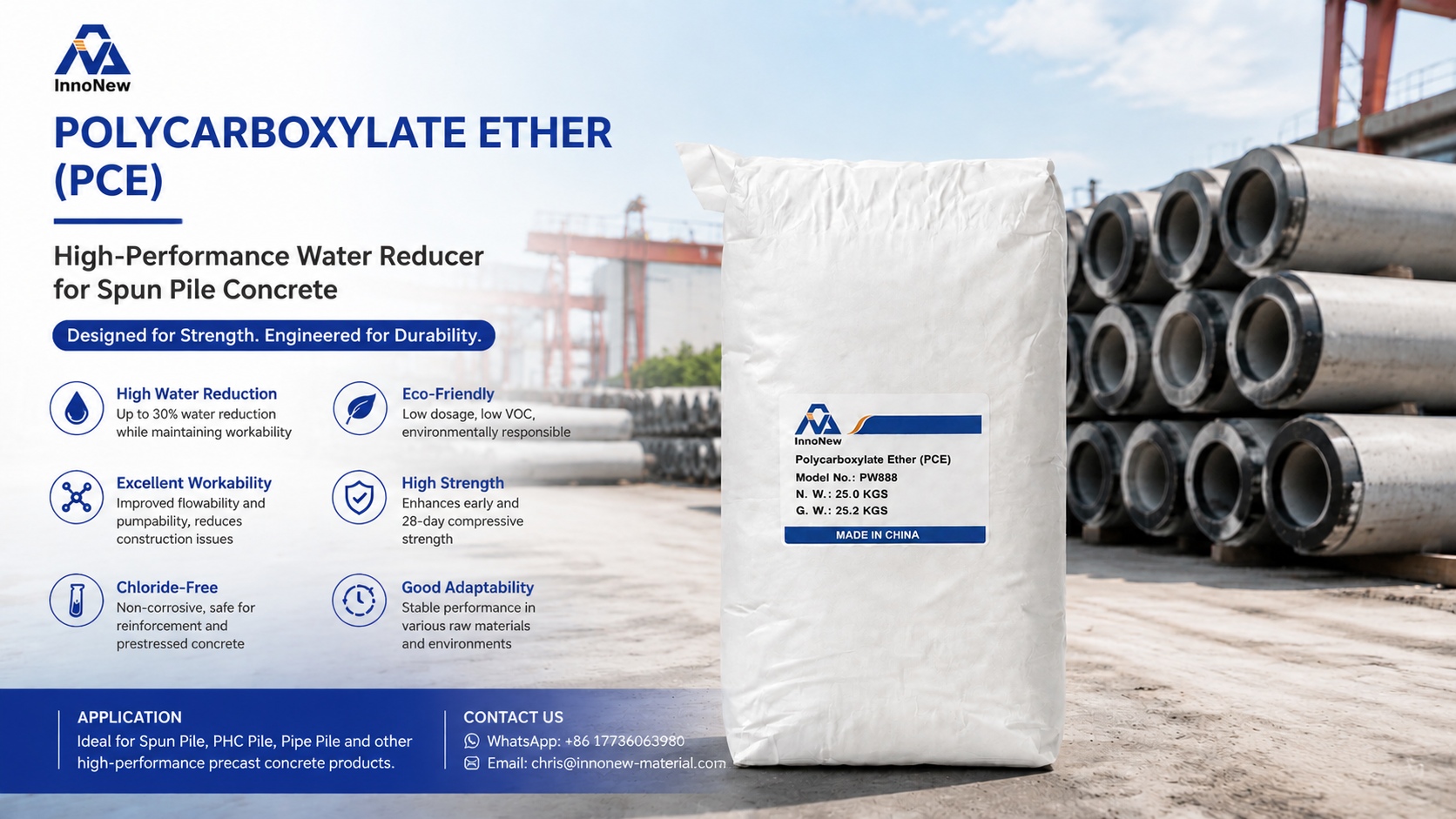
PHC (Prestressed High-Strength Concrete) spun piles represent one of the most demanding applications in modern precast concrete engineering.
Unlike conventional concrete elements, PHC spun piles are subjected to:
- High centrifugal forces during casting
- Strict dimensional tolerances
- Accelerated steam curing cycles
- High early-age prestress transfer requirements
- Long-term durability expectations under aggressive environments
To meet these requirements, concrete must be precisely engineered—not only in strength, but in rheology, density, and hydration behavior.
This is where Polycarboxylate Ether (PCE) plays a critical role as a performance control system rather than a simple water reducer.
Role of PCE in PHC Spun Pile Manufacturing
In PHC pile production, PCE is not only used to reduce water content. It directly influences the entire manufacturing process.
1. Workability Control for High-Speed Casting
PHC concrete must maintain stable flowability during mixing and charging.
PCE enables:
- Controlled viscosity
- Uniform cement dispersion
- Stable slump retention
- Reduced segregation risk
This ensures consistent feed into spinning molds.
2. Centrifugal Compaction Performance
During spinning, concrete is subjected to high centrifugal force, which determines final pile density.
Properly designed PCE improves:
- Particle packing efficiency
- Cement paste distribution
- Void reduction
- Final concrete compactness
This directly impacts pile strength and durability.
3. Low Water-Cement Ratio System Design
PHC piles typically require extremely low water-cement ratios to achieve high strength (often 80–100 MPa class concrete).
PCE allows:
- Significant water reduction
- Improved hydration efficiency
- Higher density microstructure formation
This is essential for high-load foundation applications.
4. Steam Curing Strength Development
Most PHC plants rely on steam curing for production efficiency.
PCE contributes to:
- Faster early strength gain
- Improved hydration under elevated temperature
- Reliable prestress transfer strength
- Reduced curing cycle time
This improves production turnover and plant efficiency.
5. Prestress Transfer Stability
After curing, concrete must safely transfer prestressing force without cracking or deformation.
PCE optimized systems ensure:
- Higher early compressive strength
- Better modulus development
- Improved structural integrity during release
Free-Chloride PCE for Enhanced Durability
In prestressed concrete systems, durability is as important as strength.
One of the most critical engineering concerns is chloride-induced corrosion of prestressing steel.
Free-chloride PCE systems are designed to:
- Minimize chloride introduction from admixture systems
- Reduce corrosion risk in prestressing wires
- Improve long-term structural reliability
- Support aggressive marine or coastal exposure conditions
This makes it particularly suitable for:
- Bridge foundations
- Marine infrastructure
- Port construction
- High-rise building foundations
Application in PHC Spun Pile Production Line
Typical PHC production flow:
Mixing → Charging → Centrifugal Spinning → Steam Curing → Prestress Release → Demolding → Storage
PCE influences every stage:
- Mixing: dispersion and flow control
- Spinning: compaction and density formation
- Curing: hydration acceleration
- Release: early strength assurance
This makes PCE a process-level material, not just a mix design additive.
Project Reference
Jakarta International Stadium – Indonesia
INNONEW Material PCE products have been applied in high-performance precast concrete systems used in major infrastructure projects, including:
Jakarta International Stadium (JIS)
- Large-scale infrastructure project in Indonesia
- High demand for precast concrete reliability
- Strict performance requirements for structural elements
- Use of advanced concrete admixture systems for durability and strength control
This project demonstrates the application capability of our PCE technology in real engineering environments requiring high-performance concrete systems.
Technical Advantages Summary
- High water reduction efficiency
- Excellent centrifugal casting stability
- Compatible with steam curing systems
- Improved early and final strength development
- Reduced permeability and improved durability
- Suitable for high-strength PHC pile production (80–100 MPa class)
Selection Guidelines for PHC Manufacturers
When selecting PCE for spun pile production, manufacturers should evaluate:
- Water reduction performance
- Early strength development under steam curing
- Workability retention during transport and spinning
- Cement compatibility
- Chloride content level
- Long-term durability performance
Conclusion
PHC spun pile manufacturing is a highly engineered process where concrete performance must align precisely with mechanical, thermal, and structural demands.
Polycarboxylate Ether (PCE) is no longer just a chemical admixture—it is a key enabling technology for high-performance foundation systems.
By optimizing workability, centrifugal compaction, steam curing response, and durability performance, PCE directly contributes to the quality and reliability of modern PHC spun pile infrastructure.
FAQ
What is PCE used for in PHC spun pile production?
PCE is used to control workability, reduce water demand, improve centrifugal compaction, and enhance early strength development in PHC pile manufacturing.
Why is PCE important for centrifugal casting?
It ensures uniform particle distribution and prevents segregation under high rotational forces, improving pile density and strength.
Can PCE improve steam curing performance?
Yes. PCE enhances hydration efficiency under elevated temperature conditions, enabling faster early strength gain.
What is free-chloride PCE?
It is a high-purity PCE system with extremely low chloride content, designed to reduce corrosion risk in prestressed concrete applications.
Is PCE suitable for all PHC pile factories?
Yes, but dosage and formulation should be optimized based on cement type, curing conditions, and required strength grade.