
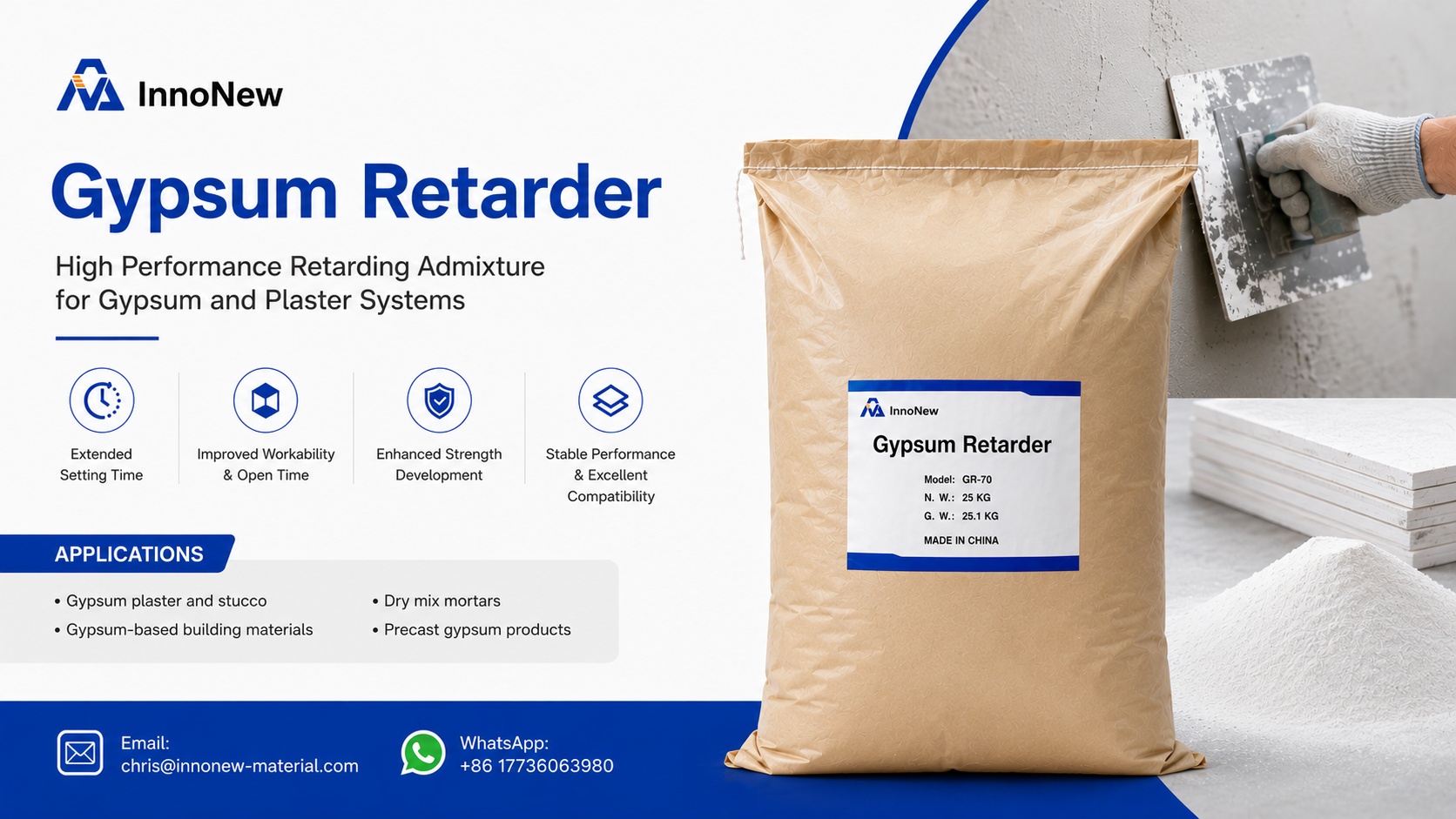
Gypsum Retarder for Gypsum Plaster
Improve Workability, Extend Open Time, and Optimize Gypsum Plaster Performance
Modern gypsum plaster systems require precise control over setting behavior to ensure smooth application, efficient construction, and consistent product quality. However, natural gypsum hydration often occurs too rapidly, limiting working time and increasing the risk of material waste and surface defects.
InnoNew Gypsum Retarder is a high-performance additive specifically developed to regulate the hydration rate of gypsum-based materials. By extending setting time and improving workability, it enables manufacturers and contractors to achieve greater process control and superior finishing quality in a wide range of gypsum plaster applications.
Whether used in hand-applied plaster, machine-applied gypsum systems, or decorative gypsum formulations, Gypsum Retarder provides reliable and predictable retardation performance.
Why Setting Time Control Matters in Gypsum Plaster
Gypsum plaster hardens through a hydration reaction in which calcium sulfate hemihydrate converts into calcium sulfate dihydrate crystals.
While rapid hardening can accelerate project schedules, excessive setting speed often creates significant operational challenges:
Reduced mixing and transportation time
Insufficient application window
Difficult leveling and finishing
Increased labor requirements
Higher material waste
Inconsistent surface quality
Production instability
For manufacturers and construction professionals, controlling setting time is essential for maintaining productivity and ensuring consistent project outcomes.
How Gypsum Retarder Works
Gypsum Retarder modifies the crystallization process that occurs during gypsum hydration.
Instead of allowing gypsum crystals to develop immediately after water addition, the retarder temporarily slows crystal nucleation and growth. This controlled reaction provides additional working time while maintaining the structural integrity of the hardened gypsum system.
Key effects include:
✓ Delayed initial setting
✓ Extended workable time
✓ Improved application flexibility
✓ Better finishing performance
✓ Enhanced production consistency
When properly dosed, the retarder achieves controlled setting without significantly affecting final strength development.
Key Benefits of Gypsum Retarder
Extended Working Time
Provides sufficient time for mixing, pumping, transportation, and application, particularly in large-scale construction projects.
Improved Workability
Maintains a smooth and uniform plaster consistency, making application easier for contractors and applicators.
Better Surface Finish
Allows additional time for troweling, leveling, and smoothing, resulting in improved appearance and reduced defects.
Reduced Material Waste
Minimizes premature hardening and decreases the amount of unusable material generated on-site.
Stable Manufacturing Performance
Supports consistent product quality by reducing variability caused by raw material differences and environmental conditions.
Excellent Compatibility
Compatible with most gypsum additives commonly used in dry-mix plaster formulations.
Typical Applications
Gypsum Retarder is widely used in:
Interior Gypsum Plaster
For residential, commercial, and industrial wall finishing systems.
Machine-Applied Gypsum Plaster
Improves pumping efficiency and application consistency in mechanized plastering operations.
Hand-Applied Gypsum Plaster
Provides longer open time for manual application and finishing.
Decorative Gypsum Systems
Suitable for ornamental plaster, decorative coatings, and architectural gypsum elements.
Lightweight Gypsum Plaster
Supports extended workability in formulations containing lightweight fillers and aggregates.
Recommended Dosage
The optimum dosage depends on:
Gypsum purity
Particle size distribution
Ambient temperature
Water-to-gypsum ratio
Target setting time
Application Recommended Dosage
Standard gypsum plaster 0.02–0.15%
Machine-applied plaster 0.05–0.20%
Extended open-time systems 0.10–0.30%
Laboratory testing is recommended to determine the ideal dosage for each formulation.
Application Guidelines
For optimal performance:
Pre-mix InnoNew Gypsum Retarder uniformly with dry gypsum powder.
Ensure homogeneous distribution throughout the formulation.
Add water according to formulation requirements.
Monitor setting time during production and application.
Adjust dosage based on seasonal temperature changes and project requirements.
Technical Considerations
Several factors influence retardation performance:
Temperature
Higher temperatures accelerate gypsum hydration and may require dosage adjustments.
Gypsum Source
Different gypsum sources may exhibit varying reactivity levels.
Formulation Components
Interactions with cellulose ethers, starch ethers, accelerators, and fillers can affect setting behavior.
Mixing Conditions
Mixing time and water quality may influence retardation efficiency.
For best results, formulation optimization should be conducted under actual production conditions.
Why Choose InnoNew Gypsum Retarder?
At InnoNew, we focus on delivering reliable additive solutions for gypsum-based building materials.
Our gypsum retarders are designed to provide:
Consistent batch-to-batch performance
Excellent formulation compatibility
Flexible setting time control
Technical support for formulation optimization
Reliable supply for global customers
By combining product performance with application expertise, InnoNew helps manufacturers improve production efficiency and achieve superior gypsum plaster quality.
Frequently Asked Questions (FAQ)
1: Why does gypsum plaster sometimes set too quickly on construction sites?
Rapid setting is often caused by highly reactive gypsum, elevated ambient temperatures, low water content, or insufficient retarder dosage. Fast setting can reduce workable time, making it difficult to apply and finish the plaster properly. Adjusting the retarder dosage and optimizing the formulation can help maintain a consistent setting profile.
2: Can gypsum retarder improve the pumping performance of machine-applied plaster?
Yes. In machine-applied gypsum plaster systems, sufficient open time is essential for stable pumping and spraying. A properly selected retarder helps prevent premature setting inside hoses and equipment, improving application efficiency and reducing downtime.
3: How does temperature affect gypsum plaster setting time?
Temperature significantly influences gypsum hydration. Higher temperatures generally accelerate setting, while lower temperatures slow the reaction. In hot climates, additional retarder dosage may be required to maintain the desired working time and application consistency.
4: What is the ideal working time for gypsum plaster applications?
The ideal working time depends on the project type and application method. Hand-applied plaster often requires 30–60 minutes of workable time, while machine-applied systems may require longer open time to ensure smooth pumping, spraying, and finishing operations.
5: Can gypsum retarder help improve gypsum plaster surface quality?
Yes. By extending the finishing window, gypsum retarder allows applicators more time for leveling, smoothing, and surface correction. This can reduce defects such as uneven texture, visible trowel marks, and premature surface hardening.
6: Why does gypsum plaster show inconsistent setting times between batches?
Variations in gypsum source, particle size distribution, moisture content, and additive compatibility can all affect setting behavior. Consistent formulation design and proper retarder selection help improve batch-to-batch stability.
7: How can manufacturers optimize gypsum plaster formulations for different climates?
Regional climate conditions can significantly affect gypsum performance. Manufacturers often adjust retarder dosage, water retention systems, and additive packages to achieve stable setting times across different temperature and humidity ranges.
8: What are the common signs of retarder overdosage in gypsum plaster?
Excessive retarder dosage may result in unusually long setting times, delayed strength development, and reduced production efficiency. Laboratory testing is recommended to determine the optimal dosage range for each formulation.
Request Technical Support
Looking for the right gypsum retarder solution for your gypsum plaster formulation?
Contact InnoNew’s technical team for product recommendations, formulation guidance, dosage optimization, and sample testing support.