Ready-Mix Plant Performance Problems: Slump Loss, Pumpability, and the Role of PCE Liquid
Ready-Mix Plant Performance Problems: Slump Loss, Pumpability, and the Role of PCE Liquid
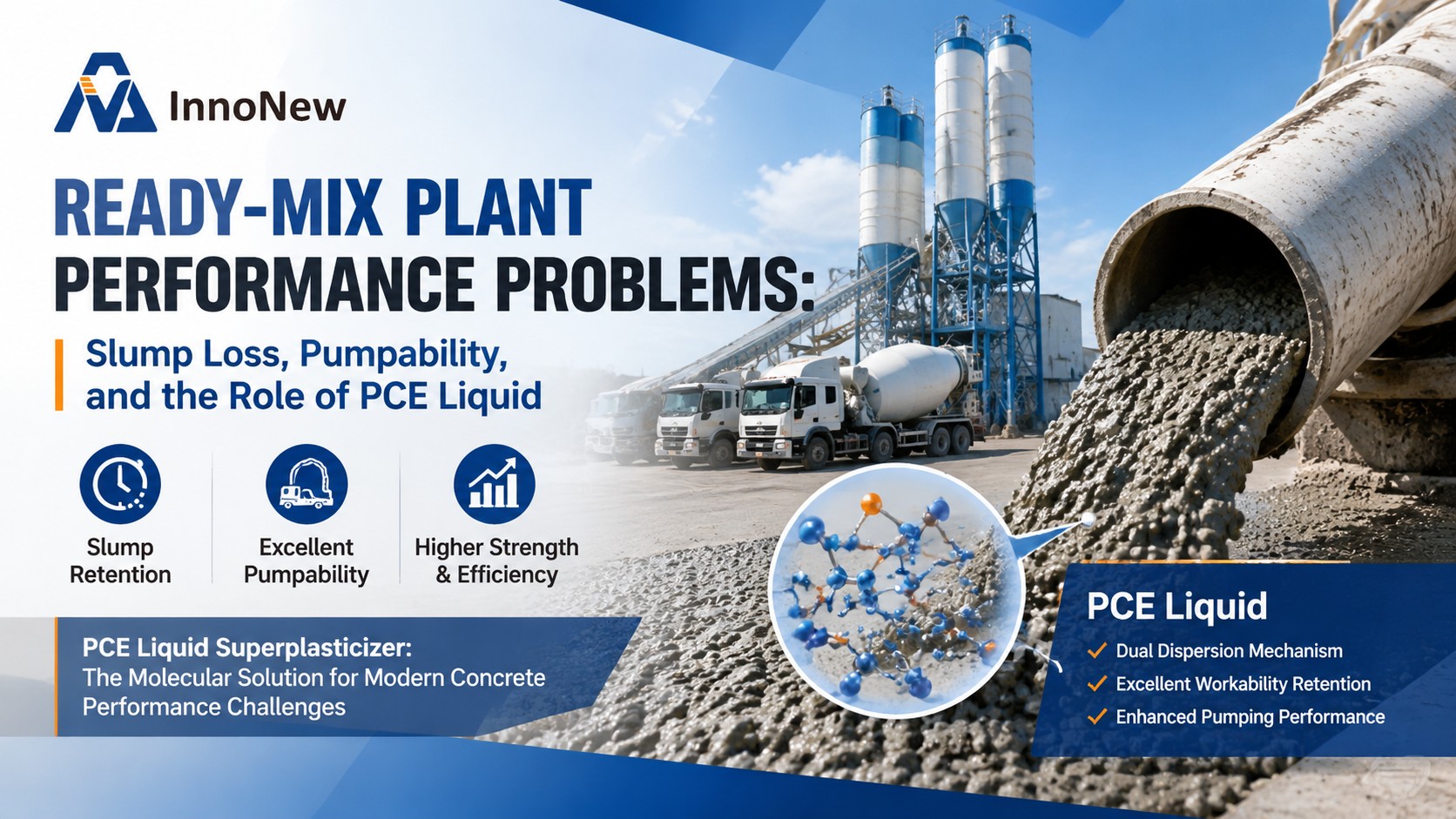
This banner illustrates key performance challenges in ready-mix concrete, including slump loss, pumpability instability, and workability degradation during transport. It highlights how Polycarboxylate Ether (PCE) liquid superplasticizer improves concrete flow behavior, enhances pumping stability, and extends slump retention through molecular-level dispersion and steric stabilization mechanisms.
1. Introduction: Ready-Mix Concrete as a Dynamic Engineering System
Ready-mix concrete (RMC) is not a static material but a time-dependent multi-phase engineering system. From the moment water contacts cement, a continuous evolution begins involving hydration, particle dispersion, and rheological transformation.
In real-world construction logistics, concrete must pass through:
batching → transport → pumping → placement
During this process, performance degradation is inevitable due to:
cement hydration kinetics
particle flocculation and re-agglomeration
temperature-driven acceleration
admixture adsorption depletion
Therefore, ready-mix plant performance should be understood as a system-level material behavior problem, not only a production control issue.
Among all performance indicators, the most critical are:
Slump loss control
Pumpability stability
Workability retention
Modern concrete engineering increasingly relies on Polycarboxylate Ether (PCE) liquid superplasticizer as the core solution for controlling these parameters at molecular scale.
Van der Waals forces dominate after dispersant depletion
Cement particles form clusters and lose mobility
Cause–Effect Logic
Temperature increase → hydration acceleration → faster admixture consumption → particle flocculation → slump loss
Engineering Parameters
Parameter
Effect on Slump Loss
Cement fineness
Higher fineness → faster slump loss
Temperature
+10°C → 20–40% faster slump decay
Water-cement ratio
Lower ratio → faster stiffening
Admixture type
Low-performance SP → rapid collapse
2.2 Pumpability Failure: Rheology Instability Under Pressure
Mechanism Explanation
Pumpability depends on concrete rheology:
Yield stress (τ₀)
Plastic viscosity (μ)
Thixotropic recovery
Pump failure occurs when:
internal resistance exceeds pump energy capacity
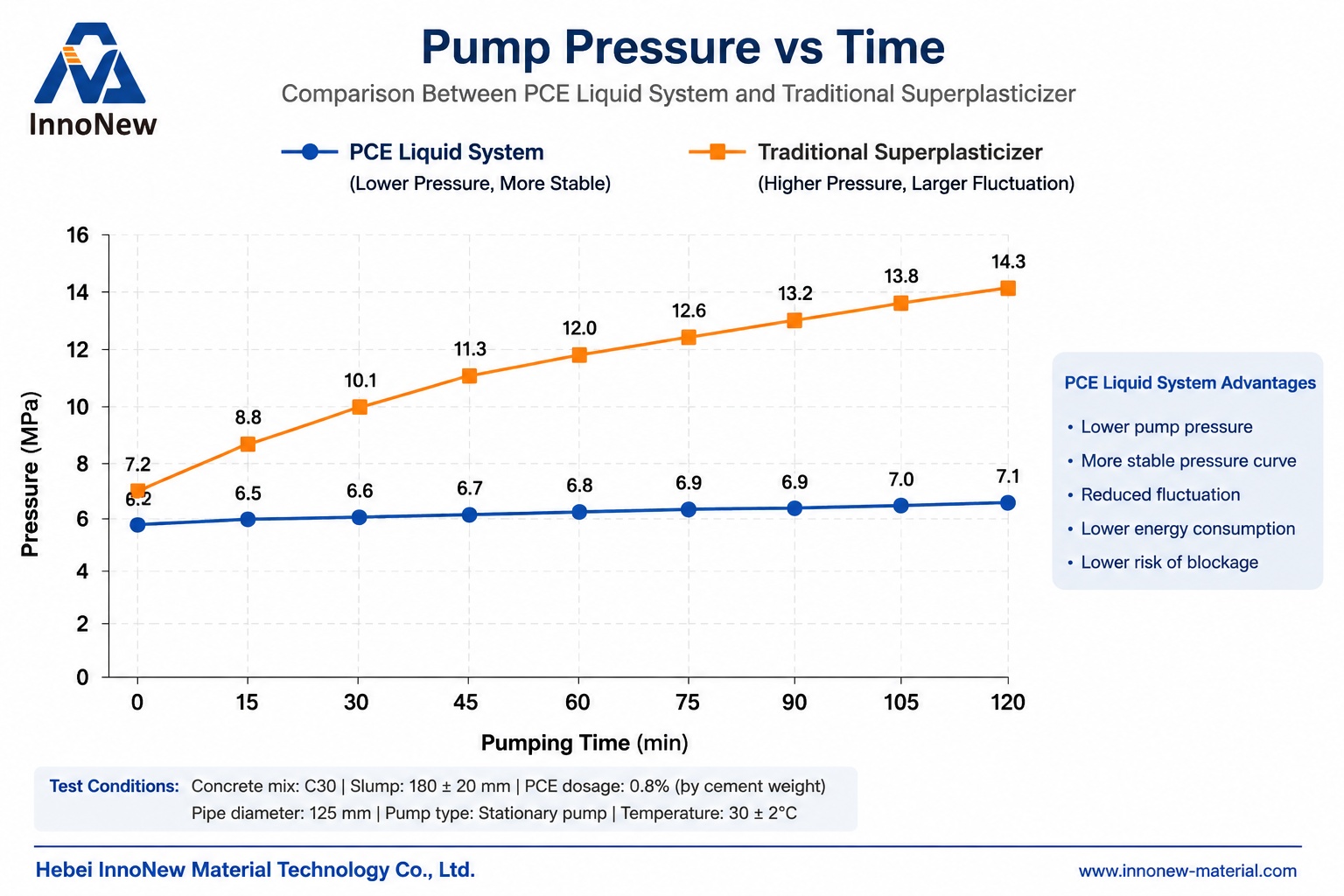
This chart demonstrates the pump pressure performance over time. The PCE liquid system shows lower pressure and greater stability, reducing pumping energy and blockage risk.
Failure Chain
Cement flocculation increases internal friction
Yield stress rises sharply
Lubrication layer at pipe wall collapses
Pump pressure increases
Flow discontinuity → blockage
Engineering Parameters
Parameter
Pumping Behavior
Yield stress
Main resistance indicator
Plastic viscosity
Flow resistance
Aggregate grading
Controls internal friction
Pump pressure
Operational safety indicator
2.3 Workability Retention Failure
Workability follows a non-linear decay curve:
Stage 1: rapid slump drop (0–30 min)
Stage 2: stabilization (30–90 min)
Stage 3: secondary stiffening (>90 min)
Main reason:
imbalance between dispersion force and hydration force
2.4 Production Variability in Ready-Mix Plants
Key instability sources:
cement source variation
aggregate moisture fluctuation
mixing energy inconsistency
admixture dosing error
This leads to batch-to-batch rheology inconsistency, often misinterpreted as “quality fluctuation”.
3. Traditional Superplasticizers vs PCE Liquid
3.1 Limitation of Conventional Systems
Traditional systems (lignosulfonates / naphthalene-based):
rely mainly on electrostatic repulsion
weak steric stabilization
fast adsorption saturation
poor slump retention
Fundamental limitation:
electrostatic repulsion collapses in high ionic strength cement pore solution
3.2 PCE Molecular Advantage
Polycarboxylate Ether (PCE) introduces a dual-mechanism system:
(1) Electrostatic repulsion
negative charge disperses cement particles
(2) Steric hindrance (key innovation)
long side chains prevent particle re-agglomeration
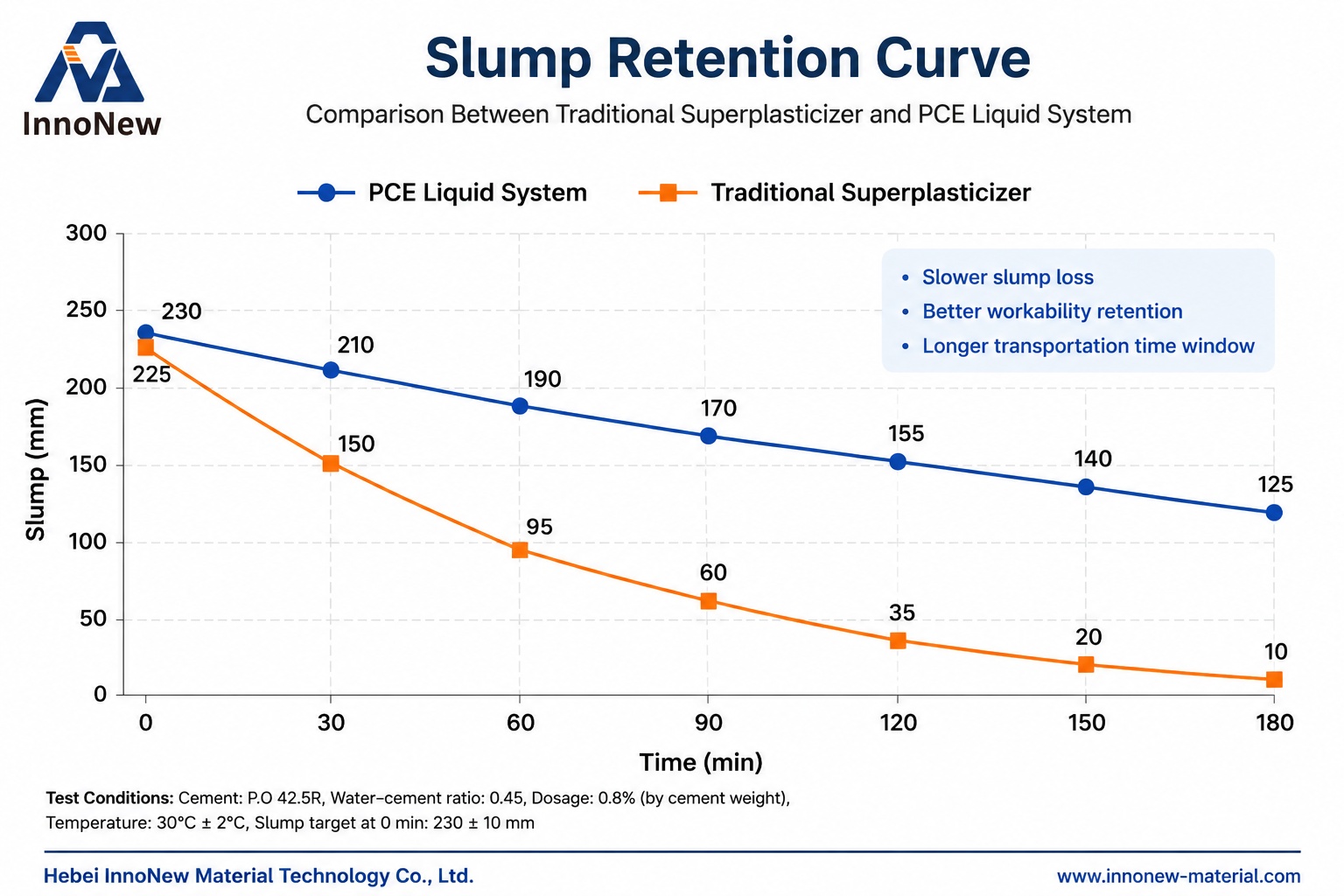
This chart illustrates the slump retention behavior of concrete over time, comparing a traditional superplasticizer with a Polycarboxylate Ether (PCE) liquid system. The PCE system demonstrates significantly improved workability retention, slower slump loss, and extended transport time stability, making it highly suitable for modern ready-mix concrete applications.
4. Mechanism-Driven Performance of PCE Liquid
4.1 Slump Retention Mechanism
delayed adsorption saturation
sustained steric barrier effect
controlled hydration interference
Result: extended workability without increasing water content
4.2 Pumpability Improvement Mechanism
PCE modifies concrete rheology:
reduces yield stress (τ₀ ↓)
reduces plastic viscosity (μ ↓)
stabilizes lubrication layer
Result: lower pump pressure + smoother flow
4.3 Water Reduction Mechanism
improved cement particle dispersion
reduced flocculation voids
optimized particle packing density
Result: 20–40% water reduction with same slump
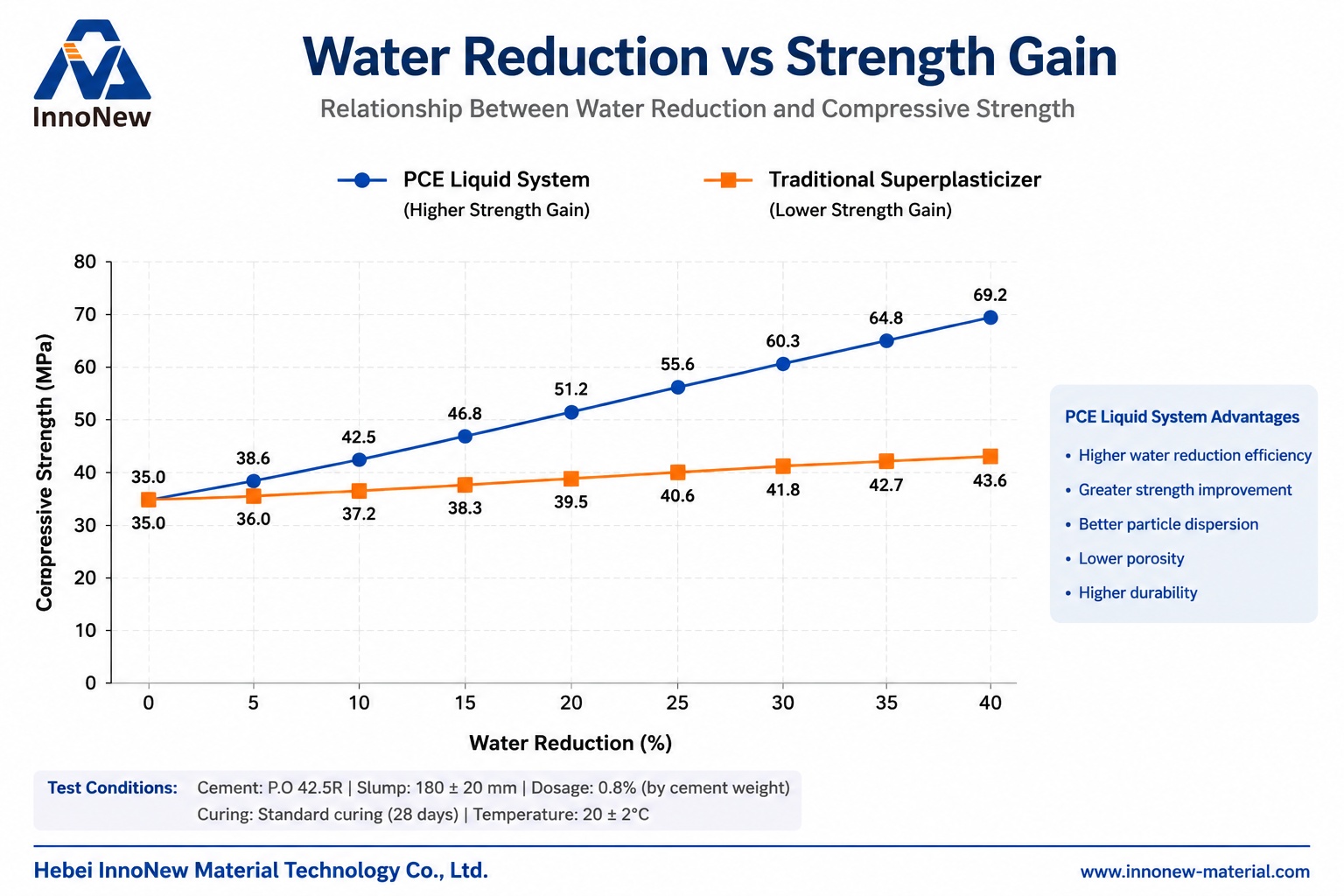
This graph illustrates the effects of liquid PCE superplasticizer and conventional superplasticizer on concrete compressive strength at different water reduction rates. The PCE system delivers markedly greater strength gains under high water reduction rates, demonstrating its dual advantages of superior water reduction and enhanced material performance.
5. Field Application Cases
Case 1: High-Rise Pumping (Middle East)
Problem: unstable pump pressure above 250m
Solution: high-retention PCE system
Result: stable pumping up to 420m, reduced blockage risk
Case 2: Hot Climate Ready-Mix Plant (Southeast Asia)
Problem: 40°C ambient temperature, rapid slump loss
Q1: Why does ready-mix concrete lose slump during transport?
Slump loss occurs due to cement hydration, particle flocculation, and progressive adsorption of superplasticizer molecules, which reduces dispersion efficiency over time.
Q2: How does PCE liquid improve pumpability?
PCE reduces yield stress and plastic viscosity while stabilizing the lubrication layer inside the pipeline, resulting in lower pumping resistance and reduced blockage risk.
Q3: Can PCE replace traditional superplasticizers?
Yes. PCE provides higher water reduction efficiency, better slump retention, and superior rheology control compared to lignosulfonate and naphthalene-based systems.
Q4: What factors affect slump retention most?
Temperature, cement fineness, water-cement ratio, and admixture compatibility are the most critical factors influencing slump retention performance.
Q5: Is PCE suitable for hot climate concrete production?
Yes. PCE systems can be engineered with retarding side chains to significantly improve performance under high-temperature conditions.
8. Conclusion
Ready-mix concrete performance is governed by a complex interaction between hydration kinetics, particle dispersion, and rheological evolution.
Traditional admixture systems are insufficient under modern pumping and transport demands.
Polycarboxylate Ether (PCE) liquid represents a molecular-level engineering solution that enables:
stable slump retention
optimized rheology
improved pumpability
higher strength efficiency
Therefore, PCE is not only a chemical additive, but a core performance control technology for modern ready-mix concrete systems.