
PVA 2488 for Powder Metallurgy
Why Binder Selection Matters in Powder Metallurgy
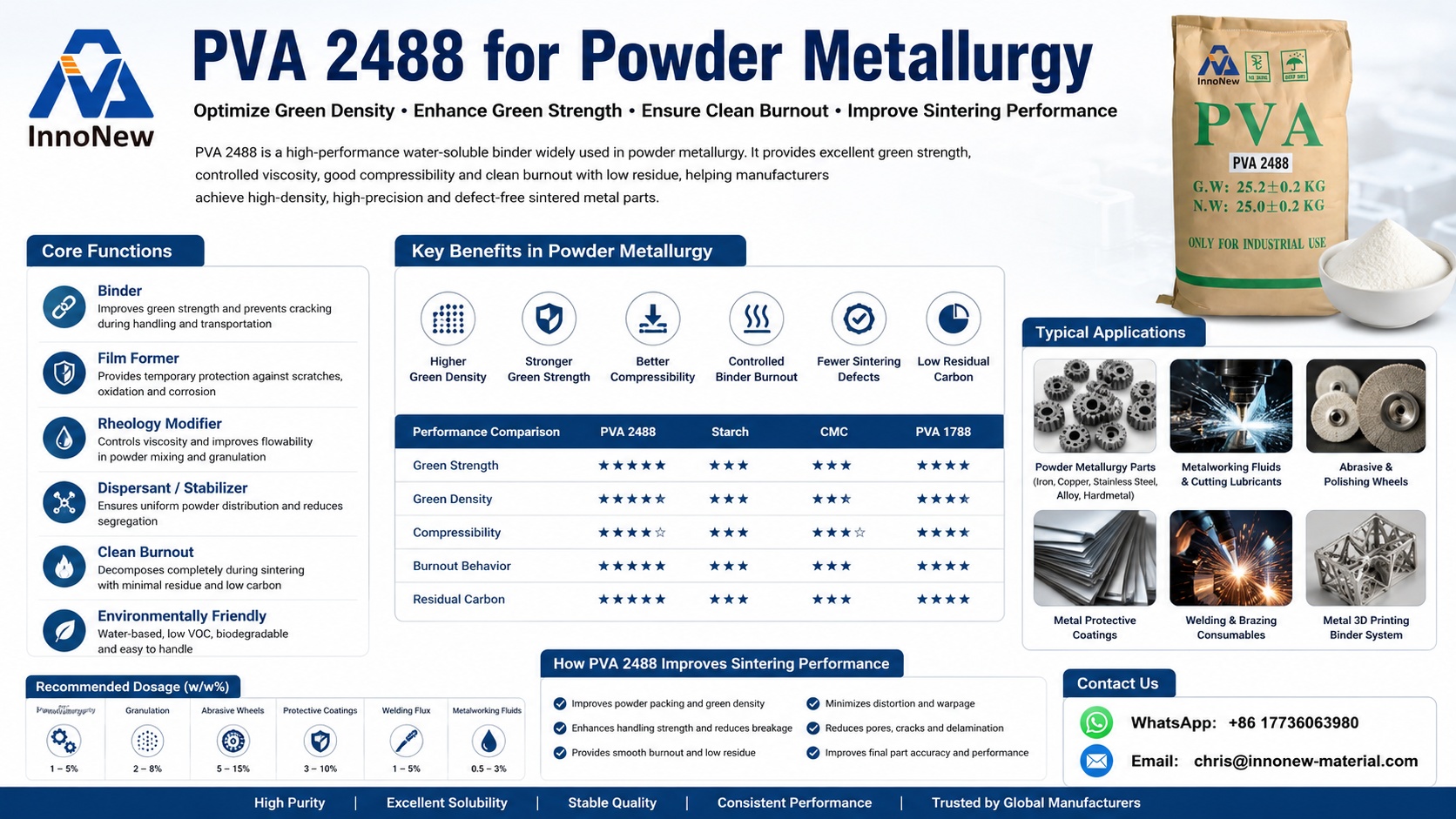
Powder metallurgy is fundamentally different from conventional casting and machining.
Instead of melting metal, manufacturers compact fine metal powders into a desired shape and subsequently sinter the compact at elevated temperatures.
The success of this process depends heavily on the behavior of the powder during:
- Mixing
- Granulation
- Compaction
- Handling
- Debinding
- Sintering
Among all additives used in powder metallurgy, the binder plays a decisive role in determining whether a compact survives the transition from loose powder to fully sintered component.
A poorly selected binder may cause:
- Low green strength
- Edge cracking
- Lamination
- Density variation
- Carbon contamination
- Distortion during sintering
For this reason, PVA 2488 has become one of the most widely used water-soluble binders in powder metallurgy production.
Its balanced combination of adhesion, film formation, thermal decomposition behavior, and process stability makes it suitable for a wide range of metal powders.
Understanding the Role of PVA 2488 in Powder Metallurgy
PVA 2488 does not become part of the final metal component.
Instead, it serves as a temporary processing aid.
During compaction, PVA forms microscopic bridges between powder particles.
These bridges provide mechanical cohesion before metallurgical bonding occurs during sintering.
At the particle level, PVA performs four critical functions:
Particle Binding
Creates temporary adhesion between neighboring particles.
Stress Distribution
Reduces local stress concentration during pressing.
Green Strength Enhancement
Improves handling strength before sintering.
Controlled Burnout
Decomposes during heating with minimal residue.
The result is improved manufacturing stability and higher production yield.
Green Density: The First Indicator of Sintering Success
What is Green Density?
Green density refers to the density of a compact immediately after pressing but before sintering.
It directly affects:
- Final density
- Mechanical strength
- Shrinkage behavior
- Dimensional accuracy
Higher and more uniform green density generally leads to better sintered properties.
How PVA 2488 Influences Green Density
Many manufacturers assume binders only improve strength.
In reality, binder selection also affects powder packing efficiency.
When properly dosed, PVA 2488:
- Promotes uniform powder distribution
- Reduces segregation
- Improves die filling consistency
- Enhances particle rearrangement during pressing
Typical improvements include:
| Parameter | Without Binder | With PVA 2488 |
|---|---|---|
| Density Uniformity | Moderate | High |
| Powder Flow | Average | Improved |
| Die Filling Consistency | Variable | Stable |
Recommended Dosage for Density Optimization
| Powder Type | PVA 2488 Addition |
|---|---|
| Iron Powder | 0.3–0.8% |
| Stainless Steel Powder | 0.5–1.2% |
| Copper Powder | 0.3–1.0% |
| Alloy Powder | 0.5–1.5% |
Excessive binder can reduce packing density by occupying inter-particle space.
More binder is not always better.
Green Strength: Preventing Cracks Before Sintering
Why Green Strength Matters
Green strength represents the mechanical strength of a pressed compact before sintering.
Low green strength can lead to:
- Corner breakage
- Chipping
- Edge cracking
- Handling damage
- Transport losses
These defects often occur before the component ever reaches the furnace.
How PVA 2488 Improves Green Strength
PVA 2488 possesses a relatively high molecular weight and strong film-forming capability.
During drying:
- Polymer chains interlock
- Flexible films develop between particles
- Internal cohesion increases
Compared with lower-viscosity PVA grades, PVA 2488 generally provides:
- Higher compact integrity
- Better drop resistance
- Reduced crack formation
This advantage is particularly important for:
- Thin-wall components
- Gears
- Structural PM parts
- Complex geometries
Compressibility and Powder Flow Behavior
The Balance Between Strength and Compressibility
One common misconception is that stronger binders always improve production.
In practice, excessive binder can reduce compressibility.
The goal is to achieve:
- High green strength
- High green density
- Good powder flow
simultaneously.
PVA 2488 achieves this balance due to its moderate hydrolysis degree and controlled viscosity profile.
Recommended Particle Size
For powder metallurgy applications:
| PVA Grade Form | Recommended Size |
|---|---|
| Powder Form | 120–200 Mesh |
| Fine Precision Parts | 120–160 Mesh |
| Granulation Process | 160-200 Mesh+ |
Smaller particle sizes improve:
- Mixing uniformity
- Dissolution speed
- Binder distribution
Binder Burnout: A Critical Stage Often Overlooked
Many powder metallurgy defects originate not during pressing but during binder removal.
What is Binder Burnout?
Binder burnout refers to thermal decomposition of organic additives before full sintering occurs.
Typical temperature range:
200°C–500°C
During this stage:
- Water evaporates
- Organic compounds decompose
- Gas exits the compact
Improper burnout can generate internal pressure.
Typical Defects Caused by Poor Burnout
Blistering
Gas trapped inside compact.
Cracking
Rapid decomposition creates internal stress.
Delamination
Layer separation during heating.
Distortion
Uneven shrinkage throughout component.
Why PVA 2488 Performs Well
Compared with many synthetic binders, PVA 2488 offers:
- Predictable thermal decomposition
- Uniform weight loss profile
- Low ash content
- Minimal smoke generation
This makes furnace control easier and improves product consistency.
Residual Carbon Control
Why Residual Carbon Matters
Residual carbon is one of the most important quality indicators in powder metallurgy.
Excess carbon can affect:
- Hardness
- Corrosion resistance
- Microstructure
- Magnetic properties
For stainless steel components, uncontrolled carbon contamination may significantly reduce corrosion resistance.
PVA 2488 and Carbon Residue
Because PVA contains:
- Carbon
- Hydrogen
- Oxygen
and no metallic contaminants, it decomposes primarily into:
- CO₂
- Water vapor
When proper burnout conditions are maintained, residual carbon levels remain extremely low.
Best practices include:
- Controlled heating rate
- Adequate furnace ventilation
- Sufficient holding time during debinding
Sintering Defects Related to Binder Selection
Many manufacturers attribute sintering defects to furnace conditions alone.
However, binder behavior often plays an equally important role.
Common Defects
Cracking
Usually caused by rapid gas evolution.
Warpage
Often linked to uneven binder distribution.
Density Gradient
Caused by poor powder flow and inconsistent compaction.
Surface Pores
May result from incomplete burnout.
How PVA 2488 Reduces Defects
PVA 2488 contributes to:
- Uniform powder coating
- Consistent compaction
- Controlled decomposition
- Stable shrinkage behavior
These factors collectively reduce rejection rates and improve dimensional accuracy.
Practical Formulation Example
Iron Powder Structural Parts
Typical formulation:
| Raw Material | Dosage |
|---|---|
| Iron Powder | 100 Parts |
| PVA 2488 | 0.5–1.0 Parts |
| Zinc Stearate | 0.4–0.8 Parts |
| Water | 2–4 Parts |
Expected outcomes:
- Improved green strength
- Better die filling
- Reduced chipping
- Stable sintering performance
Why PVA 2488 Is Preferred Over Conventional Binders
For precision powder metallurgy applications, PVA 2488 provides a more balanced combination of processing reliability and final part quality.
Conclusion
In powder metallurgy, binder selection influences much more than particle adhesion.
It affects:
- Green density
- Green strength
- Compressibility
- Binder burnout behavior
- Residual carbon levels
- Final sintering quality
PVA 2488 has become a preferred solution because it delivers a rare balance of strong temporary bonding, excellent water solubility, controlled thermal decomposition, and low-residue burnout characteristics.
For manufacturers producing iron, stainless steel, copper, alloy, and specialty powder metal components, PVA 2488 offers a reliable route toward higher yields, fewer defects, and more consistent sintered performance.
FAQ
What is the recommended dosage of PVA 2488 in powder metallurgy?
Most applications use 0.3–1.5% based on metal powder weight, depending on particle size, geometry, and required green strength.
What mesh size of PVA 2488 is best for PM applications?
Typically 120–200 mesh. Fine powders around 150–200 mesh provide the most uniform distribution.
Does PVA 2488 affect green density?
Yes. Proper dosage improves powder distribution and compaction consistency, contributing to more uniform green density.
Can PVA 2488 cause carbon contamination?
Under proper debinding and sintering conditions, residual carbon is typically very low due to the clean burnout characteristics of PVA.
Why is PVA 2488 preferred over starch binders?
PVA 2488 offers higher green strength, more predictable burnout behavior, lower residue, and better dimensional stability.
Is PVA 2488 suitable for stainless steel powder metallurgy?
Yes. It is commonly used in stainless steel powder systems where low residue and consistent green strength are critical.