
HPMC for Construction Dry-Mix Mortar Systems
Introduction
HPMC (Hydroxypropyl Methyl Cellulose) is a non-ionic cellulose ether widely used in cement-based and gypsum-based dry-mix mortar systems. It functions as a functional polymer additive that improves water retention, workability, and application stability.
Unlike binders or cementitious materials, HPMC does not participate in hydration reactions. Instead, it acts as a physical modifier controlling water transport and rheological behavior in construction systems.
Functional Mechanism of HPMC
1. Water Retention Mechanism
HPMC forms a hydrophilic polymer network that reduces capillary water loss during cement hydration. This ensures sufficient water availability for complete hydration, improving final mechanical strength.
2. Rheology Modification
HPMC increases viscosity and improves thixotropic behavior in fresh mortar systems. This prevents sagging in vertical applications such as tile adhesive and wall plaster.
3. Film Formation Effect
During drying, HPMC forms a flexible polymer film that enhances adhesion between cementitious materials and substrates, improving bonding strength and crack resistance.
Application Systems
✔ Tile Adhesive System
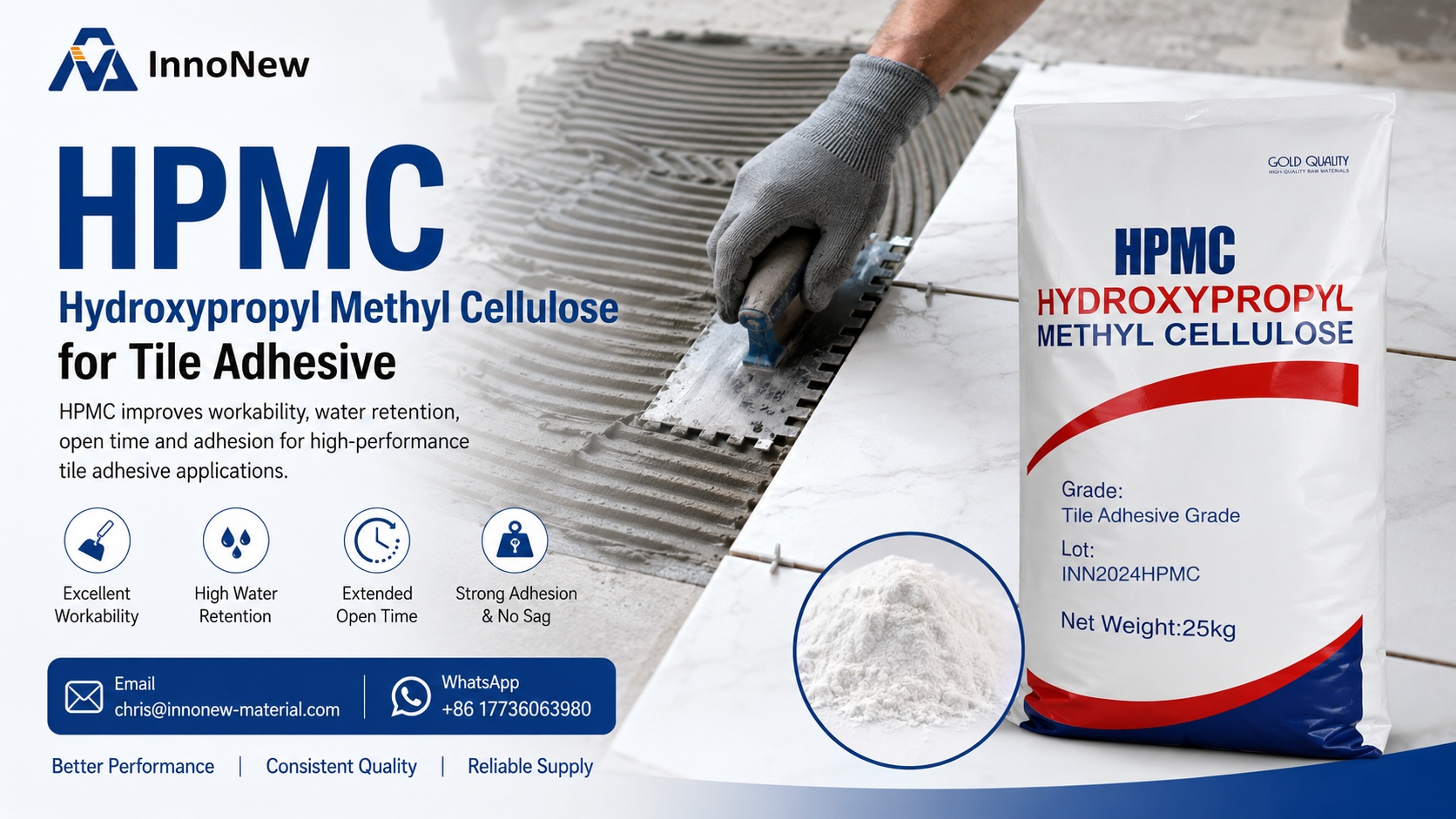
HPMC improves open time, anti-slip performance, and workability in cement-based tile adhesives. It ensures stable application on vertical surfaces.
✔ Dry Mix Mortar System
In dry mix mortar, HPMC stabilizes hydration kinetics and improves consistency during application, especially in machine-applied mortars.
✔ Gypsum Plaster System
HPMC controls water migration in gypsum systems, improving surface smoothness and leveling performance.
✔ Self-Leveling Mortar System
HPMC adjusts viscosity to balance flowability and segregation resistance, ensuring uniform surface leveling.
Regional Performance Adaptation
Southeast Asia (Vietnam, Thailand, Indonesia, Myanmar, Philippines, Malaysia)
High temperature and humidity conditions require stronger water retention and extended open time performance.
Middle East (UAE, Saudi Arabia, Jordan)
Extreme heat increases evaporation rate, requiring enhanced water retention and anti-drying performance.
Europe (EN Standards)
HPMC grades are selected according to EN C1/C2 tile adhesive classification systems with strict performance control.
Typical Dosage Range
- Tile Adhesive: 0.2% – 0.5%
- Wall Putty: 0.3% – 0.6%
- Gypsum Plaster: 0.2% – 0.4%
- Self-Leveling Mortar: 0.1% – 0.3%
Dosage depends on viscosity grade, substitution level, and system formulation.
Performance Inpact
HPMC directly influences:
- Water retention rate
- Open time of mortar
- Sag resistance in vertical applications
- Workability and smoothness
- Crack resistance after curing
Proper grade selection is critical for system stability.
Comparison
HPMC vs MHEC
- HPMC: better water retention and broad application in cement systems
- MHEC: better temperature stability in extreme climates
HPMC vs HEC
- HPMC: suitable for construction dry-mix systems
- HEC: mainly used in water-based coatings and paints
Common Application Problems & Solutions
Problem: Tile adhesive cracking
Cause: insufficient water retention
Solution: increase HPMC dosage or select higher viscosity grade
Problem: Poor open time
Cause: rapid water evaporation in hot climate
Solution: use higher substitution HPMC grade with improved retention capacity
Problem: Sagging on vertical wall
Cause: low viscosity or insufficient rheology control
Solution: increase HPMC viscosity grade
Technical Summary
HPMC is a functional cellulose ether that regulates water movement, rheology, and application behavior in cement-based systems. It does not act as a binder but as a performance modifier that ensures stable construction workability and long-term performance.
FAQ
1. What is HPMC used for in construction?
HPMC is used as a water retention and rheology modifier in tile adhesive, gypsum plaster, and dry mix mortar systems to improve workability and application performance.
2. How does HPMC improve tile adhesive performance?
It improves water retention, prevents sagging, extends open time, and enhances adhesion stability during application.
3. What is the typical dosage of HPMC in mortar?
The dosage typically ranges from 0.1% to 0.6% depending on the application system and viscosity grade.
4. What is the difference between HPMC and MHEC?
HPMC provides stronger water retention, while MHEC offers better temperature stability in extreme climates.
5. Why is HPMC important in hot climates?
In hot climates, water evaporates quickly. HPMC slows down water loss, ensuring proper cement hydration and improving construction performance.