
C1 Tile Adhesive Formula (EN Standard System): Composition, Performance Mechanism & Optimization Guide
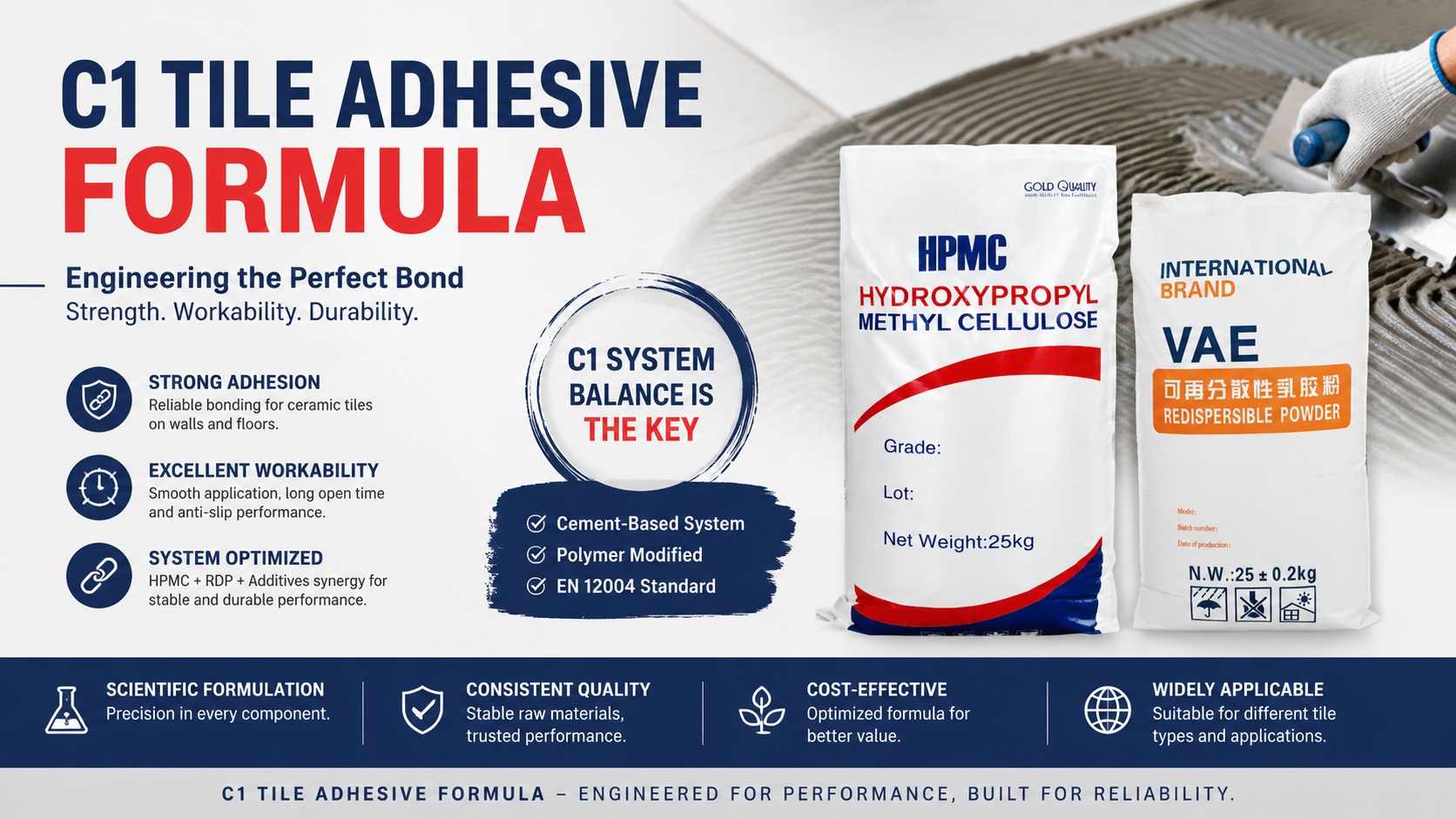
1. Introduction: What Makes C1 Tile Adhesive a “System” Material?
C1 tile adhesive is not simply a cement mixture—it is a controlled hydration and polymer-modified bonding system defined under EN 12004.
Unlike traditional mortar, its performance depends on:
- Cement hydration kinetics
- Polymer film formation
- Water retention control
- Rheology stability under shear
In modern dry-mix engineering, C1 adhesive is considered a low-to-medium polymer modified system (PMS).
2. C1 Tile Adhesive Formula (System-Level Composition)
Base Formula Structure (Engineering Range)
- Cement (42.5R / 52.5R): 30–40%
- Quartz Sand (graded): 55–65%
- HPMC (Hydroxypropyl Methylcellulose): 0.2–0.4%
- RDP (Redispersible Polymer Powder): 1.5–3.5%
- Calcium Formate: 0.3–0.8%
- Starch Ether: 0.1–0.3%
- Defoamer: 0.1–0.2%
3. System Engineering Logic (Why C1 Works)
C1 tile adhesive performance is determined by three coupled mechanisms:
3.1 Hydraulic Strength System (Cement Phase)
- Generates rigid crystalline structure (C-S-H gel)
- Defines compressive strength baseline
3.2 Polymer Bridging System (RDP Phase)
- Forms flexible polymer film after hydration
- Improves adhesion on low-absorption tiles
- Reduces interface micro-cracking
3.3 Water Retention & Rheology System (HPMC Phase)
- Controls hydration speed
- Stabilizes open time window
- Ensures uniform cement reaction
Without balance between these systems, failure occurs even if raw materials are correct.
4. Functional Role of Key Additives
4.1 HPMC: Water Retention & Hydration Control Layer
HPMC (Hydroxypropyl Methylcellulose)
- Forms colloidal protective film around cement particles
- Prevents capillary water loss
- Ensures full hydration of cement grains
- Directly affects open time + sag resistance
Low dosage variation = large performance fluctuation
4.2 RDP: Polymer Reinforcement & Adhesion Network
RDP (Redispersible Polymer Powder)
- Re-disperses into latex particles during mixing
- Forms continuous polymer film after curing
- Bridges inorganic cement matrix and tile surface
- Enhances deformation resistance under stress
RDP is the adhesion backbone of C1 system
5. Failure Mechanism Analysis (Why C1 Systems Fail)
5.1 Tile Debonding
Cause:
- Insufficient RDP film formation
Solution: - Increase polymer quality or dosage optimization
5.2 Rapid Water Loss (Drying Shrinkage)
Cause:
- Low HPMC efficiency or wrong viscosity grade
Solution: - Upgrade HPMC molecular weight or substitution level
5.3 Hollow Sound / Poor Coverage
Cause:
- Poor rheology + entrapped air
Solution: - Adjust defoamer + sand grading
5.4 Sagging on Vertical Application
Cause:
- Weak anti-slip structure
Solution: - Add starch ether synergy system
6. Performance Parameters of C1 System
- Open time: 20–30 min
- Slip resistance: ≤ 0.5 mm
- Adhesion strength: ≥ 0.5 MPa
- Water retention: ≥ 90%
- Workability: stable, smooth troweling
7. System Comparison: C1 vs C2 Engineering Logic
| Parameter | C1 System | C2 System |
|---|---|---|
| Polymer content | Low–medium | High |
| Flexibility | Standard | High |
| Tile type | Ceramic tiles | Porcelain / large format tiles |
| System cost | Optimized | Premium |
| Failure tolerance | Medium | High |
8. Optimization Strategy
C1 formulation is not “fixed recipe engineering” but environment-dependent system tuning:
- Hot climate → increase HPMC water retention efficiency
- High humidity → adjust RDP film formation speed
- Low-cost market → optimize sand grading instead of reducing polymer
- High bonding demand → increase RDP rather than cement
FAQ
Q1: What is the main difference between C1 tile adhesive and traditional cement mortar?
C1 tile adhesive uses a polymer-modified system (HPMC + RDP), while traditional mortar relies only on cement hydration. This makes C1 more stable, controllable, and suitable for modern tile installation systems.
Q2: Why is HPMC critical in C1 tile adhesive formulation?
HPMC controls water retention and hydration time. Without it, cement reacts too fast, leading to poor bonding and reduced open time. It is essential for workability and application stability.
Q3: What role does RDP play in C1 tile adhesive?
RDP forms a polymer film after curing, significantly improving adhesion strength and flexibility. It also reduces cracking and improves long-term durability of the tile bonding layer.
Q4: Can C1 tile adhesive be used for large porcelain tiles?
Generally no. C1 is designed for standard ceramic tiles. Large porcelain tiles require C2-grade adhesive with higher polymer content and stronger bonding capacity.
Q5: What happens if RDP dosage is too low?
Low RDP leads to weak adhesion, poor flexibility, and higher risk of tile debonding, especially under thermal or moisture stress.
Q6: Why does tile adhesive sometimes slip on vertical walls?
This is usually due to insufficient anti-sagging structure. Adjusting starch ether and rheology system can significantly improve vertical stability.
Q7: How does climate affect C1 tile adhesive performance?
Hot climates accelerate water loss, requiring higher HPMC efficiency. Humid climates affect curing balance, requiring optimized polymer film formation.
Q8: Is C1 tile adhesive a fixed formula worldwide?
No. C1 is a performance standard, not a fixed recipe. Each region requires adjustment based on sand type, cement quality, climate, and application method.
Conclusion
C1 tile adhesive is a balanced cement-polymer composite system where performance depends on synergy rather than raw material quantity.
The core engineering principle is:
“Hydration control (HPMC) + polymer bonding (RDP) + mineral structure (cement & sand) = stable tile adhesion system”