
Advanced Technical Review: Defoamer Mechanism in Dry Mix Mortar Systems (From Foam Formation Physics to Application-Level Performance Control)
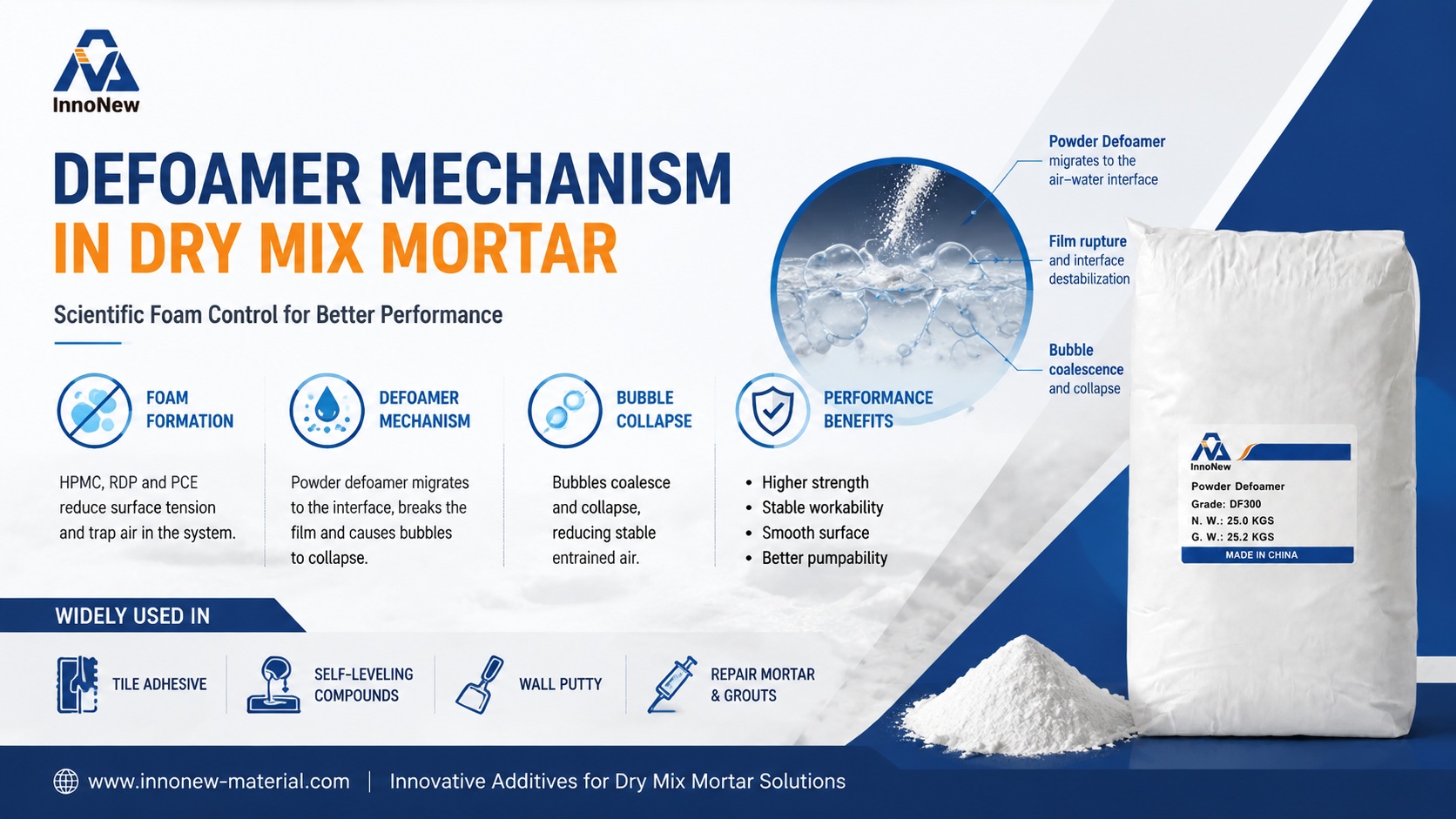
In modern dry mix mortar engineering, foam is no longer treated as a simple “air defect.” It is a multi-phase, polymer-stabilized colloidal system governed by surface chemistry, rheology, and mixing energy.
When formulations include high-performance additives such as Hydroxypropyl Methylcellulose (HPMC), Redispersible Polymer Powder (RDP), and Polycarboxylate Ether (PCE), the system becomes highly efficient—but also highly prone to stable micro-foam generation.
This paper analyzes foam from a mechanistic + application + failure mode perspective, and explains how modern Powder Defoamer systems control foam at multiple scales.
1. Foam in Dry Mix Mortar: A Multi-Scale Physical System
Foam in cementitious systems is not a single phenomenon. It exists across three scales:
1.1 Macro foam (visible bubbles > 1 mm)
- Entrapped during mixing
- Typically unstable
- Causes visible voids and surface blistering
1.2 Micro foam (50–1000 μm)
- Stabilized by polymer chains (HPMC, RDP)
- Invisible during mixing
- Major contributor to strength loss
1.3 Sub-micro entrained air (<50 μm)
- Generated by PCE dispersion effects
- Most dangerous for self-leveling and high-strength systems
- Cannot escape naturally due to viscosity barrier
Key insight:
The most harmful air is not visible foam—it is polymer-stabilized micro-air.
2. Foam Formation Mechanism: Thermodynamics + Polymer Rheology Coupling
2.1 Surface tension reduction (PCE-driven mechanism)
Polycarboxylate Ether (PCE) adsorbs onto cement particles and:
- Reduces interfacial tension (γ ↓)
- Promotes air bubble nucleation
- Stabilizes fine dispersion
Result: “invisible foam nucleation field”
2.2 Viscous stabilization (HPMC network effect)
Hydroxypropyl Methylcellulose (HPMC) creates:
- 3D polymer hydration network
- Increased yield stress
- Reduced bubble rise velocity
Foam stability condition:
If buoyancy force < yield stress → bubble is trapped
2.3 Film elasticity (RDP polymer shell formation)
Redispersible Polymer Powder (RDP) forms:
- Elastic polymer membranes around bubbles
- High resistance to rupture
- Increased foam half-life
2.4 Combined system effect
When HPMC + RDP + PCE coexist:
- Foam generation ↑↑
- Foam stability ↑↑↑
- Foam collapse probability ↓↓↓
This is why modern mortars are “high-performance but foam-sensitive systems.”
3. Why Traditional Defoaming Fails in Modern Systems
Older defoamers were designed for:
- Low-viscosity cement slurries
- Simple surfactant systems
But modern dry mix mortars are:
- High viscosity (HPMC network)
- High elasticity (RDP film)
- Low surface tension (PCE dispersant)
Failure modes of traditional defoamers:
3.1 Incompatibility with polymer network
- Cannot penetrate HPMC gel structure
- Trapped outside foam interface
3.2 Slow interfacial migration
- Foam stabilizes faster than defoamer response time
3.3 Phase separation in dry blending
- Non-uniform distribution
- Local over/under dosing
4. Powder Defoamer Mechanism: Multi-Level Foam Destruction System
Modern Powder Defoamer is not a single chemical—it is a multi-phase functional system.
4.1 Stage 1: Dry-state dispersion (pre-hydration control)
During dry mixing:
- Powder defoamer distributes uniformly with cement/fillers
- Hydrophobic particles remain dormant but dispersed
Key advantage: no phase separation risk
4.2 Stage 2: Early hydration interface activation (0–5 minutes)
Once water is added:
- Defoamer particles migrate rapidly to air–water interfaces
- Driven by surface energy minimization (ΔG < 0)
Mechanism:
hydrophobic particles → interface adsorption → local film destabilization
4.3 Stage 3: Foam film rupture kinetics
Foam stability depends on three forces:
- Surface tension (γ)
- Disjoining pressure (Π)
- Elastic modulus (E)
Powder defoamer disrupts all three:
(1) Surface tension imbalance
Creates localized γ gradient → film thinning
(2) Disjoining pressure collapse
Breaks stabilizing surfactant layer
(3) Elastic rupture of polymer film
Penetrates RDP/HPMC interface structure
4.4 Stage 4: Coalescence & collapse
Once film is weakened:
- Micro bubbles merge → macro bubbles
- Gravity + shear → bubble rupture
- Air exits system or becomes non-stable void
5. Application-Level Engineering: Where Foam Control Matters Most
5.1 Tile Adhesives (C1/C2 systems)
Problem:
- Pumping introduces shear foam
- HPMC stabilizes air
- PCE creates micro-bubbles
Failure consequences:
- Hollow tiles
- Reduced bond strength
- Open time inconsistency
Defoamer role:
- Controls micro-foam during troweling
- Ensures full adhesive contact area
5.2 Self-Leveling Compounds (SLC)
Critical requirement:
- Zero surface defects
Foam risk:
- Micro foam rises during flow leveling stage
Failure mode:
- Pinholes
- Surface craters
- Uneven reflectivity
Defoamer role:
- Eliminates sub-50 μm bubbles before gel point
- Stabilizes flow phase
5.3 Wall Putty Systems
Problem:
- High HPMC dosage → strong foam stability
Defects:
- Sand pinholes
- Poor sanding performance
Defoamer function:
- Controls foam without destroying workability
5.4 Repair Mortars
Requirement:
- High strength + low void ratio
Risk:
- Pumping-induced foam accumulation
Defoamer role:
- Maintains density consistency across batches
6. Advanced Design Principles of High-End Powder Defoamer
6.1 Multi-interface activity
Must act on:
- air–water interface
- polymer–water interface
- cement–water interface
6.2 Controlled compatibility balance
A high-performance system must NOT:
- Break HPMC viscosity network
- Reduce RDP film formation
- Destabilize PCE dispersion
Instead: It selectively targets foam interface only
6.3 Time-window activation
Ideal defoamer curve:
- Fast action: 0–10 min (foam prevention phase)
- Stable suppression: 10–120 min (workability phase)
- No rebound foam later stage
7. Industrial Insight: Why Foam Control Defines Mortar Quality
In real production environments:
Two mortars with identical formulation can perform completely differently due to:
- Mixing energy differences
- Raw material variability
- Foam distribution inconsistency
Foam is the hidden variable behind:
- strength scatter
- pump blockage
- surface defects
- customer complaints
8. Conclusion: Foam is a System Property, Not a Defect
Modern dry mix mortar systems should be understood as:
“Polymer-stabilized, air-sensitive colloidal rheology systems”
Within this framework:
- HPMC builds structure
- RDP builds elasticity
- PCE builds dispersion
- Air builds instability
And only Powder Defoamer acts as the interface stability regulator
A properly designed defoamer system ensures:
- controlled air content
- stable rheology
- consistent strength
- defect-free surface finishing
FAQ:
Q1: Why does dry mix mortar generate foam?
Foam mainly comes from mixing air and additives like Hydroxypropyl Methylcellulose (HPMC) and Polycarboxylate Ether (PCE), which reduce surface tension and trap air in the system.
Q2: What is the main problem caused by foam?
Excess foam leads to:
- lower strength
- unstable density
- surface defects (pinholes, blistering)
- poor pumpability
Q3: How does Powder Defoamer work?
Powder Defoamer moves to the air bubble surface, breaks the liquid film, and makes bubbles merge and collapse, reducing stable foam in the system.
Q4: Why use powder defoamer instead of liquid type?
Powder defoamer is better for dry mix systems because:
- it mixes evenly in dry state
- no phase separation
- better storage stability
- more consistent performance
Q5: Will defoamer affect workability?
A properly designed system will not significantly affect workability. It only targets foam, not the thickening or water retention system.
Q6: Can foam come back after defoaming?
Yes, in some cases during pumping or mixing. That is why good defoamers are designed for long-lasting foam control, not just initial defoaming.
Q7: Where is foam control most important?
It is critical in:
- tile adhesive
- self-leveling compounds
- wall putty
- repair mortars
These products require stable density and smooth surface quality.
Q8: What is the key benefit of using Powder Defoamer?
It improves:
- strength consistency
- surface finish quality
- pumping stability
- overall product reliability
About Advanced Material Solution Provider
Hebei InnoNew Material Technology Co., Ltd. focuses on high-performance construction chemical systems including powder defoamers, cellulose ethers, and polymer modifiers for dry mix mortar engineering.
Official website: Hebei InnoNew Material Technology Co., Ltd.