
Why Free-Chloride Polycarboxylate Ether (PCE) Is Essential for High-Performance PHC and PC Spun Pile Manufacturing
Introduction
The global foundation industry is experiencing a significant transformation. As infrastructure projects become larger, taller, and more demanding, the requirements placed on prestressed concrete piles continue to increase.
Modern PHC (Prestressed High-Strength Concrete) piles and PC spun piles are no longer designed solely for load-bearing capacity. Engineers today must also consider durability, corrosion resistance, service life, sustainability, and lifecycle costs.
To achieve these objectives, manufacturers have adopted advanced concrete technologies including low water-cement ratios, high-strength binders, steam curing systems, and high-performance Polycarboxylate Ether (PCE) superplasticizers.
However, one important factor is often overlooked:
The chloride content of the concrete admixture system.
For prestressed concrete structures, chloride control is not merely a quality preference—it is a long-term durability requirement.
The Evolution of Spun Pile Technology
Over the past several decades, spun pile manufacturing has evolved dramatically.
Conventional Reinforced Concrete Piles
Early pile systems typically achieved compressive strengths of 30–40 MPa and relied on conventional reinforcement.
Prestressed Concrete Piles
Prestressing technology enabled manufacturers to produce stronger and more efficient pile sections with strengths exceeding 60 MPa.
PHC Piles
Modern PHC piles commonly reach compressive strengths of 80–100 MPa while maintaining excellent dimensional stability and structural performance.
Next-Generation High-Strength Piles
Emerging infrastructure projects increasingly require:
- Ultra-high strength concrete
- Reduced pile diameter
- Greater load-bearing capacity
- Longer design service life
- Enhanced durability in marine environments
As concrete performance improves, the tolerance for material impurities becomes significantly lower.
This is where chloride control becomes increasingly important.
The Often-Overlooked Chloride Challenge in Prestressed Concrete
Unlike ordinary reinforced concrete, prestressed concrete contains high-strength prestressing wires or strands that remain under constant tensile stress throughout their service life.
These steel elements are particularly sensitive to corrosion initiation.
Even relatively small amounts of chloride ions can:
- Accelerate steel corrosion
- Damage prestressing wires
- Promote microcracking
- Reduce structural reliability
- Shorten service life
In severe cases, chloride-induced corrosion can compromise the integrity of the entire foundation system.
Because of these risks, international standards impose strict chloride limitations on prestressed concrete construction.
Engineering specifications from ACI, EN, and other international standards consistently emphasize the importance of minimizing chloride exposure in prestressed concrete applications.
For PHC and PC spun pile manufacturers, chloride management should therefore be considered a critical quality control parameter.
Why Free-Chloride PCE Matters
Polycarboxylate Ether has become the preferred superplasticizer technology for high-strength concrete due to its exceptional water-reducing capability.
However, not all PCE products are manufactured to the same quality standard.
High-performance spun pile production requires more than high water reduction.
The admixture system should also support:
- Chloride-free formulation
- High early strength development
- Steam curing compatibility
- Excellent particle dispersion
- Long-term durability
A free-chloride PCE is specifically engineered to minimize chloride contribution to the concrete system while maintaining superior workability and strength performance.
This combination is particularly valuable for prestressed concrete applications where both mechanical performance and durability are critical.
The Role of Free-Chloride PCE During Spun Pile Manufacturing
The benefits of free-chloride PCE extend throughout the entire production process.
1. Concrete Mixing
Efficient particle dispersion improves cement utilization and enables lower water-cement ratios.
Benefits include:
- Improved flowability
- Reduced water demand
- Better consistency
2. Centrifugal Casting
During spinning, concrete particles are subjected to high centrifugal forces.
A properly designed PCE helps create:
- Uniform particle distribution
- Improved concrete density
- Reduced segregation
- Enhanced pile quality
3. Steam Curing
PHC pile production often relies on accelerated steam curing cycles.
Free-chloride PCE systems can support:
- Faster strength development
- Improved curing efficiency
- Reduced production cycle time
4. Prestress Transfer
Higher early-age strength enables more reliable prestress transfer and demolding operations.
This contributes to:
- Increased productivity
- Reduced rejection rates
- Improved dimensional stability
5. Long-Term Service Performance
The ultimate objective is not only manufacturing efficiency but also long-term structural reliability.
Low-chloride concrete systems help minimize corrosion risks and support extended service life.
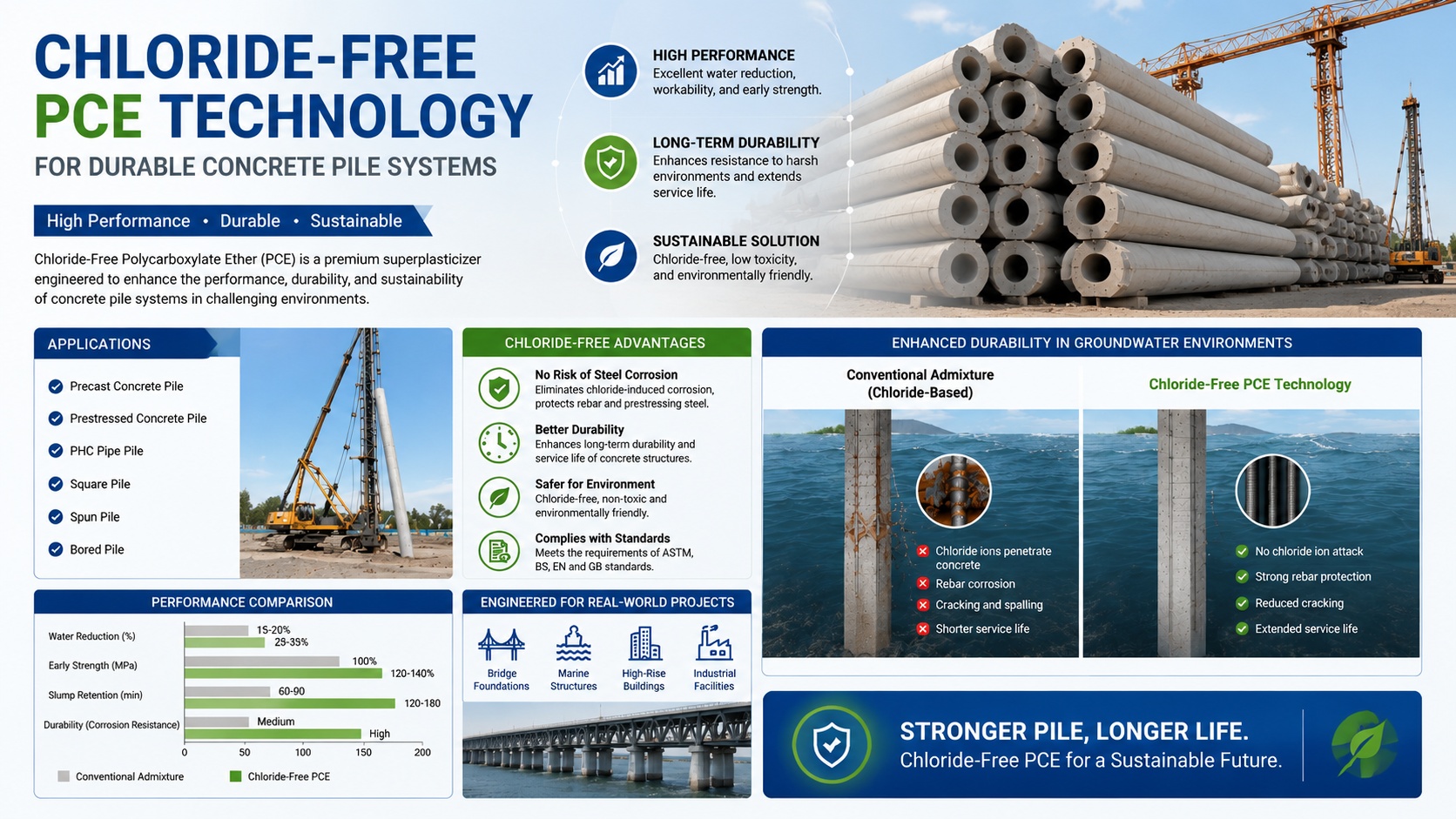
Performance Comparison
| Performance Indicator | Conventional Admixture | Free-Chloride PCE |
|---|---|---|
| Water Reduction | Moderate | High |
| Workability | Good | Excellent |
| Early Strength Development | Moderate | High |
| Steam Curing Compatibility | Good | Excellent |
| Chloride Contribution | Potential Risk | Minimal |
| Prestressing Compatibility | Moderate | Excellent |
| Long-Term Durability | Good | Excellent |
| Foundation Service Life Potential | Standard | Enhanced |
Key Selection Criteria for PHC Pile Manufacturers
When selecting a PCE supplier for prestressed spun pile production, manufacturers should evaluate more than water reduction performance.
Important considerations include:
Chloride Content
Low or free-chloride formulations help protect prestressing steel over the long term.
Water Reduction Efficiency
Higher water reduction supports lower water-cement ratios and higher compressive strength.
Early Strength Development
Critical for steam curing operations and production efficiency.
Centrifugal Casting Performance
Concrete must maintain stability during high-speed spinning.
Compatibility with Cement Systems
Different cement sources can significantly affect admixture performance.
Durability Performance
Long-term corrosion resistance remains a key consideration for foundation structures.
Future Trends in Prestressed Foundation Engineering
Several industry trends are driving demand for advanced admixture technologies:
- Larger infrastructure projects
- High-rise construction
- Marine and coastal foundations
- Port and bridge developments
- Offshore energy facilities
- Extended design service life requirements
As durability specifications become increasingly stringent, chloride-free admixture systems are expected to become a standard requirement rather than an optional upgrade.
Manufacturers that prioritize chloride control today will be better positioned to meet future engineering standards and project expectations.
FAQ:
1. What is free-chloride PCE and why is it important for spun pile production?
Free-chloride PCE is a high-performance Polycarboxylate Ether superplasticizer formulated with extremely low chloride content. It reduces water demand, improves concrete flowability, and protects prestressing steel from corrosion, ensuring long-term durability in PHC and PC spun piles.
2. How does free-chloride PCE improve centrifugal casting performance?
During spinning, concrete is subjected to high centrifugal forces. Free-chloride PCE ensures uniform particle packing, reduces segregation, maintains workability, and supports higher density and compaction of spun pile concrete.
3. Can free-chloride PCE accelerate early strength development?
Yes. Free-chloride PCE is compatible with steam curing processes commonly used in PHC pile production, enabling faster early-age strength gain, more reliable prestress transfer, and shorter production cycles.
4. Does free-chloride PCE affect long-term durability?
Absolutely. By minimizing chloride introduction, it significantly reduces corrosion risks of prestressing steel, mitigates microcracking, and enhances the overall service life of precast spun piles.
5. What are the key selection criteria when choosing PCE for spun pile production?
Manufacturers should consider:
- Chloride content (free or extremely low)
- Water reduction efficiency
- Early strength development
- Centrifugal casting compatibility
- Steam curing compatibility
- Long-term durability performance
6. Is free-chloride PCE suitable for all cement types used in PHC piles?
High-quality free-chloride PCE is generally compatible with a wide range of OPC and blended cement types, but it is recommended to perform preliminary trials to optimize dosage and performance for specific cement sources.
Conclusion
The evolution of PHC and PC spun pile technology has shifted industry focus beyond compressive strength alone. Modern foundation systems require a balanced approach that combines strength, durability, productivity, and long-term reliability.
While Polycarboxylate Ether is widely recognized for its water-reducing performance, its chloride profile is equally important in prestressed concrete applications.
By utilizing free-chloride PCE technology, spun pile manufacturers can improve concrete quality, support efficient production, protect prestressing steel, and enhance the long-term durability of critical foundation structures.
As infrastructure projects demand higher performance and longer service lives, free-chloride PCE is increasingly becoming an essential component of advanced PHC and PC spun pile manufacturing systems.