
Drymix Mortar Additives System Solution: The Complete Engineering Guide to High-Performance Mortar Formulation
Introduction
Modern drymix mortar has evolved far beyond a simple blend of cement, sand, and water. Today’s high-performance mortars are sophisticated material systems engineered through the interaction of multiple functional additives.
Whether in tile adhesives, wall putty, self-leveling compounds, repair mortars, EIFS systems, or external rendering applications, the final performance of drymix mortar depends largely on the synergy among additives rather than on any individual component.
As construction standards continue to rise worldwide, manufacturers face increasing demands for workability, adhesion, durability, crack resistance, open time, water retention, and climate adaptability. Meeting these requirements requires a systematic formulation approach.
This article presents a comprehensive engineering framework for understanding drymix mortar additive systems, including their functional roles, interaction mechanisms, formulation principles, and optimization strategies.
Understanding the Drymix Mortar Additive System
A drymix mortar additive system can be defined as:
A functional combination of specialty construction chemicals designed to control rheology, hydration, adhesion, water retention, durability, and application performance throughout the lifecycle of mortar.
Unlike traditional formulations that focus on individual ingredients, modern mortar engineering emphasizes system integration.
The most successful formulations achieve a balanced interaction among:
- Cellulose Ether (HPMC / HEMC)
- Redispersible Polymer Powder (RDP)
- Polycarboxylate Ether Superplasticizer (PCE)
- Retarders
- Accelerators
- Defoamers
- Starch Ether
- Fiber Reinforcement
- Shrinkage Control Additives
Each component contributes specific functionalities while influencing the effectiveness of other additives within the system.
Key Performance Challenges in Drymix Mortar
Before selecting additives, formulators must clearly understand the engineering problems they are solving.
1. Workability Instability
Poor workability can lead to:
- Difficult mixing
- Uneven application
- Increased labor costs
- Inconsistent job-site performance
Workability is influenced by particle packing, water demand, viscosity control, and rheological behavior.
2. Insufficient Water Retention
Water retention directly affects cement hydration.
Excessive water loss may result in:
- Reduced strength development
- Weak bonding
- Surface dusting
- Premature drying
This issue becomes particularly critical in hot and dry climates.
3. Adhesion Failure
Bond strength remains one of the most important performance indicators for tile adhesives and repair mortars.
Common causes include:
- Inadequate polymer content
- Rapid moisture loss
- Poor substrate compatibility
- Insufficient open time
4. Cracking and Shrinkage
Drying shrinkage generates internal stress within hardened mortar.
Without proper formulation control, cracks may develop due to:
- Excessive water demand
- Rapid hydration
- Weak polymer networks
- Thermal movement
5. Open Time Limitations
Modern construction projects require longer workable periods.
Maintaining sufficient open time while preserving early strength development remains a major formulation challenge.
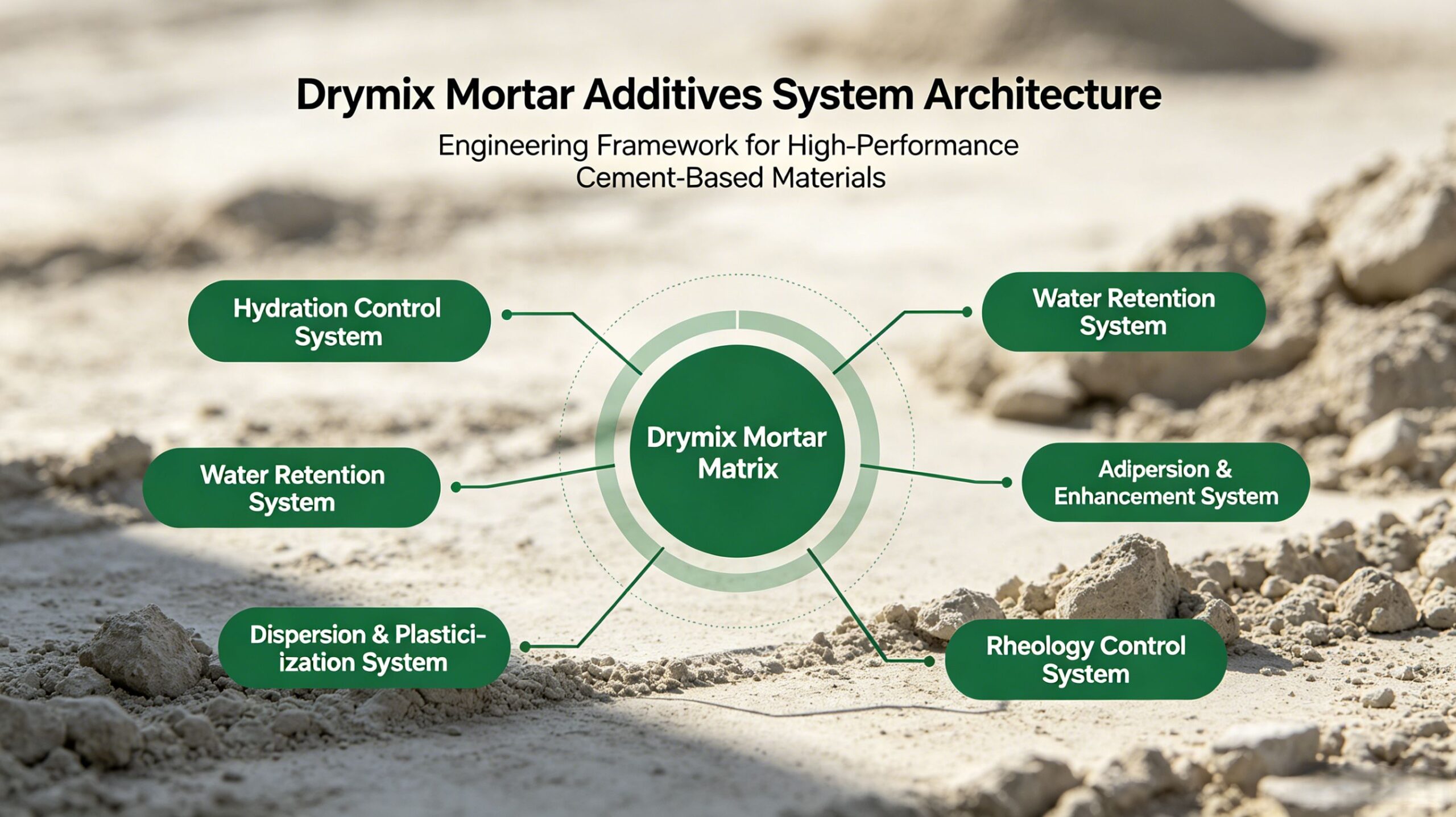
Functional Architecture of a Modern Drymix Mortar System
A high-performance mortar formulation consists of several interconnected functional modules.
Rheology Control Module
Primary Additives:
- HPMC
- HEMC
- Starch Ether
Functions:
- Viscosity adjustment
- Anti-sagging performance
- Improved troweling
- Enhanced workability
This module determines how the mortar behaves during application.
Water Retention Module
Primary Additives:
- HPMC
- HEMC
Functions:
- Moisture preservation
- Cement hydration support
- Extended working time
- Reduced water evaporation
A stable water retention system is essential for achieving consistent mechanical properties.
Adhesion Enhancement Module
Primary Additives:
Functions:
- Polymer film formation
- Increased tensile adhesion
- Improved flexibility
- Better substrate compatibility
RDP creates a polymer network that bridges microcracks and enhances interface bonding.
Dispersion and Flow Control Module
Primary Additives:
Functions:
- Particle dispersion
- Reduced water demand
- Improved flowability
- Enhanced strength development
PCE technology enables low water-to-binder ratios while maintaining excellent workability.
Hydration Management Module
Primary Additives:
Functions:
- Setting time control
- Hydration regulation
- Construction scheduling flexibility
This module becomes especially important in extreme climatic conditions.
How Additives Interact Inside Cement-Based Systems
One of the most misunderstood aspects of drymix mortar technology is additive interaction.
Many formulators incorrectly evaluate additives individually.
In reality, performance is generated through synergistic interactions.
For example:
HPMC + PCE Interaction
HPMC improves water retention and viscosity.
PCE disperses cement particles and improves flow.
Improper dosage balance may reduce effectiveness of both materials.
Proper optimization creates a mortar with excellent consistency, workability, and strength.
HPMC + RDP Interaction
HPMC retains water during hydration.
RDP forms flexible polymer films after drying.
Together they improve:
- Adhesion
- Flexibility
- Crack resistance
- Durability
RDP + Cement Interaction
Polymer particles redisperse upon water addition and subsequently form films throughout the hardened matrix.
This creates:
- Improved cohesion
- Reduced brittleness
- Enhanced long-term durability
Application-Oriented Formulation Design
Different mortar applications require different additive strategies.
Tile Adhesives
Key Targets:
- High bond strength
- Anti-slip performance
- Extended open time
- Water retention
Typical Core Additives:
- HPMC
- RDP
- PCE
Wall Putty
Key Targets:
- Smooth application
- Easy sanding
- Crack resistance
Typical Core Additives:
- HPMC
- Starch Ether
- Defoamer
Self-Leveling Mortar
Key Targets:
- High fluidity
- Rapid leveling
- Surface smoothness
Typical Core Additives:
- PCE
- Defoamer
- Retarder
External Rendering Mortar
Key Targets:
- Water retention
- Crack resistance
- Weather durability
Typical Core Additives:
- HPMC
- RDP
- Fiber Reinforcement
Climate-Specific Formulation Strategies
Environmental conditions significantly affect mortar performance.
Hot Climate Regions
Examples:
- Saudi Arabia
- UAE
- Qatar
- Oman
Challenges:
- Rapid evaporation
- Short open time
- Increased cracking risk
Recommended Strategy:
- Higher water retention
- Optimized retarders
- Enhanced polymer modification
Tropical Regions
Examples:
- Vietnam
- Indonesia
- Malaysia
- Philippines
Challenges:
- High humidity
- Variable curing conditions
Recommended Strategy:
- Balanced hydration control
- Moisture-resistant polymer systems
Cold Climate Regions
Examples:
- Northern Europe
- Canada
Challenges:
- Slow hydration
- Delayed strength gain
Recommended Strategy:
- Accelerators
- Optimized cement chemistry
- Controlled water demand
Common Formulation Mistakes
Many mortar performance issues originate from formulation errors rather than raw material quality.
The most common mistakes include:
Overdosing Cellulose Ether
Results:
- Excessive viscosity
- Poor leveling
- Reduced productivity
Insufficient Polymer Content
Results:
- Poor adhesion
- Increased brittleness
- Reduced durability
Incorrect PCE Selection
Results:
- Compatibility problems
- Segregation
- Flow instability
Ignoring Additive Synergy
Results:
- Inconsistent performance
- Higher production costs
- Reduced quality stability
Future Trends in Drymix Mortar Technology
The next generation of mortar formulations is moving toward:
Smart Formulation Design
Data-driven optimization based on performance prediction.
Sustainable Construction Materials
Reduced carbon footprint through advanced additive efficiency.
Digital Quality Control
AI-assisted formulation development and process monitoring.
High-Performance Multifunctional Mortars
Products designed to simultaneously deliver adhesion, flexibility, durability, and sustainability.
FAQ
Q1: Why use a system instead of a single additive?
Because performance in drymix mortar depends on synergy between additives, especially in humid climates.
Q2: What is the best combination for tile adhesive in Vietnam?
RDP + HPMC is essential for adhesion and water retention.
Q3: How to improve crack resistance in wall putty?
Use RDP + PVA combination for flexible film formation.
Q4: Can PCE be used in drymix mortar?
Yes, especially in self-leveling systems, to improve flow without increasing water.
Conclusion
Drymix mortar is no longer a simple building material. It is a sophisticated engineered system whose performance is determined by the interaction of multiple functional additives.
Successful formulation development requires understanding not only the role of individual additives such as HPMC, RDP, and PCE, but also the mechanisms through which these materials interact within cement-based matrices.
Manufacturers that adopt a system-oriented approach to additive selection and formulation design can achieve superior workability, adhesion, durability, and long-term performance while meeting the evolving requirements of modern construction projects worldwide.