
PP Fiber vs Steel Fiber: Understanding Their Roles in Modern Concrete Engineering
Introduction
Fiber reinforcement has become an essential component of modern concrete technology. As construction projects demand higher durability, longer service life, and improved crack resistance, engineers increasingly rely on fibers to enhance concrete performance beyond what conventional reinforcement can achieve.
Among all fiber types used in concrete, Polypropylene (PP) Fiber and Steel Fiber represent the two most widely adopted solutions. While both materials improve concrete behavior, they serve fundamentally different engineering purposes.
One of the most common misconceptions in the construction industry is that PP Fiber and Steel Fiber are direct substitutes. In reality, they address different failure mechanisms and often complement rather than replace each other.
This guide explains the engineering principles behind both materials, compares their performance characteristics, and provides practical selection criteria for various construction applications.
Understanding Fiber Reinforcement in Concrete
Concrete possesses excellent compressive strength but relatively poor tensile strength.
During its service life, concrete experiences:
- Plastic shrinkage
- Drying shrinkage
- Thermal stress
- Settlement movement
- Impact loading
- Fatigue loading
- Abrasion
- Structural deformation
Fiber reinforcement introduces millions of distributed reinforcement points throughout the concrete matrix.
Unlike conventional steel rebar, which acts at specific locations, fibers create a three-dimensional reinforcement network that helps control crack formation and crack propagation.
The effectiveness of fiber reinforcement depends largely on:
- Fiber material
- Fiber geometry
- Aspect ratio
- Dispersion quality
- Dosage rate
- Bond strength with cement paste
What Is PP Fiber?
Polypropylene Fiber is a synthetic micro-reinforcement manufactured from virgin polypropylene resin.
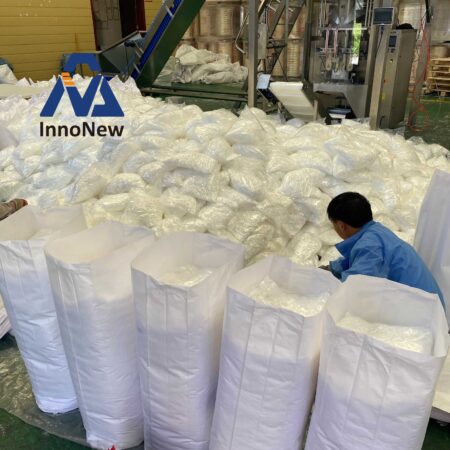
Its primary function is to control early-age cracking and improve concrete durability.
Typical characteristics include:
- Low density
- Corrosion resistance
- Chemical stability
- Excellent dispersion
- High crack-arresting capability
- Non-magnetic properties
PP fibers are generally added in small dosages and become uniformly distributed throughout the concrete matrix.
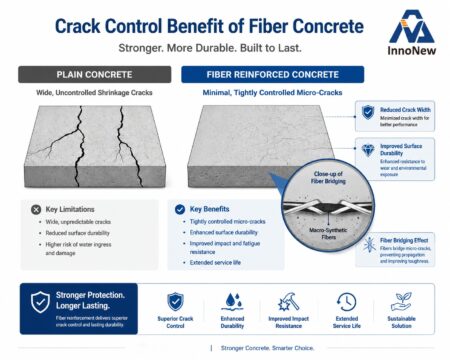
Their main engineering value lies in controlling microcracks before they develop into visible structural defects.
What Is Steel Fiber?
Steel Fiber is a discontinuous reinforcement material manufactured from carbon steel wire, sheet steel, or extracted wire products.
Steel fibers provide:
- Increased post-crack load capacity
- Enhanced toughness
- Improved impact resistance
- Better fatigue performance
- Higher flexural strength
Unlike PP fibers, steel fibers are designed to contribute directly to the mechanical performance of hardened concrete.
They are commonly used in applications where structural load transfer is critical.
The Fundamental Difference: Crack Prevention vs Load Carrying
This distinction is the most important concept for engineers.
PP Fiber Controls Crack Formation
PP fibers work primarily during the early stages of concrete curing.
They reduce:
- Plastic shrinkage cracking
- Settlement cracking
- Early microcrack formation
Their role is preventive.
They help stop cracks before they appear.
Steel Fiber Controls Crack Propagation
Steel fibers become most effective after cracking begins.
They bridge cracks and transfer stress across crack surfaces.
Their role is structural.
They help maintain load-carrying capacity after cracking occurs.
Performance Comparison
Mechanical Properties
| Property | PP Fiber | Steel Fiber |
|---|---|---|
| Density | Very Low | High |
| Tensile Strength | High | Very High |
| Elastic Modulus | Low | Very High |
| Flexural Strength Improvement | Limited | Significant |
| Impact Resistance | Moderate | Excellent |
| Toughness Improvement | Moderate | Excellent |
| Fatigue Resistance | Moderate | Excellent |
Steel fibers generally outperform PP fibers when structural toughness is the primary requirement.
Crack Control Performance
| Crack Type | PP Fiber | Steel Fiber |
|---|---|---|
| Plastic Shrinkage Cracks | Excellent | Limited |
| Settlement Cracks | Excellent | Limited |
| Drying Shrinkage Cracks | Good | Moderate |
| Thermal Cracks | Good | Good |
| Structural Cracks | Limited | Excellent |
For early-age crack prevention, PP fiber is usually the more effective solution.
Durability Performance
| Durability Factor | PP Fiber | Steel Fiber |
|---|---|---|
| Corrosion Resistance | Excellent | Potential Risk |
| Chemical Resistance | Excellent | Moderate |
| Chloride Exposure | Excellent | Moderate |
| Marine Environment | Excellent | Requires Protection |
| Freeze-Thaw Resistance | Good | Good |
In aggressive environments, PP fiber offers significant durability advantages because it does not corrode.
Application-Based Selection Guide
Industrial Floors
Typical Requirements:
- Impact resistance
- Heavy loading
- Forklift traffic
- Abrasion resistance
Recommended Solution:
Steel Fiber
Steel fibers improve load distribution and reduce slab thickness requirements in many industrial flooring systems.
Residential Slabs
Typical Requirements:
- Shrinkage control
- Surface quality
- Cost efficiency
Recommended Solution:
PP Fiber
PP fibers effectively reduce early-age cracking while maintaining economical project costs.
Concrete Pavements
Typical Requirements:
- Fatigue resistance
- Crack control
- Long-term durability
Recommended Solution:
PP Fiber + Steel Fiber Hybrid System
Many modern pavement designs combine both materials to achieve balanced performance.
Tunnel Shotcrete
Typical Requirements:
- Energy absorption
- Impact resistance
- Structural support
Recommended Solution:
Steel Fiber
Steel Fiber Reinforced Shotcrete has become a standard solution in many underground construction projects.
Precast Concrete
Typical Requirements:
- Surface integrity
- Dimensional stability
- Crack prevention
Recommended Solution: PP Fiber
Microfibers help minimize shrinkage-related defects during manufacturing and curing.
Can PP Fiber Replace Steel Fiber?
The answer depends on project requirements.
PP Fiber can replace steel fiber when the objective is:
- Plastic shrinkage control
- Surface crack reduction
- Durability enhancement
- Fire spalling resistance
- Lightweight reinforcement
However, PP Fiber generally cannot replace steel fiber where:
- Structural load transfer is required
- Flexural toughness is critical
- Impact resistance is a primary design criterion
- Post-crack residual strength must be maintained
In these situations, steel fiber remains the preferred engineering solution.
Why Many Modern Projects Use Hybrid Fiber Systems
An increasing number of infrastructure projects utilize hybrid reinforcement strategies.
The concept is straightforward:
PP Fiber Handles Microcracks
- Early-age protection
- Shrinkage control
- Durability enhancement
Steel Fiber Handles Macrocracks
- Structural performance
- Load transfer
- Toughness improvement
The combination creates a multi-scale reinforcement system that improves overall concrete performance throughout its service life.
Sustainability Considerations
Sustainability has become an important factor in material selection.
PP Fiber advantages include:
- Lower transportation weight
- Reduced embodied energy
- Corrosion-free service life
- Simplified handling
Steel Fiber advantages include:
- Recyclability
- Structural efficiency
- Potential reduction of conventional reinforcement
The optimal choice should consider both environmental and engineering requirements.
Engineering Selection Checklist
Before selecting fiber reinforcement, engineers should evaluate:
✓ What type of cracking must be controlled?
✓ Is structural toughness required?
✓ Will the concrete face aggressive environmental exposure?
✓ Are corrosion risks present?
✓ What is the target service life?
✓ Is the project focused on durability, strength, or both?
✓ Would a hybrid fiber system provide better performance?
Answering these questions often leads to a more effective fiber strategy than simply choosing the lowest-cost material.
FAQ – PP Fiber vs Steel Fiber in Concrete
Q1: What is the primary difference between PP Fiber and Steel Fiber in concrete?
A: PP Fiber primarily controls early-age and microcracks caused by plastic shrinkage and settlement, while Steel Fiber provides structural toughness, impact resistance, and post-crack load-bearing capacity. They serve complementary roles rather than interchangeable functions.
Q2: Can PP Fiber replace Steel Fiber in structural applications?
A: No. PP Fiber is effective for crack prevention and durability enhancement but cannot provide significant structural load transfer or impact resistance. Steel Fiber remains necessary where post-crack performance and flexural toughness are critical.
Q3: What are the recommended applications for PP Fiber and Steel Fiber?
A:
- PP Fiber: Residential slabs, precast concrete, pavements, shrinkage-sensitive applications.
- Steel Fiber: Industrial floors, tunnel shotcrete, heavy-duty pavements, impact or fatigue-prone structures.
- Hybrid Systems: Combination of PP Fiber + Steel Fiber is often used for optimal durability and toughness.
Q4: How does fiber dosage affect concrete performance?
A: Correct dosage ensures uniform micro-reinforcement for PP Fiber or adequate crack bridging for Steel Fiber. Overdosing can cause mixing and workability issues, while underdosing may reduce effectiveness. Engineers should follow application-specific dosage guidelines.
Q5: What are the durability advantages of PP Fiber over Steel Fiber?
A: PP Fiber is corrosion-resistant, chemically stable, and provides excellent performance in aggressive environments such as marine or high-chloride conditions, whereas Steel Fiber may require additional protection against corrosion to maintain long-term durability.
Conclusion
Polypropylene Fiber and Steel Fiber are not competing technologies; they are engineering tools designed to solve different concrete performance challenges.
PP Fiber excels at controlling early-age cracking, improving durability, and protecting concrete from shrinkage-related damage.
Steel Fiber excels at enhancing toughness, impact resistance, load transfer, and post-crack structural performance.
The most successful modern concrete designs recognize that fiber selection should be driven by project requirements rather than material preference.
As infrastructure projects continue demanding longer service life, reduced maintenance costs, and improved sustainability, understanding the distinct roles of PP Fiber and Steel Fiber becomes increasingly important for engineers, contractors, and concrete producers worldwide.