
Construction Chemicals Supplier in Philippines: Market Insights, Climate Challenges, Technical Solutions & Sourcing Guide
Introduction
The Philippines is one of Southeast Asia’s most dynamic construction markets. Driven by rapid urbanization, population growth, infrastructure modernization, and expanding residential demand, the country continues to attract significant investments in both public and private construction projects.
From high-rise residential towers in Metro Manila to infrastructure developments across Luzon, Visayas, and Mindanao, modern construction increasingly depends on advanced construction chemicals to improve performance, durability, efficiency, and sustainability.
However, selecting the right construction chemicals in the Philippines requires more than choosing products based on specifications alone. The country’s tropical climate, high humidity, coastal exposure, and intense rainfall create unique engineering challenges that directly influence material performance.
This guide provides an in-depth overview of the Philippine construction chemicals market, major application sectors, climate-related challenges, additive technologies, sourcing considerations, and future industry trends.
Overview of the Construction Chemicals Market in the Philippines
The Philippine construction sector has evolved significantly over the past decade. Traditional construction practices are increasingly being replaced by modern building technologies that emphasize quality, productivity, and long-term durability.
Several factors continue to drive demand for construction chemicals:
Urban Expansion
Growing urban populations require large-scale housing developments, commercial buildings, transportation infrastructure, and public facilities.
Infrastructure Development
Roads, bridges, airports, railways, ports, and public utility projects require advanced concrete technologies capable of achieving higher strength and longer service life.
Demand for Higher Construction Quality
Developers and contractors are under increasing pressure to improve construction quality while reducing labor dependency and project timelines.
Growth of Dry Mix Construction Systems
Factory-produced dry mix mortars, tile adhesives, self-leveling compounds, and repair mortars are becoming more common as the industry shifts toward standardized and quality-controlled materials.
As a result, construction chemicals are no longer optional additives; they have become essential performance components in modern building systems.
Why Climate Matters More Than Product Selection
One of the most overlooked factors in construction chemical selection is environmental adaptation.
Many additives that perform well in temperate climates may not deliver optimal results under Philippine conditions.
Understanding climate-related challenges is therefore critical.
High Humidity Environment
Relative humidity levels frequently exceed 75–85% in many regions.
Potential impacts include:
- Extended curing periods
- Slower moisture evaporation
- Reduced drying efficiency
- Increased risk of mold formation
- Tile installation performance issues
Construction formulations must therefore be optimized for moisture management and workability control.
Heavy Rainfall Exposure
The Philippines experiences frequent tropical storms and seasonal monsoon conditions.
Challenges include:
- Surface erosion
- Water penetration
- Premature deterioration
- Waterproofing failures
Construction systems require enhanced durability and water resistance.
Coastal Construction Conditions
As an archipelago nation, many projects are located near marine environments.
Common risks include:
- Chloride penetration
- Reinforcement corrosion
- Sulfate attack
- Reduced concrete durability
Durability-enhancing admixture systems become particularly important in coastal regions.
High Temperature and Slump Loss
Concrete transportation distances and elevated temperatures often accelerate slump loss.
This can result in:
- Poor workability
- Reduced pumpability
- Inconsistent placement quality
Advanced superplasticizer technologies play a critical role in maintaining concrete performance.
Key Construction Chemical Categories Used in the Philippines
Rather than viewing construction chemicals as individual products, it is more useful to understand them as components of integrated building systems.
Concrete Admixture Systems
Concrete remains the foundation of Philippine construction.
Modern concrete mixtures increasingly rely on:
Polycarboxylate Superplasticizers (PCE)
Functions:
- High water reduction
- Improved workability
- Enhanced slump retention
- Increased compressive strength
- Lower cement consumption
Applications:
- Ready-mix concrete
- High-rise buildings
- Infrastructure projects
- Pumped concrete
Concrete Accelerators
Used to:
- Speed up setting time
- Improve early strength development
- Increase construction efficiency
Dry Mix Mortar Additive Systems
The dry mix mortar industry continues to expand due to its consistency and labor-saving advantages.
Key additives include:
Hydroxypropyl Methyl Cellulose (HPMC)
Functions:
- Water retention
- Open time extension
- Workability enhancement
- Sag resistance
Redispersible Polymer Powder (RDP)
Functions:
- Adhesion improvement
- Flexibility enhancement
- Crack resistance
- Durability improvement
Starch Ether
Functions:
- Anti-slip performance
- Improved application properties
- Enhanced texture control
Reinforcement Systems
Polypropylene Fiber (PP Fiber)
Provides:
- Crack control
- Impact resistance
- Shrinkage reduction
- Enhanced durability
Widely used in:
- Industrial floors
- Pavements
- Shotcrete
- Precast concrete
Gypsum System Additives
The adoption of gypsum-based finishing systems continues to grow in commercial and residential construction.
Gypsum Retarder
Benefits include:
- Controlled setting time
- Improved workability
- Better finishing quality
- Reduced material waste
Recommended Construction Chemical Solutions for Philippine Applications
Ready-Mix Concrete
Recommended System:
- Polycarboxylate Superplasticizer
- Slump Retention Technology
- Accelerator (when required)
Objectives:
- Maintain workability during transportation
- Improve strength development
- Reduce water demand
Tile Adhesive Manufacturing
Recommended System:
- HPMC
- RDP
- Starch Ether
Objectives:
- Improved adhesion
- Better open time
- Reduced slipping
- Enhanced installation efficiency
Dry Mix Mortar Production
Recommended System:
- HPMC
- RDP
- Starch Ether
Objectives:
- Stable quality
- Easy application
- Improved consistency
Self-Leveling Flooring
Recommended System:
- PCE
- Defoamer
Objectives:
- Flowability optimization
- Surface smoothness
- Bubble reduction
Gypsum Plaster Systems
Recommended System:
- Gypsum Retarder
- HPMC
Objectives:
- Extended working time
- Better finish quality
- Improved productivity
How to Evaluate a Construction Chemicals Supplier
Price should never be the sole selection criterion.
Professional buyers typically evaluate suppliers based on five dimensions.
Product Consistency
Batch-to-batch consistency directly affects production stability and finished product quality.
Technical Support Capability
Suppliers should provide formulation guidance, application troubleshooting, and optimization support.
Manufacturing Capacity
Reliable capacity ensures stable supply during peak demand periods.
Quality Control Systems
Comprehensive testing procedures are essential for maintaining product reliability.
Documentation and Compliance
Professional suppliers should provide:
- Technical Data Sheets (TDS)
- Safety Data Sheets (SDS/MSDS)
- Certificates of Analysis (COA)
- Export documentation
Future Trends in the Philippine Construction Chemicals Industry
The next decade is expected to bring significant technological transformation.
Low-Carbon Construction
Reducing cement consumption through high-efficiency admixtures will become increasingly important.
Performance-Based Building Materials
Builders are shifting from material-focused purchasing to performance-focused specifications.
Industrialized Construction
Factory-controlled dry mix systems will continue replacing traditional on-site mixing.
Durable Infrastructure
Longer service-life requirements will drive adoption of advanced admixture technologies.
Sustainable Construction Practices
Environmental performance and resource efficiency will become major procurement criteria.
Construction Chemical System Architecture for Philippine Projects
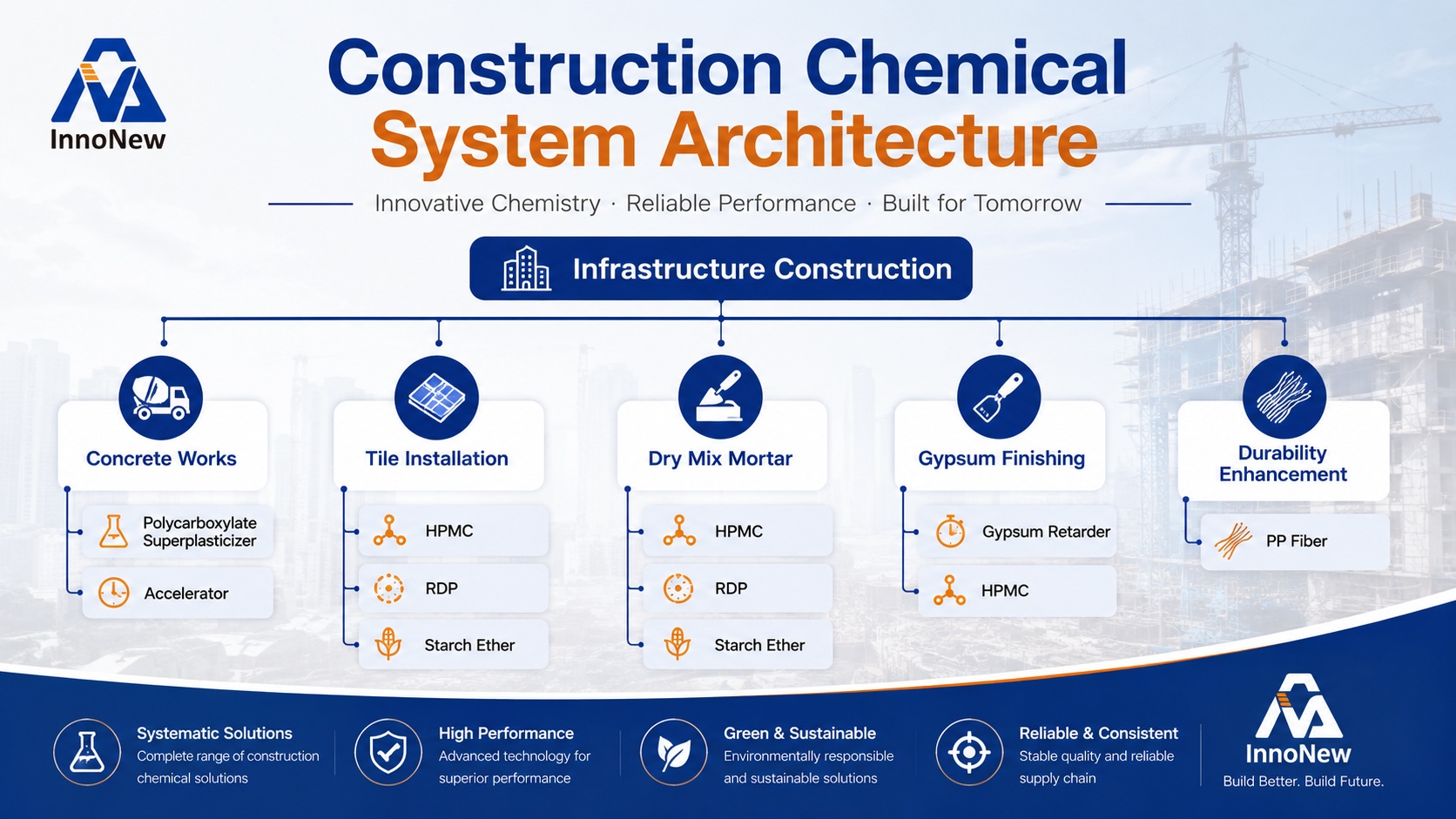
This integrated system perspective allows contractors, manufacturers, and distributors to optimize construction performance across multiple applications while adapting to the unique climatic conditions of the Philippines.
FAQ
1. What construction chemicals are most commonly used in the Philippines?
The most widely used construction chemicals include polycarboxylate superplasticizers (PCE), HPMC, redispersible polymer powder (RDP), polypropylene fiber (PP Fiber), accelerators, and gypsum retarders. These products are commonly applied in concrete, tile adhesives, dry mix mortars, self-leveling compounds, and gypsum systems.
2. Why is climate adaptation important when selecting construction chemicals in the Philippines?
The Philippines experiences high humidity, heavy rainfall, elevated temperatures, and coastal exposure. Construction chemicals must be selected and formulated to maintain performance under these environmental conditions.
3. How do polycarboxylate superplasticizers improve concrete performance?
PCE-based admixtures significantly reduce water demand while improving workability, slump retention, strength development, and pumping performance. They also help lower overall cement consumption.
4. What additives are essential for tile adhesive manufacturing?
A typical tile adhesive formulation uses HPMC for water retention and workability, RDP for adhesion and flexibility, and starch ether for anti-slip performance and improved application characteristics.
5. How can PP Fiber improve concrete durability?
PP Fiber helps control plastic shrinkage cracking, improves impact resistance, reduces crack propagation, and enhances long-term durability in concrete applications.
6. What should buyers look for when choosing a construction chemicals supplier?
Key evaluation factors include product consistency, manufacturing capability, technical support, quality control systems, export experience, and the availability of professional documentation such as COA, TDS, and SDS.
Related Solutions
- Ready Mix Concrete Solutions in Philippines
- Tile Adhesive Solutions in Philippines
- Dry Mix Mortar Additives Solutions in Philippines
- Self-Leveling Compound Solutions in Philippines
- Gypsum Plaster Solutions in Philippines
- Polycarboxylate Superplasticizer Supplier in Philippines
- HPMC Supplier in Philippines
- RDP Supplier in Philippines
- PP Fiber Supplier in Philippines
- Gypsum Retarder Supplier in Philippines