
HPMC vs MHEC vs HEC: Complete Technical Comparison for Construction and Coating Applications
Introduction
In modern construction chemicals and industrial formulations, cellulose ethers play a critical role in controlling water retention, workability, rheology, open time, and application performance. Among the most widely used cellulose ethers are Hydroxypropyl Methyl Cellulose (HPMC), Methyl Hydroxyethyl Cellulose (MHEC/HEMC), and Hydroxyethyl Cellulose (HEC).
Although these materials belong to the same cellulose ether family, their chemical structures, thermal properties, rheological behavior, and application suitability differ significantly.
For dry mix mortar manufacturers, tile adhesive producers, wall putty plants, gypsum system suppliers, and coating formulators, selecting the correct cellulose ether directly affects:
- Water retention performance
- Sag resistance
- Open time
- Workability
- Pumpability
- Film formation
- Production consistency
- Final application durability
This technical guide provides a comprehensive comparison of HPMC vs MHEC vs HEC, helping formulators and construction chemical manufacturers select the most suitable cellulose ether for specific applications and climate conditions.
What Is HPMC?
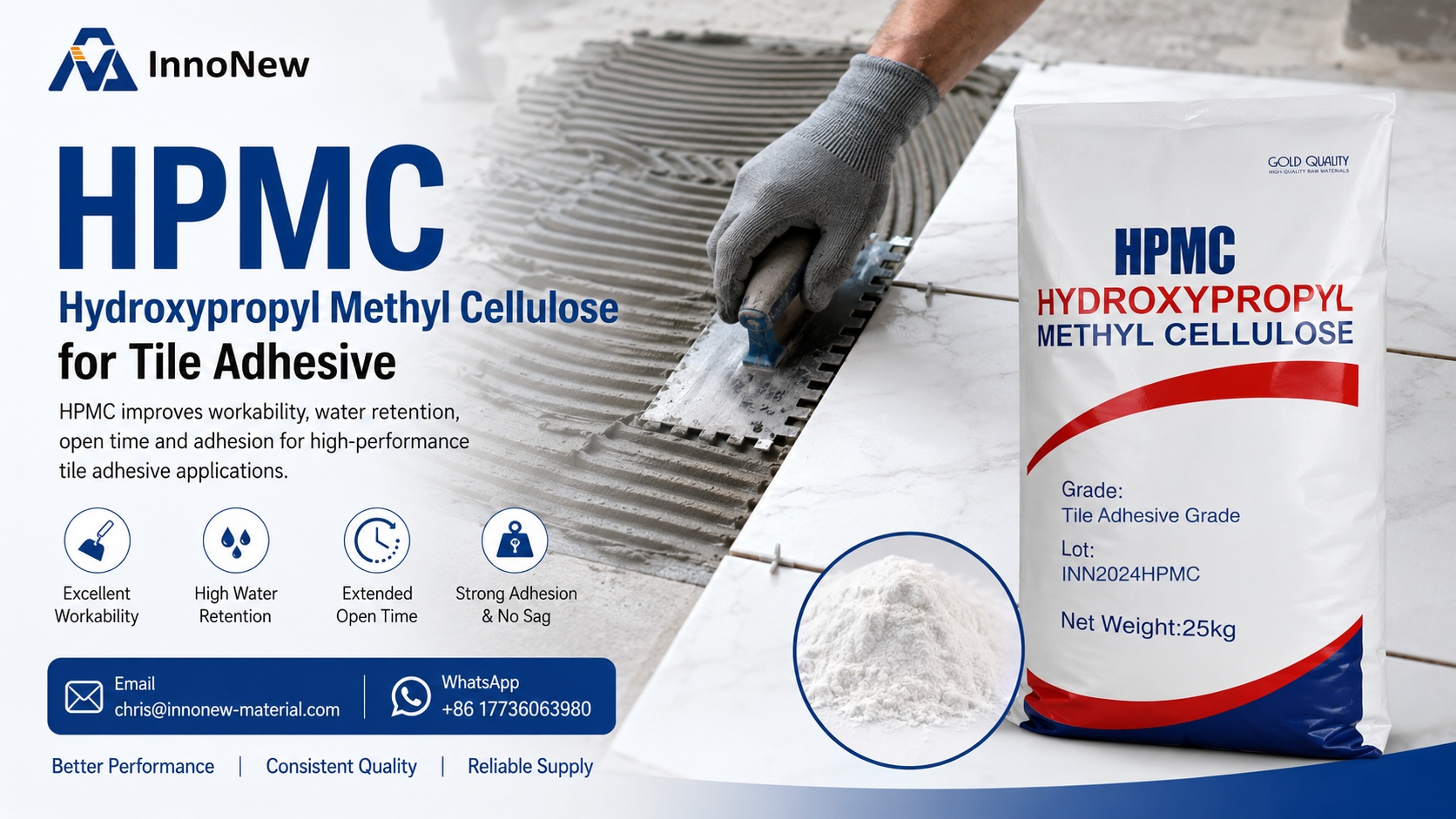
Hydroxypropyl Methyl Cellulose (HPMC) is a non-ionic cellulose ether produced through the etherification of purified cotton cellulose.
HPMC is widely used in:
- Tile adhesives
- Cement mortar
- EIFS systems
- Wall putty
- Gypsum plaster
- Self-leveling compounds
- Pharmaceutical applications
Its primary advantages include:
- Excellent water retention
- Strong thickening efficiency
- Good anti-sag performance
- Stable workability
- Reliable cement compatibility
In cement-based dry mix systems, HPMC is considered one of the most versatile and widely adopted rheology modifiers.
What Is MHEC (HEMC)?
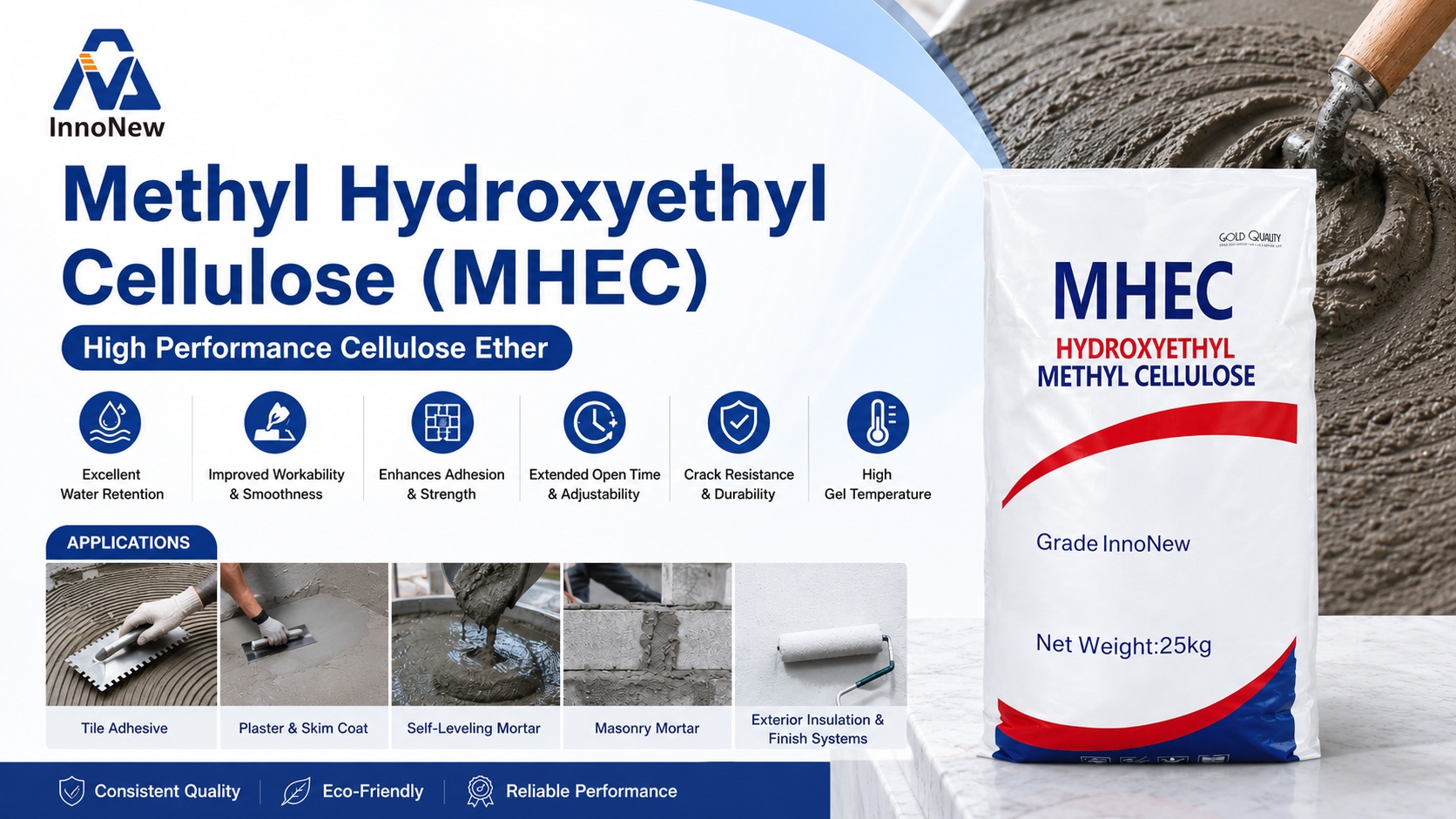
Methyl Hydroxyethyl Cellulose (MHEC or HEMC) is another non-ionic cellulose ether modified with hydroxyethyl groups.
Compared with standard HPMC grades, MHEC often provides:
- Better temperature stability
- Improved open time
- Smoother workability
- Enhanced water retention under hot climates
- Better anti-slip performance in some tile adhesive systems
MHEC is commonly used in:
- Tile adhesive
- Cement render
- EIFS systems
- Skim coat
- Gypsum-based mortar
- Exterior insulation systems
In regions with high ambient temperatures, such as the Middle East, Southeast Asia, Africa, and South America, MHEC is often preferred for its superior thermal stability during construction.
What Is HEC?
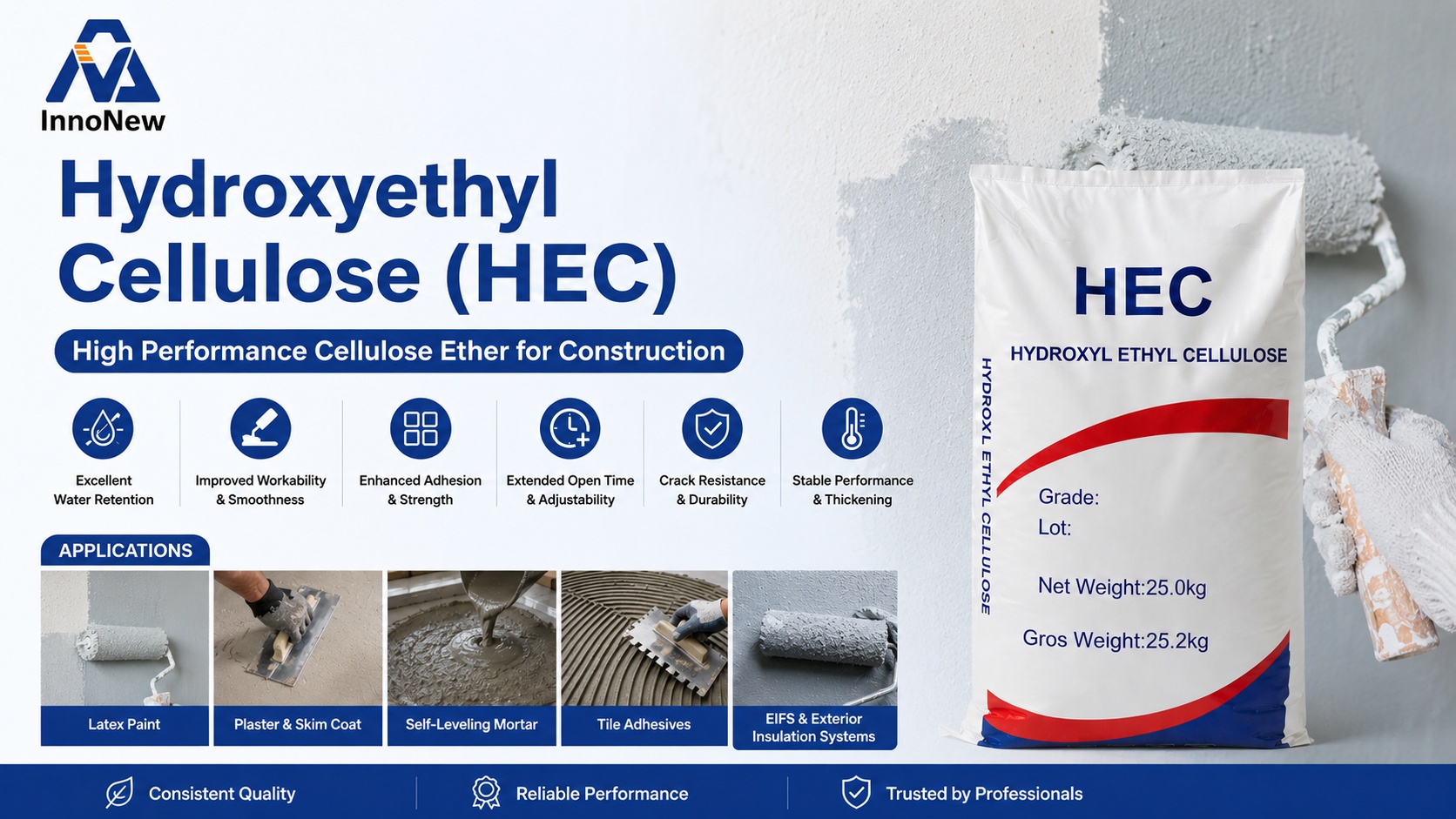
Hydroxyethyl Cellulose (HEC) is a water-soluble non-ionic cellulose ether mainly used in water-based coating and chemical formulations.
Unlike HPMC and MHEC, HEC is generally not the primary choice for cement-based mortar systems.
HEC is widely used in:
- Latex paint
- Water-based coatings
- Personal care products
- Detergents
- Oil drilling fluids
- Waterborne systems
Its main advantages include:
- Excellent rheology control
- Smooth flow behavior
- Good pigment suspension
- Excellent leveling performance
- High compatibility with waterborne coatings
HEC is especially suitable for latex paint formulations requiring optimized viscosity stability and brushing performance.
HPMC vs MHEC vs HEC: Technical Comparison Table
| Property | HPMC | MHEC / HEMC | HEC |
|---|---|---|---|
| Chemical Type | Hydroxypropyl Methyl Cellulose | Methyl Hydroxyethyl Cellulose | Hydroxyethyl Cellulose |
| Ionic Type | Non-ionic | Non-ionic | Non-ionic |
| Primary Application | Construction mortar | Construction mortar | Water-based coatings |
| Water Retention | Excellent | Excellent | Moderate |
| Open Time | Good | Excellent | Moderate |
| Thermal Stability | Good | Excellent | Moderate |
| Cement Compatibility | Excellent | Excellent | Limited |
| Anti-Sag Performance | Excellent | Excellent | Weak |
| Paint Compatibility | Moderate | Moderate | Excellent |
| Leveling Performance | Good | Excellent | Excellent |
| Hot Climate Suitability | Good | Excellent | Moderate |
| Latex Paint Use | Limited | Limited | Excellent |
| Dry Mix Mortar Use | Excellent | Excellent | Rare |
HPMC vs MHEC in Tile Adhesive Formulations
In tile adhesive systems, both HPMC and MHEC are widely used. However, their performance characteristics differ depending on climate, formulation design, cement quality, and construction conditions.
HPMC Advantages in Tile Adhesive
HPMC is commonly selected when formulators require:
- Strong water retention
- Good anti-sag resistance
- Stable thickening performance
- Cost-effective mortar production
- Reliable adhesion performance
HPMC performs particularly well in standard ceramic tile adhesive formulations for general construction applications.
MHEC Advantages in Tile Adhesive
MHEC is often preferred for premium tile adhesive formulations because it provides:
- Longer open time
- Improved workability
- Better troweling smoothness
- Enhanced thermal stability
- More stable performance in high-temperature environments
In tropical and desert climates above 35°C ambient temperature, MHEC often maintains better application consistency than standard HPMC grades.
For exterior tile installation and large-format tile systems, MHEC can help improve installer comfort and reduce premature drying.
HEC vs HPMC in Water-Based Coatings
Although HPMC can be used in some coating systems, HEC remains the dominant cellulose ether in latex paint formulations.
Why HEC Is Preferred in Latex Paint
HEC provides:
- Excellent viscosity stability
- Better pigment suspension
- Smooth brushing properties
- Good leveling behavior
- Improved anti-spatter performance
HEC also exhibits excellent compatibility with many waterborne resin systems used in architectural coatings.
Limitations of HEC in Cement Systems
Compared with HPMC and MHEC, HEC has weaker performance in cement mortar because:
- Water retention is lower
- Cement interaction is weaker
- Anti-sag performance is limited
- Open time control is less stable
As a result, HEC is rarely used as the primary cellulose ether in dry mix mortar production.
Climate-Based Selection Guide
Choose HPMC If:
- Producing standard tile adhesive
- Cost-performance balance is important
- Strong water retention is required
- Mortar consistency is priority
- Standard climate conditions apply
Choose MHEC If:
- Project is located in hot climate regions
- Longer open time is required
- Better thermal stability is critical
- Exterior construction performance is important
- High-end tile adhesive is being produced
Choose HEC If:
- Manufacturing latex paint
- Producing water-based coatings
- Smooth rheology is priority
- Pigment suspension is critical
- Excellent leveling performance is required
Common Formulation Challenges
Problem: Tile Adhesive Dries Too Fast
Possible causes:
- Low cellulose ether dosage
- Poor water retention
- High ambient temperature
- Improper cellulose ether selection
Recommended solution:
- Upgrade from standard HPMC to premium MHEC
- Increase water retention grade
- Optimize viscosity specification
Problem: Mortar Sagging on Vertical Application
Possible causes:
- Insufficient thickening efficiency
- Poor rheology structure
- Incorrect viscosity balance
Recommended solution:
- Select high-quality HPMC
- Improve anti-sag formulation design
- Optimize cellulose ether dosage
Problem: Poor Paint Leveling
Possible causes:
- Inadequate rheology control
- Poor pigment suspension
- Incorrect thickener compatibility
Recommended solution:
- Use high-quality HEC
- Optimize coating rheology package
- Improve viscosity distribution
How Cellulose Ether Selection Affects Production Efficiency
Choosing the correct cellulose ether not only impacts construction performance, but also affects manufacturing efficiency and production stability.
Proper cellulose ether selection can help manufacturers:
- Reduce formulation instability
- Improve batch consistency
- Enhance construction efficiency
- Lower customer complaints
- Improve project durability
- Reduce raw material waste
For large-scale dry mix mortar factories and coating manufacturers, cellulose ether optimization is often a key factor in improving long-term product competitiveness.
Recommended Applications for Each Cellulose Ether
| Application | Recommended Product |
|---|---|
| Tile Adhesive | HPMC / MHEC |
| Wall Putty | HPMC / MHEC |
| Gypsum Plaster | MHEC |
| Cement Render | HPMC / MHEC |
| Self-Leveling Mortar | Modified HPMC |
| EIFS System | MHEC |
| Latex Paint | HEC |
| Water-Based Coatings | HEC |
| Oil Drilling Fluid | HEC |
| Detergent | HEC |
Conclusion
HPMC, MHEC, and HEC are all important cellulose ethers, but their optimal applications differ significantly.
- HPMC is a versatile solution for cement-based dry mix mortar.
- MHEC offers superior thermal stability and workability for premium construction applications.
- HEC remains the preferred rheology modifier for water-based coatings and latex paint systems.
For construction chemical manufacturers, selecting the correct cellulose ether should be based on:
- Application type
- Climate condition
- Construction method
- Required open time
- Rheology performance
- Cost-performance balance
A well-optimized cellulose ether system can significantly improve mortar quality, construction efficiency, and long-term application durability.
FAQ
Is MHEC better than HPMC?
Not necessarily. MHEC generally performs better in hot climates and premium tile adhesive systems, while HPMC offers excellent cost-performance balance for standard mortar applications.
Can HEC replace HPMC in tile adhesive?
In most cases, no. HEC does not provide sufficient water retention and anti-sag performance for cement-based tile adhesive systems.
Which cellulose ether is best for latex paint?
HEC is typically the preferred choice for latex paint because of its excellent rheology control, leveling performance, and pigment suspension capability.
Why is MHEC preferred in hot climates?
MHEC often provides better thermal stability and longer open time under high ambient temperature conditions.
Which cellulose ether has the best water retention?
High-quality HPMC and MHEC both provide excellent water retention performance in dry mix mortar systems.