
PCE vs SNF: Complete Guide for Concrete Admixture Selection
Introduction
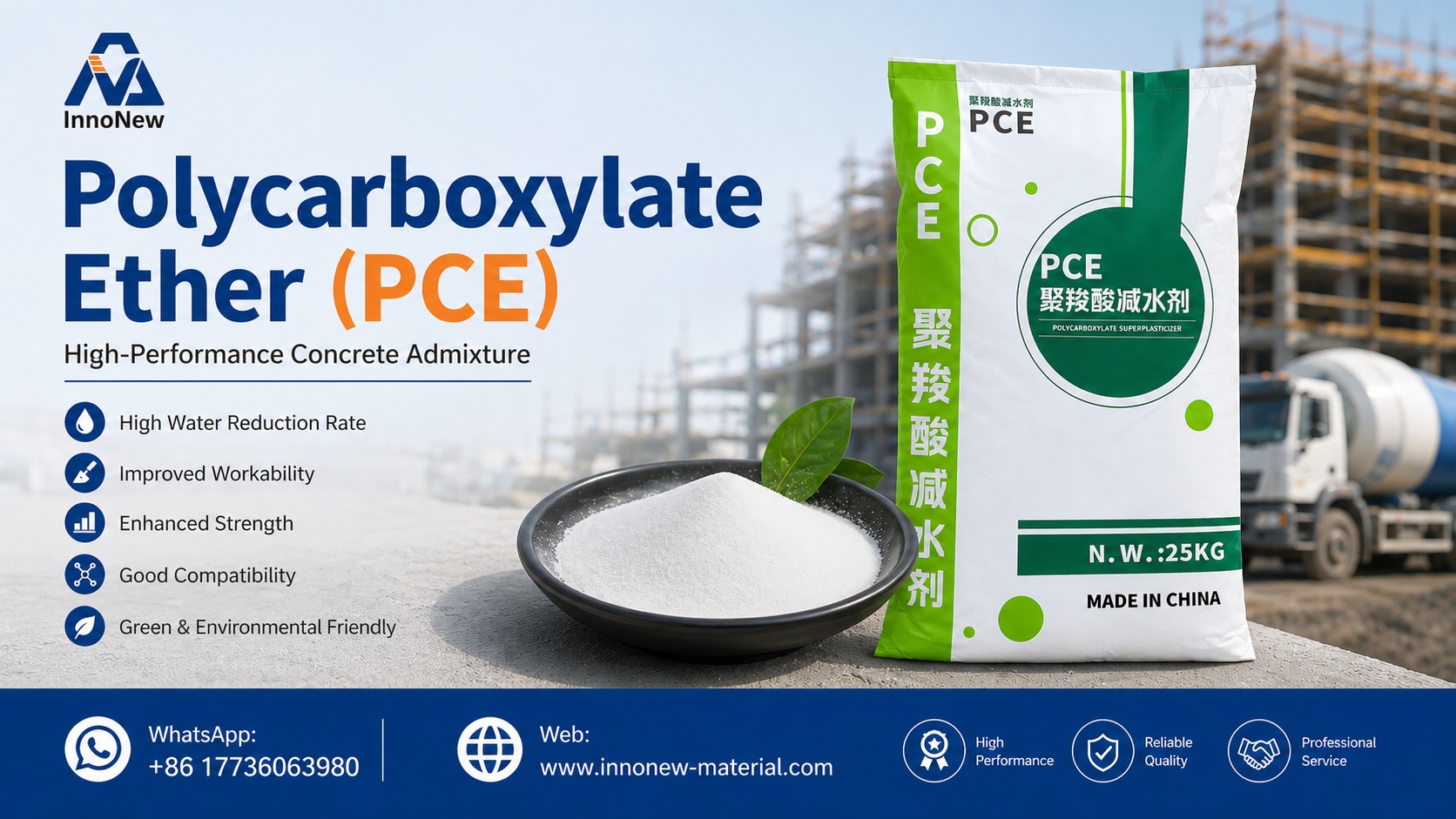
In the global construction chemicals market, PCE vs SNF is one of the most frequently asked questions among engineers, contractors, and procurement managers.
Both Polycarboxylate Ether (PCE) and Sulfonated Naphthalene Formaldehyde (SNF) are widely used superplasticizers (water reducers) in concrete and dry mix mortar.
However, the difference between PCE and SNF lies in their performance, cost efficiency, and application suitability.
- PCE superplasticizer → High-performance, modern solution
- SNF water reducer → Cost-effective, traditional option
Choosing the right one directly affects:
- Concrete strength
- Workability
- Project cost
- Long-term durability
Comparison: PCE vs SNF Difference
| Parameter | PCE Superplasticizer | SNF Water Reducer |
|---|---|---|
| Chemical Type | Polycarboxylate Ether polymer | Sulfonated Naphthalene Formaldehyde |
| Water Reduction | 25–40% | 10–20% |
| Slump Retention | Long (1–3 hours) | Short (30–60 min) |
| Flowability | Excellent (SCC capable) | Moderate |
| Strength Development | High | Medium |
| Dosage | Low | High |
| Cost Structure | Higher unit, lower total cost | Lower unit, higher total cost |
| Environmental Impact | Low VOC, eco-friendly | Contains formaldehyde residues |
When evaluating PCE vs SNF, PCE delivers superior performance, while SNF remains a budget-driven alternative.
High-Value Performance Analysis
1. Water Reduction & Strength
The biggest PCE vs SNF difference is water reduction efficiency.
- PCE superplasticizer:
- Enables low water-cement ratio
- Produces high-strength concrete
- Ideal for C50+ and UHPC
- SNF water reducer:
- Suitable for standard strength concrete
- Limited for high-performance mixes
2. Workability & Flow
- PCE vs SNF in workability:
- PCE uses steric hindrance → superior dispersion
- SNF relies on electrostatic repulsion
Result:
PCE is essential for:
- Self-compacting concrete
- Pumping concrete
3. Slump Retention
- PCE superplasticizer:
- Maintains workability during long transport
- SNF water reducer:
- Rapid slump loss
For ready-mix plants:
PCE vs SNF → PCE wins clearly
4. Cost Analysis
Many buyers misunderstand PCE vs SNF cost:
- SNF: low price per ton
- PCE: high price per ton
BUT: PCE vs SNF total cost per m³ → PCE is lower
Because:
- Lower dosage
- Better performance
- Reduced cement usage
Application Scenarios
When to Use PCE Superplasticizer
- High-strength concrete
- Ready-mix concrete plants
- Infrastructure projects (bridges, tunnels)
- Precast & prestressed concrete
- Self-compacting concrete (SCC)
- Dry mix mortar (tile adhesive, grout)
When to Use SNF Water Reducer
- Standard concrete (C20–C40)
- Budget-driven projects
- Short-distance construction
- Non-critical structures
Application Scenarios with Real Project Cases (PCE vs SNF)
1. PCE Superplasticizer – Real Project Applications
Case 1: High-Rise Commercial Building (C60 Concrete)
Project Type: 45-story commercial tower
Location: Southeast Asia
Concrete Grade: C60
Challenge:
- High pump height (>150m)
- Strict slump retention (≥2 hours)
- Low water-cement ratio required (<0.32)
Solution:
Use PCE superplasticizer (0.18% dosage)
Performance Data:
- Water reduction: ~32%
- Initial slump: 220 mm
- Slump after 2 hours: 180 mm
- 28-day compressive strength: +18% vs SNF mix
- Cement reduction: ~8–10%
Result: Stable pumping, no segregation, improved structural strength.
Case 2: Bridge Infrastructure Project (Prestressed Concrete)
Project Type: Highway bridge beams
Concrete Type: Prestressed concrete
Requirement:
- High early strength (3-day strength critical)
- Dense microstructure for durability
Solution:
Use PCE-based high-range water reducer
Performance Data:
- Water reduction: 28–35%
- 3-day strength increase: +15%
- Chloride permeability reduced by ~25%
- Improved durability (freeze-thaw cycles +20%)
Why PCE wins:
- Enables low W/C ratio (~0.30)
- Better particle dispersion → stronger hydration
Case 3: Ready-Mix Concrete Plant (Long Distance Supply)
Scenario:
- Transport time: 90–120 minutes
- Hot weather conditions (30–38°C)
Using PCE:
- Slump retention agent included
- Dosage: 0.15–0.25%
Performance:
- Slump loss after 2h: <20%
- No re-tempering required
- Pumpability improved by ~30%
Economic Impact:
- Reduced rejected batches
- Lower labor & adjustment cost
Case 4: Dry Mix Mortar (Tile Adhesive / Grout)
Application:
- Tile adhesive (C1/C2 grade)
- Self-leveling mortar
With PCE Powder:
- Dosage: 0.1–0.3%
Performance Improvement:
Result:
Improved open time, easier application, stronger bonding.
SNF Water Reducer – Real Project Applications
Case 5: Residential Housing (C25–C35 Concrete)
Project Type: Standard residential buildings
Concrete Grade: C25–C35
Requirement:
- Cost control priority
- Short transport distance (<30 min)
Using SNF:
- Dosage: 0.8–1.2%
Performance Data:
- Water reduction: 12–18%
- Slump retention: ~45 minutes
- Strength: meets standard requirements
Why SNF is chosen:
- Lower price per ton
- Acceptable for non-critical structures
Case 6: Road Construction (Mass Concrete)
Project Type: Road base / pavement
Requirement:
- Large volume concrete
- Low cost priority
- No need for long slump retention
Using SNF:
- Dosage: ~1.0%
Performance:
- Moderate workability
- Acceptable compaction
- Cost saving: ~10–15% vs PCE upfront
Limitation:
- Higher water usage → slightly lower durability
Case 7: Small Precast Yard (Low-Tech Setup)
Scenario:
- No advanced mixing control
- Manual batching
Using SNF:
- Easier to produce locally
- Stable but basic performance
Reason: SNF technology is mature and less sensitive
How to Use
PCE Superplasticizer Usage
- Dosage: 0.1%–0.3%
- Method: post-addition recommended
- Compatible with:
- Cellulose ether (HPMC)
- Redispersible polymer powder (RDP)
SNF Water Reducer Usage
- Dosage: 0.5%–1.5%
- Requires:
- Strict time control
- Temperature management
Product Advantages
PCE Superplasticizer Advantages
- Ultra-high water reduction
- Excellent slump retention
- Improved strength & durability
- Suitable for modern concrete systems
SNF Water Reducer Advantages
- Lower initial cost
- Mature technology
- Easy production
WHY CHOOSE US
As a professional construction chemical supplier, we offer:
- Stable quality PCE superplasticizer & SNF water reducer
- Customized formulation solutions
- Cost optimization for concrete production
- Strong export experience (Asia, Middle East, Europe, South America)
- Technical support: lab testing + formulation design
We provide not just products, but complete concrete additive solutions
FAQ
1. What is the main difference between PCE and SNF?
The main difference between PCE vs SNF is performance. PCE offers higher water reduction and better slump retention, while SNF is more cost-effective but less efficient.
2. Is PCE better than SNF?
Yes, in most modern applications, PCE is better than SNF due to higher efficiency and lower overall cost per cubic meter.
3. Why is PCE more expensive than SNF?
PCE has a more advanced chemical structure, but its lower dosage makes it more cost-effective in real applications.
4. Can SNF replace PCE?
SNF can replace PCE only in low-performance or budget-sensitive projects.
5. Which is better for dry mix mortar?
PCE is generally better due to compatibility with modern additives and improved performance.
Final Recommendation
When choosing between PCE vs SNF:
- Choose PCE superplasticizer for:
- Performance
- Durability
- Long-term cost efficiency
- Choose SNF water reducer for:
- Budget control
- Standard construction
CONTACT US
Looking for a reliable PCE supplier or SNF manufacturer?
We provide:
- Free sample testing
- Custom formulation design
- Competitive pricing
Contact us now to get your best concrete admixture solution.
Email: chris@innonew-material.com | WhatsApp: +86 17736063980