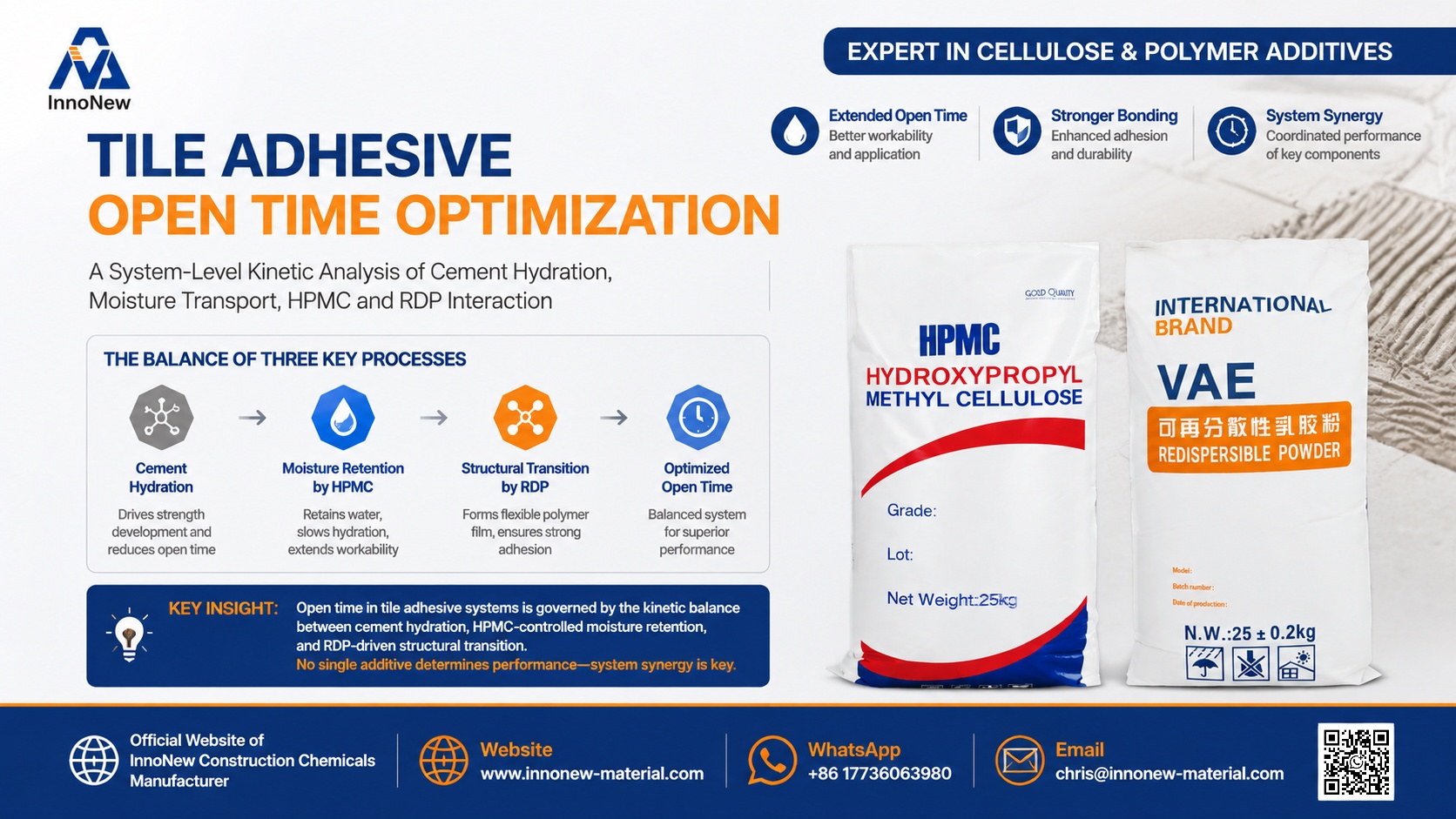
The role of HPMC and RDP in optimizing tile adhesive open time performance. It highlights cement hydration control, water retention, and polymer modification mechanisms in dry mix mortar systems for improved workability, adhesion, and durability.
A System-Level Kinetic Analysis of Cement Hydration, Moisture Transport, HPMC and RDP Interaction
1. Introduction: Open Time as a System Behavior
In tile adhesive technology, open time is not a fixed material property, but a time-dependent system behavior influenced by cement hydration, moisture transport, and polymer modification.
HPMC primarily regulates water retention and rheology
RDP governs polymer film formation and structural transition
Open time is therefore a result of system interaction, not single additive performance.
2. Mechanism of Open Time Loss
Open time failure occurs when the adhesive transitions from a plastic state to a semi-rigid structure before tile placement.
This transition is driven by three coupled processes:
2.1 Cement Hydration Kinetics
Cement hydration is the internal driving force of stiffness development.
C₃S reacts rapidly with available water
Heat generation accelerates reaction speed
Free water is continuously consumed
Role of HPMC
HPMC slows down this process indirectly by:
Reducing water mobility
Stabilizing free water distribution
Delaying hydration access to cement particles
However:
HPMC does not change the chemical nature of hydration — only the water availability.
2.2 Moisture Transport and Environmental Loss
Water loss occurs through:
Surface evaporation
Substrate absorption
Internal capillary migration
HPMC contribution
HPMC is the main water retention system in tile adhesive:
Forms a hydrated gel network
Reduces rapid moisture migration
Maintains workability window under normal conditions
Limitation
Under high temperature or porous substrates:
Even optimized HPMC cannot fully prevent rapid moisture depletion, leading to shortened open time.
– HPMC powder, key additive for tile adhesive to improve bonding strength. – Hydroxypropyl Methylcellulose for tile adhesive, enhances workability and anti-sag.
2.3 Polymer Transition Controlled by RDP
RDP particles undergo a transition from dispersion to film formation during drying.
This process affects:
Cohesion development
Elasticity formation
Final bond structure
Role of RDP
RDP contributes to open time behavior by:
Delaying rigid network formation
Maintaining plastic deformation capacity
Improving post-installation bonding performance
Unlike HPMC, RDP affects the structural evolution stage, not the water phase.
RDP improves bonding strength and flexibility in tile adhesive
3. System Interaction Model
Open time is defined by the balance between three competing processes:
Cement hydration (stiffening driver)
Moisture retention controlled by HPMC
Structural transition governed by RDP
3.1 Relative System Influence
Interpretation
Cement hydration is the strongest internal driver of open time loss
HPMC controls moisture stability but has environmental limits
RDP determines the final structural locking stage
Open time is a multi-factor equilibrium system, not a single additive function.
4. Engineering Failure Mechanism in Real Conditions
In real construction environments, open time is significantly shorter than laboratory results due to:
Elevated temperature accelerating cement hydration
Wind-induced evaporation increasing water loss
Substrate suction creating local dry zones
System consequence:
Even when HPMC and RDP are properly dosed, uneven moisture distribution leads to:
Early surface skin formation
Loss of transfer ability
Reduced bonding efficiency
5. Engineering Optimization Strategy
Effective open time optimization requires system-level tuning rather than additive increase.
5.1 HPMC optimization
Adjust molecular weight for balanced viscosity
Optimize substitution pattern (DS/MS ratio)
Improve thermal stability in hot climates
5.2 RDP optimization
Select appropriate Tg for application temperature
Balance flexibility and film formation speed
Improve coalescence behavior under moisture variation
5.3 System coordination principle
HPMC controls the water phase, RDP controls the structural phase, and cement controls the reaction phase.
Open time stability is achieved only when all three phases are synchronized.
6. Engineering Flow Diagram
Cement Hydration Acceleration
            ↓
Water Consumption Increase
            ↓
HPMC Water Retention Buffering
            ↓
Moisture Loss (Evaporation + Absorption)
            ↓
Reduction of Plastic State Stability
            ↓
RDP Polymer Coalescence Begins
            ↓
Structural Transition to Elastic Network
            ↓
OPEN TIME TERMINATION
7. Key Engineering Insight
Open time in tile adhesive systems is governed by the kinetic balance between cement hydration, HPMC-controlled moisture retention, and RDP-driven structural transition.
This means:
No single additive determines performance
System synergy is the real controlling factor
Optimization must be kinetic, not dosage-based
8. FAQ
Q1: What is the role of HPMC in tile adhesive open time?
HPMC controls water retention and rheology, maintaining workability by slowing moisture loss and hydration access.
Q2: What is the role of RDP in open time performance?
RDP controls polymer film formation and structural transition, influencing the later stage of open time behavior.
Q3: Why does tile adhesive lose open time in hot climates?
High temperature accelerates both cement hydration and evaporation, reducing the effectiveness of HPMC and shortening open time.
Q4: Can open time be improved by increasing HPMC dosage?
Not always. Excess HPMC can negatively affect cement hydration balance and workability.
Q5: How do HPMC and RDP work together?
HPMC controls moisture availability, while RDP governs structural evolution, together defining the functional open time window.
Q6: What is the correct strategy for open time optimization?
The correct strategy is system-level kinetic balancing of hydration, moisture retention, and polymer transition.