
HPMC vs RDP: Key Differences, Applications & Best Combination
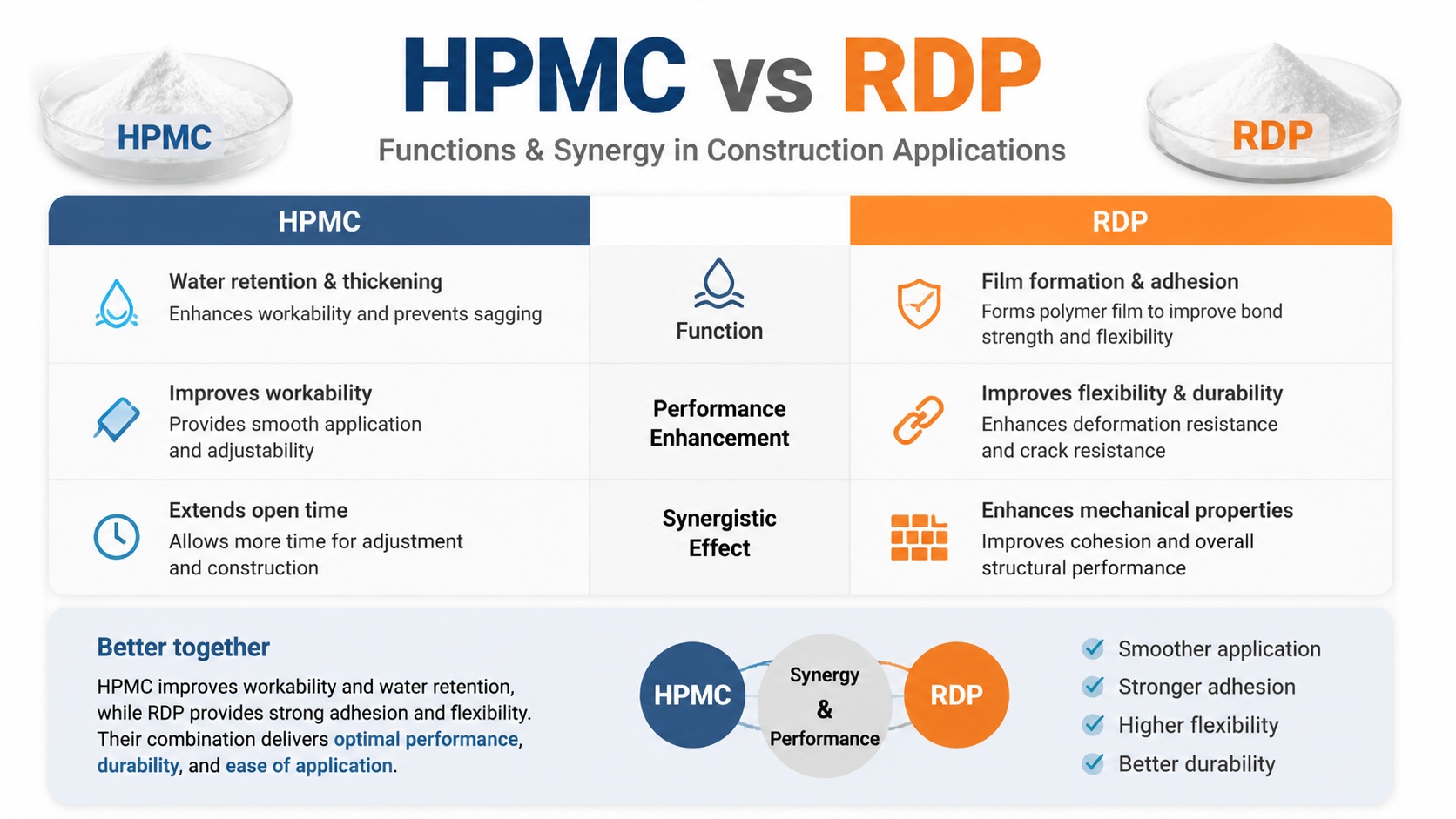
HPMC and RDP both have film-forming, water retention, and adhesion capabilities. However, they differ in gelation mechanism, flexibility, and application performance. This guide focuses on functional differences and synergistic effects, rather than cost comparisons. This guide explains the differences between InnoNew HPMC (Hydroxypropyl Methyl Cellulose) and RDP (Redispersible Polymer Powder), their applications in construction materials, and how combining both improves adhesion, workability, and durability. Includes real Brazil customer case study.
Understanding these differences is crucial for construction engineers and formulators to achieve optimal performance in terms of workability, durability, and crack resistance.
Why Compare HPMC vs RDP?
In modern dry mix mortar systems, understanding the difference between HPMC vs RDP is critical for optimizing performance, cost, and formulation stability.
Both InnoNew HPMC and InnoNew RDP are essential construction additives, but they serve fundamentally different roles:
- HPMC → water retention & workability
- RDP → adhesion & flexibility
The real competitive advantage comes from using them together strategically.
HPMC vs RDP:Core Differences
| Comparison | HPMC (Hydroxypropyl Methylcellulose) | RDP (Redispersible Polymer Powder) |
|---|---|---|
| Adhesion | Medium-high, provides sustained bonding | High adhesion, versatile in different substrates |
| Film Formation | Controllable film formation across temperature range | Excellent film formation, strong flexibility |
| Water Retention | Excellent | Excellent |
| Crack Resistance | Good | Significant enhancement |
| Flexibility | Good | More significant flexibility |
| Workability | Improves workability and application smoothness | Further improves workability, flexibility, and application ease |
| Synergistic Effect | Enhances overall performance when combined with RDP, especially in crack resistance and adhesion | Synergizes with HPMC to deliver balanced performance and durability |
Key Insight
HPMC controls the system → RDP strengthens the system
InnoNew HPMC Product Grades
We provide multiple viscosity grades to match different applications:
- InnoNew HPMC K5 – 50,000 cps
deal for tile adhesive & plaster (balanced workability) - InnoNew HPMC K10 – 100,000 cps
Standard grade for wall putty & mortar - InnoNew HPMC K20 – 200,000 cps
High-performance systems requiring superior water retention
Application Comparison (HPMC vs RDP)
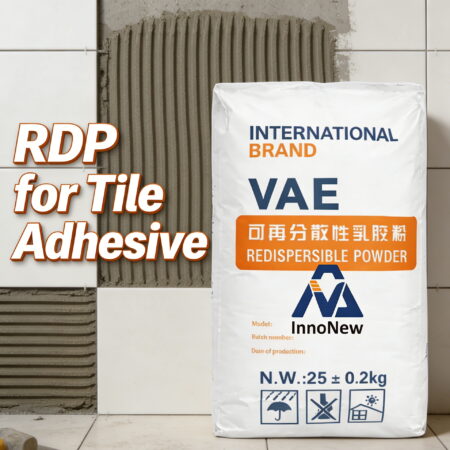
1. Tile Adhesive
Best practice: HPMC + RDP combination
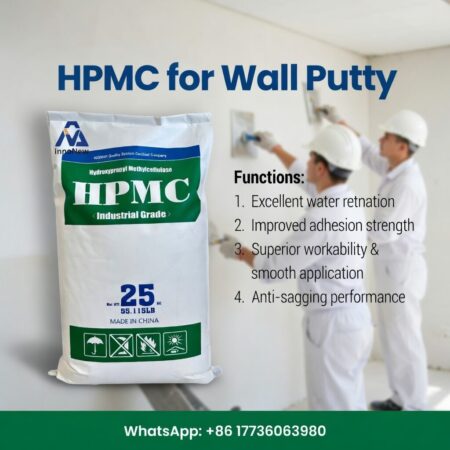
2. Wall Putty
3. Dry Mix Mortar
- HPMC: Controls consistency
- RDP: Adds flexibility & durability
Why Use InnoNew HPMC + RDP Together?
Synergistic Benefits
- Improved workability + strong adhesion
- Extended open time + reduced cracking
- Better water retention + enhanced durability
- Optimized formulation performance
This combination creates a high-performance construction system
Combining HPMC and RDP maximizes the strengths of both materials. HPMC stabilizes the mortar or plaster mixture, while RDP reinforces film formation and flexibility. This combination enhances adhesion, reduces micro-cracking, and improves overall durability.
Brazil Customer Case Study
A construction material manufacturer in Brazil faced:
- Poor tile adhesion
- Cracking in wall putty
- Short open time in tile adhesive
Solution (InnoNew System)
We recommended:
- InnoNew HPMC K10 (100,000 cps)
- InnoNew RDP (high bonding grade)
Results
- ✔ Adhesion strength increased by 35%
- ✔ Open time extended significantly
- ✔ Cracking issues eliminated
- ✔ Application became smoother
Key Takeaway
HPMC alone was not enough → RDP completed the system
How to Use (Formulation Guidance)
Recommended Dosage
| Product | Dosage |
|---|---|
| InnoNew HPMC | 0.2% – 0.5% |
| InnoNew RDP | 1% – 5% |
Mixing Tips
- Add HPMC first for water control
- Add RDP for bonding performance
- Ensure uniform dry mixing
Product Advantages (InnoNew)
InnoNew HPMC
- Stable viscosity
- Excellent water retention
- Wide application range
InnoNew RDP
- Strong adhesion
- Good redispersibility
- High flexibility
WHY CHOOSE US
- Direct factory supply
- Export to Brazil, India, Middle East, Southeast Asia, Europe, Australia
- Consistent quality control system
- Technical formulation support
- Fast delivery & stable supply
We are not just a supplier — we are your formulation partner
FAQ
1. What is the main difference between HPMC and RDP?
HPMC improves workability and water retention, while RDP enhances adhesion and flexibility.
2. Can HPMC replace RDP?
No. They serve different functions and cannot replace each other.
3. Why use HPMC and RDP together?
Because their combination delivers optimal performance in mortar and tile adhesive systems.
4. Which HPMC viscosity should I choose?
- K5 → tile adhesive
- K10 → general use
- K20 → high-performance systems
5. Is RDP necessary in Dry mix mortar?
Typically 1–5%, depending on application requirements.
Conclusion
Understanding the difference between HPMC vs RDP is essential for building high-performance construction materials.
The most effective solution is not choosing one —
but combining InnoNew HPMC + RDP
CONTACT US
Looking for a reliable HPMC supplier or RDP manufacturer?
👉 Contact us now for:
- Free formulation advice
- Sample testing
- Competitive pricing
Email: chris@innonew-material.com | WhatsApp: +86 17736063980
📩 Get technical support & quotation today