
Polycarboxylate Ether (PCE) Powder: The Ultimate Technical Guide to Water Reduction, Slump Retention, Concrete Performance, and Global Applications
Introduction
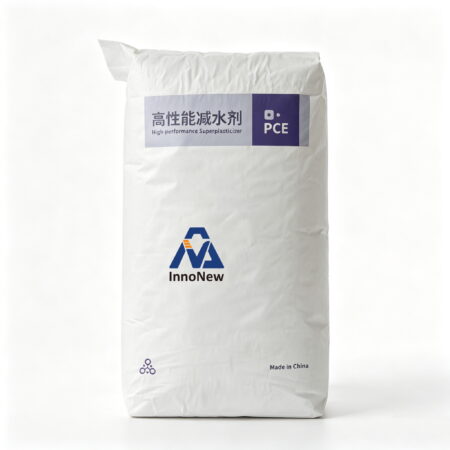
Modern concrete technology continues to evolve toward higher strength, improved durability, and enhanced workability. Among the many innovations that have transformed the construction industry, Polycarboxylate Ether (PCE) Powder has become the most widely used high-range water-reducing admixture for high-performance concrete.
Compared with traditional water reducers such as Sulfonated Naphthalene Formaldehyde (SNF) and Lignosulfonate-based admixtures, PCE Powder offers significantly higher water reduction, superior slump retention, lower dosage requirements, and improved compatibility with modern cement systems.
Today, PCE-based superplasticizers are widely used in ready-mix concrete, precast concrete, self-compacting concrete (SCC), ultra-high-performance concrete (UHPC), and large infrastructure projects worldwide.
This guide explains the chemistry, performance mechanisms, technical specifications, applications, and industry standards of Polycarboxylate Ether Powder.
What Is PCE Powder?
Polycarboxylate Ether Powder (PCE Powder) is a third-generation concrete superplasticizer manufactured through advanced polymerization technology.
Unlike conventional water reducers, PCE molecules possess a comb-shaped molecular structure consisting of a main backbone and side chains. This unique architecture provides both electrostatic repulsion and steric hindrance, enabling highly efficient dispersion of cement particles.
PCE Powder is typically supplied as a free-flowing white powder that dissolves rapidly in water and can be formulated into liquid admixtures or dry-mix mortar systems.
One important characteristic of high-quality PCE Powder is that it is chloride-free, making it suitable for reinforced concrete and prestressed concrete applications where corrosion resistance is critical.
Chemical Composition
Polycarboxylate Ether Powder is synthesized from polycarboxylate-based polymers through spray drying technology.
Typical composition includes:
- Polycarboxylate polymer
- Functional side chains
- Water-soluble dispersing groups
- Performance-modifying additives
Typical characteristics:
- Appearance: White fine powder
- Solid Content: ≥97%
- Moisture Content: ≤3%
- pH Value (10% solution): 6–8
- Chloride Ion Content: ≤0.02%
- Water Reduction Rate: 25–40%
The chloride-free nature of PCE Powder helps protect steel reinforcement from corrosion and supports long-term concrete durability.
How Polycarboxylate Ether PCE Works
The effectiveness of PCE Powder originates from its molecular structure.
When added to concrete, PCE molecules adsorb onto the surface of cement particles. The negatively charged backbone creates electrostatic repulsion, while the long side chains generate steric hindrance.
As a result:
- Cement particles disperse efficiently.
- Flocculation is minimized.
- Water trapped inside cement clusters is released.
- Concrete flowability increases significantly.
This dual-dispersion mechanism makes PCE substantially more efficient than earlier-generation water reducers.
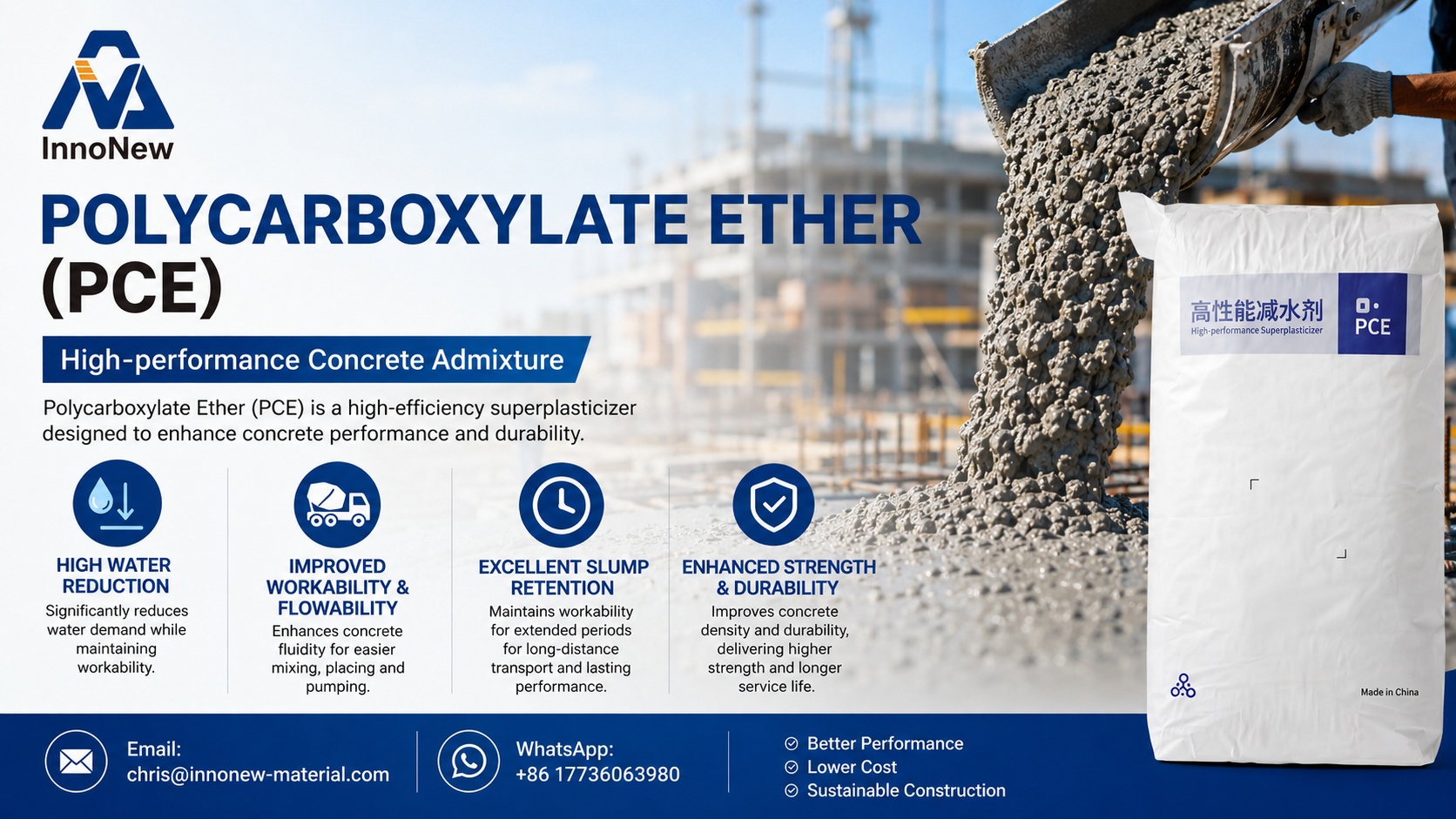
Water Reduction Mechanism
Water reduction is one of the most important functions of PCE Powder.
In conventional concrete, cement particles tend to agglomerate, trapping large amounts of mixing water.
PCE disperses these particles uniformly throughout the mix, releasing trapped water and improving fluidity.
Benefits include:
- Water reduction rates of 25–40%
- Lower water-cement ratio
- Higher compressive strength
- Reduced permeability
- Improved durability
- Enhanced freeze-thaw resistance
The ability to reduce water demand while maintaining workability makes PCE the preferred admixture for high-performance concrete.
Slump Retention Mechanism
Maintaining concrete workability during transportation and placement is essential.
The side-chain structure of PCE continuously provides steric stabilization, preventing cement particles from re-agglomerating over time.
Advantages include:
- Extended workability
- Reduced slump loss
- Improved pumping performance
- Better concrete placement
- Reduced risk of cold joints
This characteristic is particularly valuable in hot climates and long-distance concrete transportation.
Key Technical Specifications
Typical specifications of high-quality PCE Powder include:
| Property | Specification |
|---|---|
| Appearance | White Fine Powder |
| Solid Content | ≥97% |
| Moisture Content | ≤3% |
| pH Value | 6–8 |
| Chloride Ion Content | ≤0.02% |
| Water Reduction Rate | 25–40% |
| Solubility | Completely Water Soluble |
| Bulk Density | 450–650 kg/m³ |
Actual specifications may vary depending on product grade and formulation.
Types of PCE Powder
Several grades of PCE Powder are available for different applications.
High Water Reduction Type
Designed for maximum strength development and low water-cement ratios.
Slump Retention Type
Optimized for extended workability and transportation times.
Comprehensive Type
Balances water reduction and slump retention performance.
Dry-Mix Mortar Grade
Developed for tile adhesives, repair mortars, grouts, and self-leveling compounds.
Applications
PCE Powder is widely used throughout the construction industry.
Major applications include:
- Ready-Mix Concrete
- Precast Concrete
- Self-Compacting Concrete (SCC)
- High-Performance Concrete (HPC)
- Ultra-High-Performance Concrete (UHPC)
- Bridge Construction
- Tunnel Projects
- Dam Construction
- Industrial Flooring
- Pumped Concrete
- Dry-Mix Mortars
- Cement-Based Grouts
Its versatility makes it one of the most important admixtures in modern concrete technology.
Advantages Over SNF and Lignosulfonate
Compared with traditional admixtures, PCE Powder offers significant performance advantages.
| Property | PCE | SNF | Lignosulfonate |
| Water Reduction | 25–40% | 15–25% | 5–12% |
| Slump Retention | Excellent | Moderate | Poor |
| Dosage | Low | Medium | High |
| Early Strength | High | Moderate | Low |
| Compatibility | Excellent | Good | Limited |
| Durability | Excellent | Good | Moderate |
These advantages explain why PCE has become the global standard for modern concrete admixture technology.
Dosage Recommendations
Typical dosage ranges:
| Application | Dosage |
| Ready-Mix Concrete | 0.10–0.25% |
| HPC | 0.15–0.30% |
| SCC | 0.15–0.30% |
| Precast Concrete | 0.10–0.25% |
| Dry-Mix Mortar | 0.05–0.30% |
Actual dosage should be determined through laboratory and field testing.
Common Problems and Solutions
Excessive Air Content
Cause:
- Overdosage
- Improper formulation
Solution:
- Reduce dosage
- Use compatible defoamer
Rapid Slump Loss
Cause:
- Cement incompatibility
- High temperature
Solution:
- Use slump-retention grade PCE
- Adjust admixture dosage
Delayed Strength Development
Cause:
- Excessive water
- Incorrect dosage
Solution:
- Optimize mix design
- Conduct trial testing
Segregation
Cause:
- Excessive fluidity
Solution:
- Adjust water content
- Use viscosity-modifying admixture if necessary
Global Standards
PCE Powder products are commonly evaluated according to international standards including:
- ASTM C494
- ASTM C1017
- EN 934-2
- GB 8076
- JIS A 6204
Compliance with these standards helps ensure consistent quality and performance in global construction projects.
Frequently Asked Questions
Is PCE Powder chloride-free?
Yes. High-quality Polycarboxylate Ether Powder is chloride-free, making it suitable for reinforced and prestressed concrete applications.
What is the water reduction rate of PCE Powder?
Typically between 25% and 40%, depending on dosage and cement compatibility.
Can PCE Powder be used in dry-mix mortar?
Yes. Special grades are designed specifically for dry-mix mortar formulations.
Does PCE Powder improve strength?
Yes. By reducing water demand and lowering the water-cement ratio, PCE contributes to higher compressive strength and improved durability.
Is PCE better than SNF?
In most modern concrete applications, PCE provides higher water reduction, better slump retention, lower dosage requirements, and improved overall performance.
What makes your PCE powder truly chloride-free?
We adopt chloride-free raw materials for the whole synthesis process, plus multi-stage purification and precise spray drying technology. Chloride ions are eliminated from the production source, instead of just being removed by post-processing.
Which projects are suitable for this chloride-free PCE powder?
It is ideal for coastal engineering, subways, tunnels, high-speed railways, precast concrete components and all high-standard projects with strict requirements on harmful ion content.
Conclusion
Polycarboxylate Ether (PCE) Powder has become the leading superplasticizer technology in the global concrete industry. Its unique molecular structure enables exceptional cement dispersion, delivering water reduction rates of 25–40%, excellent slump retention, improved durability, and superior concrete performance.
As a chloride-free admixture, PCE Powder is particularly suitable for reinforced concrete structures requiring long-term durability and corrosion resistance. From ready-mix concrete and precast production to high-performance infrastructure projects, PCE continues to play a vital role in advancing modern construction technology.
For engineers, contractors, concrete producers, and admixture manufacturers seeking higher performance and greater efficiency, PCE Powder remains the benchmark solution for contemporary concrete design.