
Gypsum Retarder: The Complete Technical Guide to Setting Time Control in Modern Gypsum Systems
Introduction
Gypsum-based materials have become essential components of modern construction due to their lightweight characteristics, smooth surface finish, fire resistance, and ease of application. From gypsum plaster and gypsum putty to gypsum boards and self-leveling compounds, these products are widely utilized across residential, commercial, and industrial projects.
Despite their advantages, gypsum materials present a significant formulation challenge: rapid setting. Depending on the quality and type of gypsum used, setting can occur within minutes after water addition. Insufficient working time can lead to application difficulties, poor surface quality, increased material waste, and reduced construction efficiency.
To overcome these challenges, formulators rely on gypsum retarders. These specialized additives play a critical role in controlling hydration kinetics, extending working time, improving process stability, and enhancing overall application performance.
This article provides a comprehensive technical analysis of gypsum retarders, including their working mechanisms, industrial applications, dosage optimization, compatibility considerations, and formulation best practices.
Understanding Gypsum Hydration and Setting Behavior
To understand the importance of gypsum retarders, it is essential to first examine how gypsum hardens.
Construction gypsum is primarily composed of calcium sulfate hemihydrate (CaSO₄·½H₂O). When mixed with water, a hydration reaction occurs, converting hemihydrate into calcium sulfate dihydrate (CaSO₄·2H₂O).
The hydration process consists of several stages:
Stage 1: Dissolution
Hemihydrate particles dissolve in water, releasing calcium and sulfate ions.
Stage 2: Supersaturation
As ion concentration increases, the solution becomes supersaturated.
Stage 3: Nucleation
Tiny gypsum crystal nuclei begin to form.
Stage 4: Crystal Growth
Needle-shaped gypsum crystals rapidly grow and interlock.
Stage 5: Setting and Hardening
A rigid crystal network develops, resulting in material hardening and strength development.
The rate of nucleation and crystal growth directly determines the setting time of the gypsum system.
What Is a Gypsum Retarder?
A gypsum retarder is a functional additive specifically designed to slow down the hydration process of gypsum and extend the material’s working time.
Rather than preventing hydration entirely, a retarder carefully regulates crystal formation and growth, allowing sufficient open time for mixing, transportation, pumping, application, and finishing operations.
In modern gypsum formulations, retarders are commonly used in:
- Gypsum plaster
- Gypsum putty
- Gypsum board manufacturing
- Gypsum-based self-leveling compounds
- Decorative gypsum products
- Prefabricated gypsum components
The primary objective is to achieve predictable and controllable setting behavior without significantly compromising final mechanical properties.
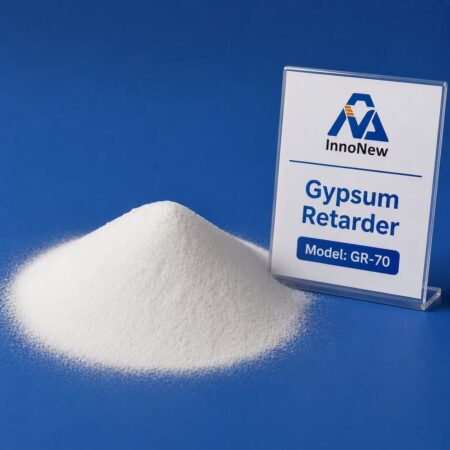
How Gypsum Retarders Work: Scientific Mechanisms
The effectiveness of a gypsum retarder depends on its ability to influence crystal formation during hydration.
Several mechanisms contribute to retardation effects.
1. Crystal Surface Adsorption
Retarder molecules adsorb onto the surface of growing gypsum crystals.
This adsorption creates a barrier that slows crystal growth and reduces the rate at which crystals interconnect.
Result:
- Extended setting time
- Improved workability
- More stable hydration process
2. Calcium Ion Complexation
Certain retarder chemistries temporarily bind calcium ions in solution.
This reduces the availability of free calcium ions required for crystal formation.
Result:
- Delayed nucleation
- Controlled crystal development
- Extended induction period
3. Crystal Growth Inhibition
Some retarders interfere directly with crystal morphology.
Instead of allowing rapid needle-like crystal formation, the additive modifies growth patterns and slows interlocking.
Result:
- Slower hardening
- Improved application window
- Better process control
4. Dissolution Rate Regulation
Advanced retarders may also reduce the dissolution rate of hemihydrate particles.
This slows the overall hydration reaction from the earliest stages.
Result:
- Enhanced setting consistency
- Improved formulation stability
Major Types of Gypsum Retarders
Various chemical technologies are used in commercial gypsum retarder systems.
Organic Acid-Based Retarders
Examples include:
- Citric Acid
- Tartaric Acid
Advantages:
- High efficiency
- Cost-effective
- Easy formulation
Limitations:
- Potential strength reduction at excessive dosages
Protein-Based Retarders
Protein retarders are widely used in industrial gypsum formulations.
Advantages:
- Excellent retardation efficiency
- Stable setting control
- Broad dosage range
Applications:
- Gypsum plaster
- Gypsum board production
- Decorative gypsum products
Phosphate-Based Retarders
These systems influence calcium ion activity during hydration.
Advantages:
- Strong retardation effect
- Good consistency
Applications:
- Specialized industrial gypsum systems
Applications of Gypsum Retarders in Construction Materials
Gypsum Plaster
Gypsum plaster requires sufficient working time for mixing, pumping, leveling, and finishing.
Benefits of retarders include:
- Extended open time
- Improved workability
- Better surface smoothness
- Reduced application defects
Gypsum Putty
Wall finishing products demand consistent setting behavior.
Retarders help achieve:
- Improved spreadability
- Reduced cracking risk
- Better finishing quality
- Stable production performance
Gypsum Board Manufacturing
In gypsum board production lines, precise setting control is essential.
Benefits include:
- Stable board formation
- Improved manufacturing efficiency
- Better process control
- Reduced production variability
Self-Leveling Gypsum Systems
Self-leveling compounds require flow retention during installation.
Retarders provide:
- Longer flow time
- Improved leveling performance
- Reduced premature setting
- Enhanced surface quality
Dosage Optimization: Finding the Right Balance
The performance of a gypsum retarder depends heavily on dosage.
Typical addition levels range from:
0.05% to 0.50% by weight of gypsum
However, the optimal dosage depends on multiple factors.
Gypsum Purity
Higher-purity gypsum often requires different dosage levels compared to recycled or industrial gypsum sources.
Particle Size Distribution
Finer gypsum particles generally hydrate more rapidly and may require increased retardation.
Temperature
Higher ambient temperatures accelerate hydration and frequently require dosage adjustments.
Desired Setting Time
Different applications demand different working times.
Examples:
- Hand-applied plaster
- Machine-applied plaster
- Gypsum board production
- Decorative molding products
Other Additives Present
Formulation interactions can significantly influence retarder performance.
Laboratory testing is therefore essential for optimization.
Compatibility with Other Construction Additives
Modern gypsum formulations rarely rely on a single additive.
Retarders must be evaluated alongside other performance-enhancing ingredients.
Cellulose Ethers (HPMC / HEMC)
Cellulose ethers improve:
- Water retention
- Workability
- Sag resistance
Proper compatibility testing ensures balanced setting and application performance.
Starch Ether
Starch ether contributes:
- Anti-sagging properties
- Improved consistency
- Better handling characteristics
Interactions with retarders should be carefully optimized.
Redispersible Polymer Powder (RDP)
RDP enhances:
- Adhesion
- Flexibility
- Crack resistance
Retarder compatibility affects curing behavior and final performance.
Polycarboxylate Ether (PCE)
In specialized gypsum formulations, PCE may improve flowability and reduce water demand.
The combined effect with retarders should be evaluated through formulation trials.
Common Challenges in Gypsum Formulation
Over-Retardation
Excessive dosage may result in:
- Very slow setting
- Delayed strength development
- Production inefficiencies
Inconsistent Raw Materials
Variations in gypsum source and purity can alter retarder effectiveness.
Quality control procedures are essential.
Temperature Sensitivity
Seasonal changes may require dosage adjustments to maintain consistent performance.
Additive Interactions
Unexpected interactions between additives can affect setting behavior.
Comprehensive formulation testing is recommended before commercialization.
Future Trends in Gypsum Retarder Technology
The construction industry continues to demand higher performance and greater process stability.
Future gypsum retarder developments are expected to focus on:
- Improved dosage efficiency
- Better compatibility with multifunctional additives
- Enhanced temperature stability
- Lower environmental impact
- Consistent performance across diverse gypsum sources
As gypsum-based building materials continue to expand globally, advanced setting-control technologies will remain critical to formulation success.
FAQ:
What Is the Recommended Dosage of Gypsum Retarder?
Typical dosage ranges from 0.05% to 0.50% based on gypsum weight. The optimal amount depends on gypsum purity, fineness, ambient temperature, and target setting time.
Can Gypsum Retarder Be Used with HPMC?
Yes. Gypsum retarders are commonly used together with HPMC or HEMC in gypsum plaster formulations. HPMC improves water retention and workability, while the retarder controls hydration kinetics and setting time.
Does Gypsum Retarder Reduce Final Strength?
When properly dosed, a gypsum retarder has minimal impact on final compressive and flexural strength. However, excessive dosage may delay hydration excessively and negatively affect early strength development.
Is Gypsum Retarder Suitable for Machine-Applied Plaster?
Yes. Machine-applied gypsum plaster typically requires longer open time and stable pumpability. Properly selected retarders help maintain consistent performance during pumping and application.
How Does Temperature Influence Gypsum Retarder Performance?
Temperature directly affects gypsum hydration kinetics. Higher temperatures accelerate dissolution and crystal growth, often requiring increased retarder dosage to achieve the same setting time. Formulations should therefore be adjusted seasonally or according to local climate conditions.
Conclusion
Gypsum retarders are indispensable additives in modern gypsum-based construction materials. By controlling hydration kinetics, regulating crystal growth, and extending working time, these additives enable stable production, improved workability, and enhanced application performance.
Whether used in gypsum plaster, gypsum putty, gypsum boards, or self-leveling systems, selecting the appropriate retarder and optimizing dosage are essential for achieving consistent setting behavior and reliable product quality.
For manufacturers seeking to improve formulation performance, reduce production variability, and enhance construction efficiency, gypsum retarders remain one of the most important tools in modern gypsum technology.