
1. Introduction
In global construction chemical trade, correct HS Code classification is essential for customs clearance, tax calculation, and smooth international logistics.
Polycarboxylate Superplasticizer (PCE) is a high-performance concrete admixture widely used in:
- Ready-mix concrete production
- Precast concrete factories
- Pumped concrete systems
- Ultra-high-performance concrete (UHPC)
As global infrastructure demand increases, accurate HS classification becomes critical for importers and exporters.
Hebei InnoNew Material Technology Co., Ltd. is a professional manufacturer of construction chemical additives, supplying Polycarboxylate Superplasticizer (PCE Powder and Liquid) with full export documentation support, including MSDS, COA, and TDS.
2. Core HS Code Classification
The most widely accepted HS Code for Polycarboxylate Superplasticizer is:
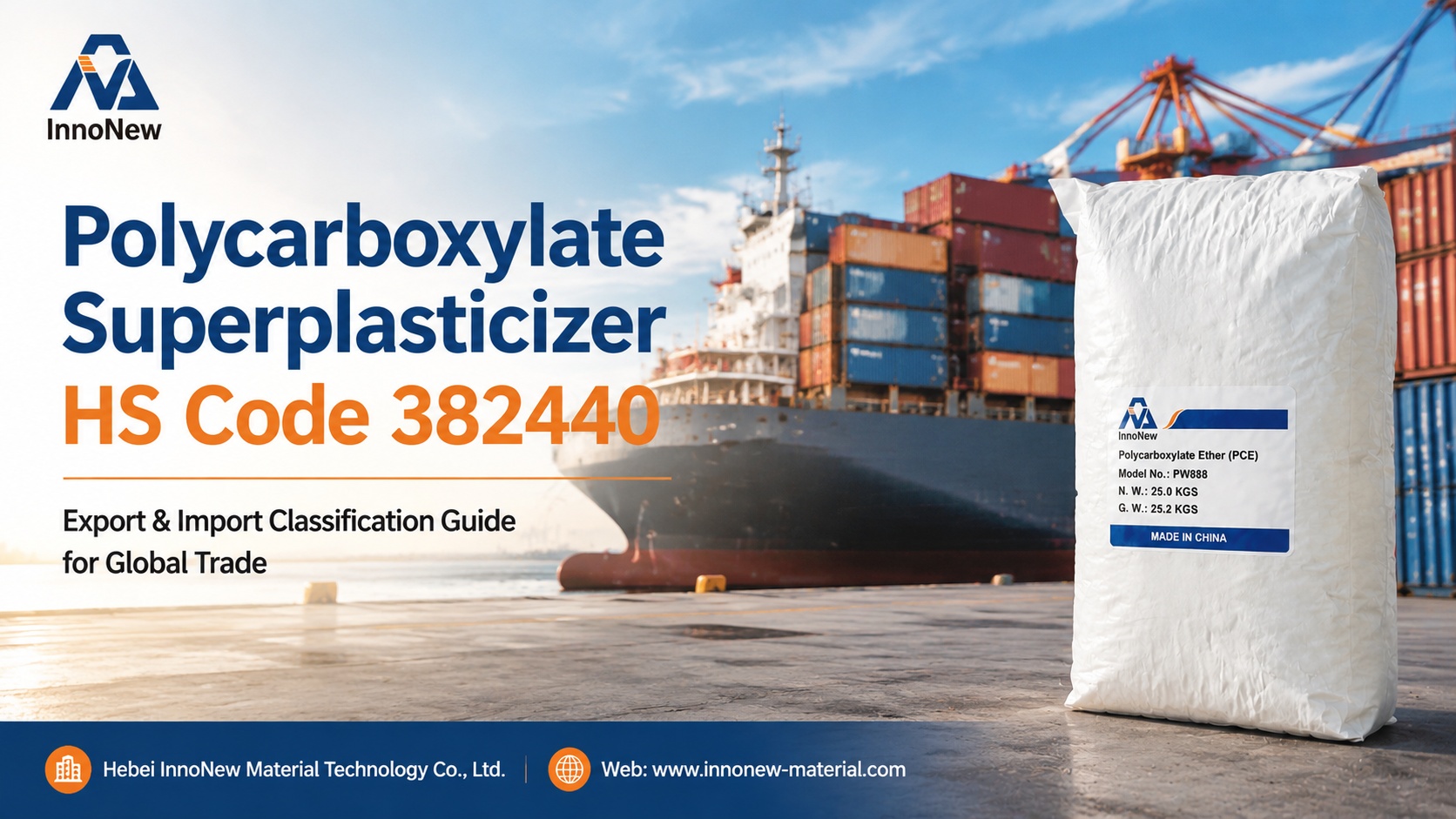
HS Code 382440 – Prepared additives for cement, mortars or concretes
Why 382440?
This classification includes:
- Concrete admixtures
- Cement performance enhancers
- Mortar chemical additives
PCE is classified under this category because its primary function is to:
- Reduce water usage
- Improve workability
- Enhance concrete strength
Important Note:
HS Code interpretation may vary slightly depending on country customs regulations, but 382440 is the most commonly recognized international classification.
3. Product Form vs HS Code
3.1 PCE Powder
- Used in dry-mix mortar systems
- Typically classified under HS 382440
3.2 PCE Liquid
- Used in ready-mix concrete batching plants
- Same HS Code: 382440
3.3 Flake / Solid PCE
- Rare industrial form
- Still classified under HS 382440
Conclusion:
Product physical form does not change HS Code classification, but may affect customs declaration details.
4. Customs Documentation Requirements
To ensure smooth import/export clearance, the following documents are required:
- Material Safety Data Sheet (MSDS)
- Certificate of Analysis (COA)
- Technical Data Sheet (TDS)
- Commercial Invoice
- Packing List
Safety Classification:
PCE is generally:
- Non-hazardous chemical
- Not classified as dangerous goods for transport
5. International HS Code Interpretation
Southeast Asia
- Thailand / Vietnam / Indonesia: HS 382440 commonly used
- Strict MSDS requirements
Middle East
- UAE / Saudi Arabia:
- HS 382440 standard
- Possible SASO compliance required
Africa Markets
- Standard HS 382440 classification
- Focus on shipping documentation
Latin America
- Mostly aligned with HS 382440
- Minor subcategory variations possible
6. HS Code vs CAS vs UN Number
| Classification | Purpose | Application |
|---|---|---|
| HS Code | Customs classification | Tax and import/export |
| CAS Number | Chemical identity | Scientific reference |
| UN Number | Dangerous goods transport | Logistics safety |
PCE typically:
- Has CAS number (depending on formulation)
- No UN number (non-hazardous)
7. Common Customs Mistakes
- Incorrect chemical category selection
- Missing MSDS documentation
- Inconsistent product descriptions
- Mismatch between invoice and HS code
These mistakes can cause:
- Customs delays
- Higher import taxes
- Cargo inspection issues
8. Why Accurate HS Code Matters
Correct HS classification helps importers:
- Reduce customs clearance risk
- Avoid unnecessary taxation
- Improve logistics efficiency
- Ensure regulatory compliance
9. Manufacturer Support
Hebei InnoNew Material Technology Co., Ltd.
We specialize in concrete admixtures and construction chemical additives, including:
- Polycarboxylate Superplasticizer (PCE Powder & Liquid)
- Concrete Mold Release Agent
- Powder Defoamer
- Polypropylene Fiber (PP Fiber)
- HPMC, HEC, MHEC, RDP, PVA systems
- Concrete admixture solutions for:
- Precast concrete
- Ready-mix concrete
- UHPC applications
We provide global customers with:
- Full export documentation support
- Technical consultation for customs classification
- Stable supply and packaging solutions
10. FAQ
1. What is the HS Code of Polycarboxylate Superplasticizer?
It is generally classified under HS Code 382440.
2. Is HS Code 382440 used globally?
Yes, but some countries may apply sub-classifications.
3. Is PCE a hazardous chemical?
No, it is generally non-hazardous.
4. Do I need MSDS for customs clearance?
Yes, MSDS is required in most countries.
5. Does PCE powder and liquid have different HS codes?
No, both usually fall under HS 382440.
6. Can wrong HS code affect import cost?
Yes, it may cause tax changes or customs delays.
7. What documents are needed for export?
MSDS, COA, TDS, invoice, and packing list.