
Gypsum Retarder for Wallboard Production | InnoNew Material
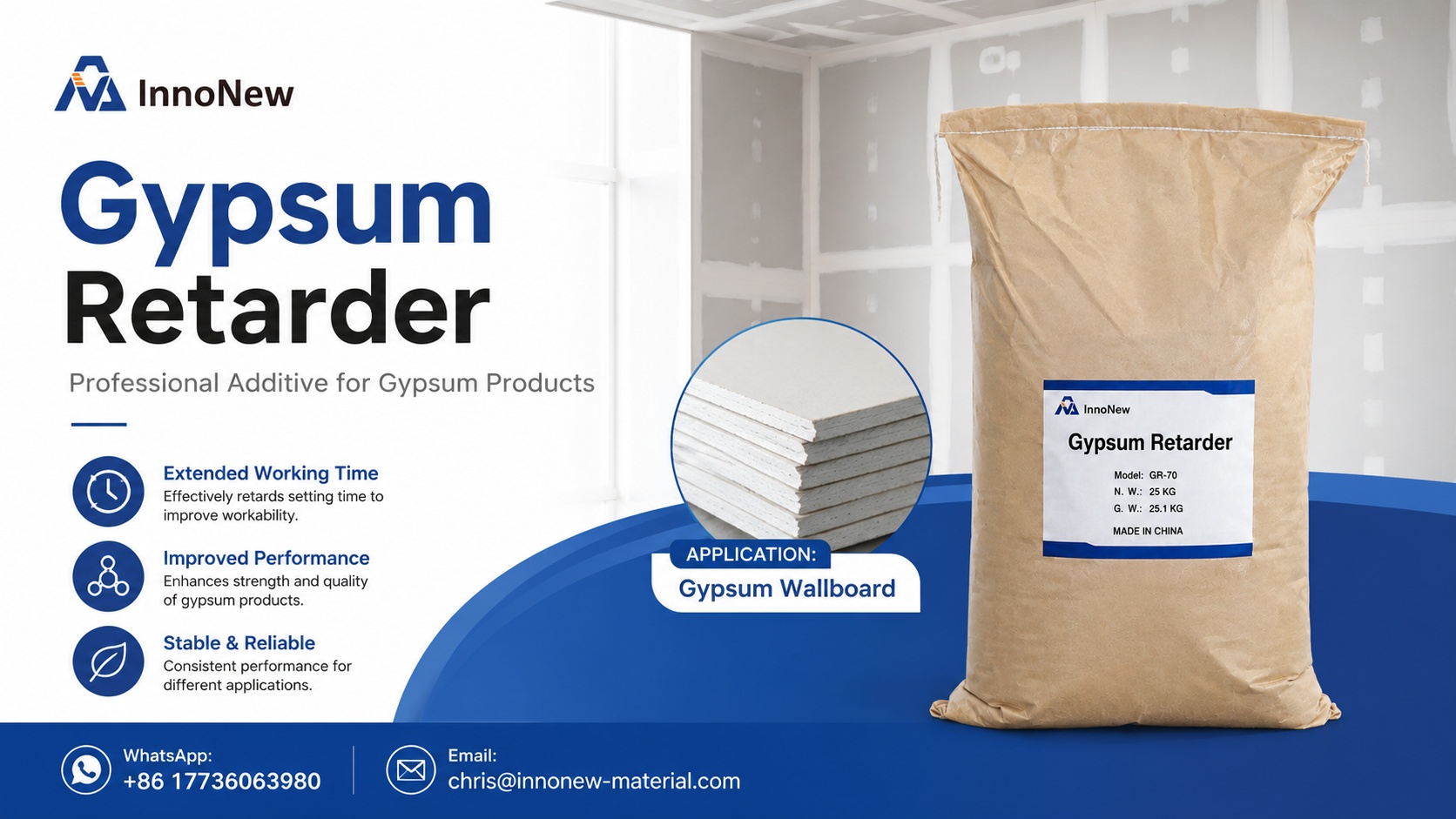
The manufacturing of modern gypsum wallboard (plasterboard) is an exercise in high-speed industrial precision. With continuous production lines operating at speeds exceeding 100 meters per minute, the window for mixing, slurry deposition, board forming, and knife-cutting is measured in seconds. At the heart of this thermodynamic and mechanical orchestration lies a critical chemical challenge: controlling the hydration kinetics of calcium sulfate hemihydrate .
For global B2B wallboard manufacturers, an unmanaged hydration process leads directly to premature thickening in the mixer, equipment downtime, or conversely, slow setting that bottlenecks line speed and escalates kiln-drying costs. Transitioning from generic chemical additives to a high-efficiency, synthetically engineered Gypsum Retarder is no longer merely an option for cost reduction—it is a technical necessity for stabilizing core matrix integrity and maximizing operational throughput.
The Physical Chemistry: Crystal Nucleation and Hydration Kinetics
To understand the necessity of targeted retardation in wallboard production, one must examine the phase transition from semi-hydrated plaster to the dihydrate crystalline matrix CaSO4 2H2O). This exothermic reaction progresses through three distinct thermodynamic stages: the dissolution period, the induction period, and the rapid acceleration/crystallization period.
[Hemihydrate Dissolution] -> [Controlled Induction Window] -> [Rapid Interlocking Acceleration]
         │                                 │                                  │
         ▼                                 ▼                                  ▼
   Ca²+ & SO₄²⁻ Ions                 InnoNew Retarder                  Dense Needle-like
   Saturate Solution                 Regulates Nuclei                  Crystalline Core
Unlike manual-application gypsum plasters, which require a prolonged, flat setting profile to extend open time for workers, continuous wallboard manufacturing demands a highly specialized, steep hydration curve. The ideal retarder must extend the initial induction period just long enough to ensure absolute fluid stability inside the high-speed pin mixer, and then immediately step aside to allow a burst of rapid crystallization before the slurry reaches the cutting knife.
InnoNew Material’s advanced gypsum retarder achieves this via a multi-functional molecular architecture. Optimized carboxyl (-COOH) and amino (-NH2) functional groups act via selective structural adsorption. They temporarily complex free Ca2+ ions in the aqueous phase and selectively adsorb onto the active growth steps of embryonic dihydrate nuclei. This increases the activation energy barrier for critical nucleus size formation, precisely extending the induction window without permanently poisoning the crystals.
Overcoming Industrial Processing Dilemmas
1. The Balance Between Line Speed and Mechanical Setting
In continuous lines, the slurry must transition from a low-viscosity fluid to a rigid, structural plank within a span of 2 to 4 minutes. If the setting profile is too linear or sluggish, the board core will lack sufficient “knife-cutting strength” (early mechanical strength), resulting in edge deformation, structural sagging, or total line blockage at the cutter.
By implementing InnoNew’s high-efficiency retarder, manufacturers achieve a command-set profile. The chemical induction ends abruptly as the temperature rises past a specific thermodynamic threshold, causing the retarder molecules to desorb systematically. This triggers a synchronized crystallization event, allowing the board to establish optimal green strength exactly when it reaches the knife.
2. Low Water-to-Plaster (W/P) Ratios and Polycarboxylate Synergy
Minimizing the water-to-plaster ratio is the primary lever for reducing fuel consumption in the drying kilns. However, operating at low W/P ratios requires heavy dosages of dispersants, such as Polycarboxylate Superplasticizers (PCE). In many manufacturing setups, crude organic acid or protein-based retarders exhibit severe competitive adsorption, displacing the PCE molecules from the gypsum particles and causing catastrophic slump loss or erratic setting times.
InnoNew’s synthetic formulation is engineered for interfacial compatibility. It works in mechanical harmony via a complementary adsorption mechanism. The long pegylated side chains of the PCE maintain steric hindrance and high fluid mobility, while our retarder controls ionic supersaturation at the sub-micron scale. This prevents compatibility cross-interference, allowing plants to comfortably lower water consumption without risking premature setting.
3. Preserving Core Density and Interfacial Adhesion
The injection of aqueous foams (typically alkyl ether sulfates) is vital to engineering lightweight, cost-effective wallboards with a micro-porous core matrix. A recurring vulnerability in plant settings is foam destabilization caused by surfactant incompatibility with the retarder chemistry.
Our chemical stabilizers are thoroughly verified for interfacial tension neutrality. They do not migrate to the air-water interface of the micro-bubbles, preventing coalescence or drainage. The resulting wallboard retains a perfectly homogenous pore distribution, which optimizes structural weight ratios and facilitates the deep penetration of dihydrate crystal needles into the paper liner—ensuring an unbreakable paper-to-core mechanical bond (wet-bond and dry-bond adhesion).
FAQ
1. How does InnoNew’s Gypsum Retarder prevent the “blinding effect” of recycled scrap crystal seeds?
A: In modern wallboard plants, recycled plasterboard scrap or chemical accelerators are frequently introduced to seed crystallization right before the forming station. Traditional, unselective retarders cause a detrimental “blinding effect”, where they indiscriminately coat these micro-crystal seeds, rendering them chemically inert and causing a sluggish hydration tail that compromises final mechanical properties.
InnoNew’s retarder uses selective adsorption kinetics. It focuses primarily on managing the ionic saturation of the liquid phase during the induction window, leaving the crystal seed growth faces accessible for rapid, accelerated development once the rapid crystallization threshold is crossed.
2. What prevents your synthetic retarder from degrading during the high-temperature calcination and mixing cycles?
A: Unlike protein-based retarders, which are highly susceptible to thermal degradation, alkaline hydrolysis, and bacterial breakdown, InnoNew’s gypsum retarder is a synthetically polymerized organic molecule. It possesses high thermal stability up to temperatures well above standard mixing and processing parameters ($>100^\circ\text{C}$). This molecular resilience guarantees consistent retardation behavior regardless of local temperature fluctuations in the processing water or the residual heat of the calcined stucco arriving from the silos.
3. Why does this retarder maintain a higher final compressive strength compared to traditional citric or tartaric acids?
A: Traditional low-molecular-weight organic acids like citric acid drastically alter the crystal habit of dihydrate gypsum, changing the natural, robust interlocking acicular (needle-like) structure into short, stubby, isometric crystals. These blunt crystals cannot weave together effectively, leading to a brittle board core with poor flexural values.
InnoNew’s structural polymer design only delays the timing of nucleation; it does not alter the morphology of final crystal growth. The resulting matrix retains its dense, interlocking needle network, fully preserving the board’s design compressive and flexural strengths.
4. How does the product accommodate variations in stucco quality, such as FGD gypsum vs. natural gypsum?
A: Flue Gas Desulfurization (FGD) gypsum and phosphogypsum contain varying residual impurities, soluble salts (such as soluble $P_2O_5$ or fluorides), and fluctuating pH levels that alter natural setting rates.
Our retarder features a highly robust buffering capacity against ionic interference. The specific density of its chelating groups allows it to preferentially complex $Ca^{2+}$ ions without being easily neutralized by background monovalent or divalent impurity ions. This delivers predictable, reproducible retardation across a wide variance of raw stucco batches.
5. In what specific way does this formulation optimize the wet-bond adhesion between the gypsum slurry and the paper liner?
A: True interfacial adhesion relies on the physical migration of growing gypsum crystal needles into the micro-pores of the paper liner before drying. If a retarder causes a sluggish or incomplete chemical setting, these crystals fail to anchor deeply before the water evaporates in the kiln, causing the paper to peel.
By engineering a sharp, abrupt end to the induction period, InnoNew’s retarder forces a high-density front of crystal growth directly at the core-paper boundary layer. This establishes a robust mechanical lock, entirely eliminating the risk of delamination during subsequent handling and installation.
Technical Support & Formulation Design: Optimizing a high-speed wallboard production line requires individual analysis of stucco chemistry, water quality, and equipment geometry. InnoNew Material provides comprehensive formulation audits alongside our high-efficiency additives.
For technical inquiries, product samples, or digital consultations, contact our application engineering desk directly via Email at chris@innonew-material.com or connect with our technical consultants via WhatsApp at +86 17736063980.