
Powder Defoamer in Dry Mix Mortar Systems
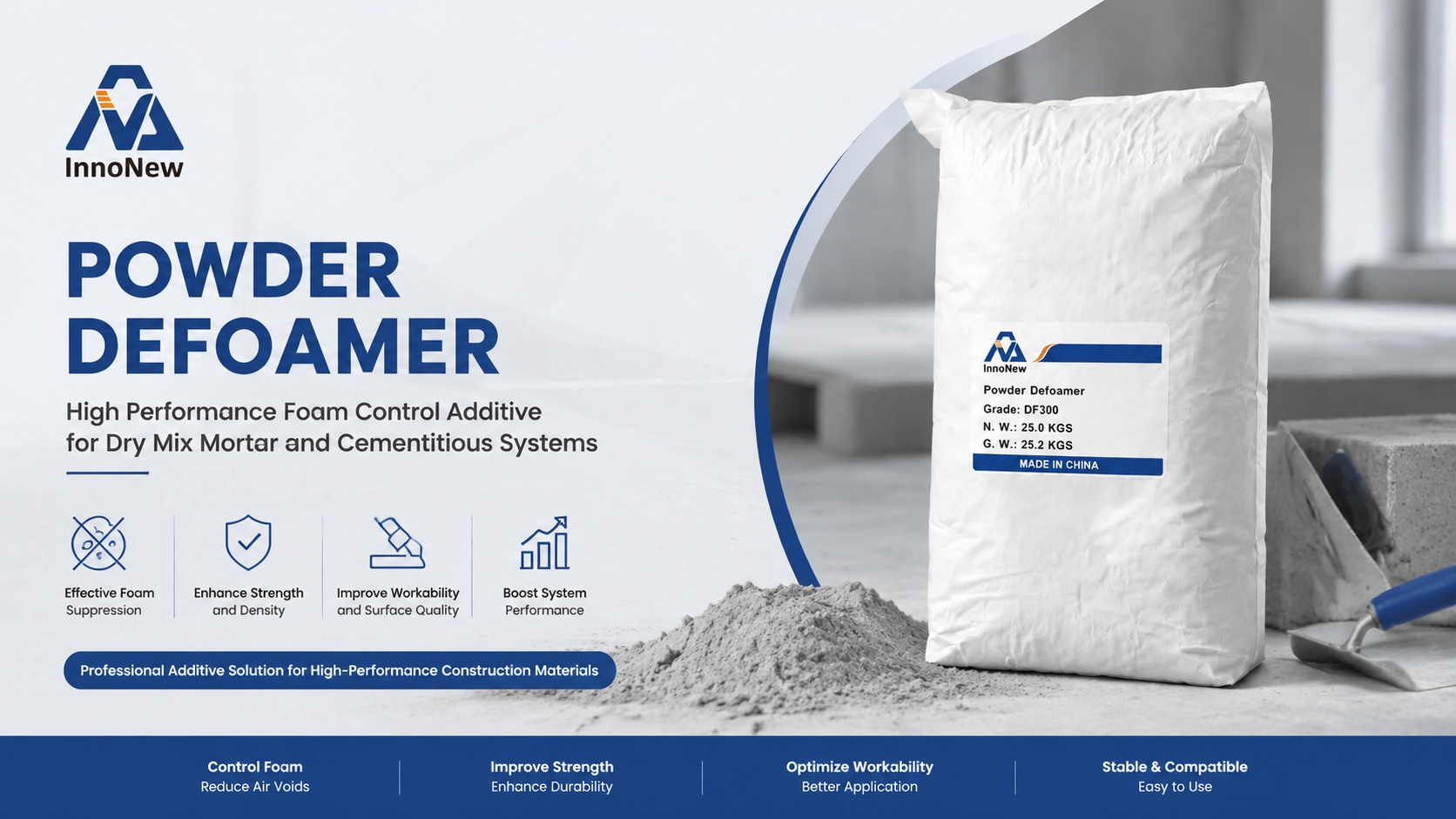
Foam Control Mechanism, System Compatibility, and Engineering Application in Modern Construction Materials
1. Introduction: Foam is Not a Surface Problem, but a System Defect
In modern dry mix mortar technology, air entrainment is no longer a minor defect—it is a system-level performance instability factor.
With the increasing use of:
- Cellulose ethers (HPMC / MHEC)
- Redispersible polymer powder (RDP / VAE)
- Polycarboxylate superplasticizers (PCE)
- High-performance fillers and fine powders
the system becomes highly dispersive and surfactant-rich, which significantly increases foam stability during mixing.
Foam is no longer “air bubbles”
It becomes stable micro-void structure trapped inside cement matrix
This directly affects:
- Mechanical strength
- Density
- Surface finishing
- Pumpability
- Shrinkage behavior
2. Foam Formation in Dry Mix Systems
Foam in dry mix mortar is generated through a combination of physical and chemical interactions:
2.1 Physical Entrapment
High-speed mixing introduces:
- Air vortex entrainment
- Particle collision voids
- Poor wetting of fine powders
2.2 Surfactant Stabilization
Modern additives act as foam stabilizers:
- HPMC → increases viscosity, slows bubble collapse
- RDP → polymer film stabilizes air pockets
- PCE → dispersion increases air entrainment risk
- Starch ether → enhances water retention, stabilizes foam film
2.3 Result: Stable Micro-Foam Network
Instead of collapsing, bubbles become:
“Viscous polymer-stabilized air void systems”
These voids remain into hardened structure.
3. System-Level Impact of Entrapped Air
Air voids are not just cosmetic defects—they change material physics:
In Fresh State:
- Reduced flow stability
- Inconsistent rheology
- Pumping resistance fluctuation
- Surface segregation risk
In Hardened State:
- Reduced compressive strength (critical impact)
- Increased permeability
- Lower density and cohesion
- Poor surface smoothness (pinholes, craters)
- Reduced durability in wet environments
In high-performance systems (tile adhesive C2, self-leveling), even 1–2% air variation can significantly affect performance class compliance.
4. Powder Defoamer: Functional Mechanism in Multi-Component Systems
Powder Defoamer is not a simple “foam breaker”.
It is a solid-phase interfacial instability agent designed for dry-mix environments.
Its function is based on three mechanisms:
4.1 Interfacial Film Collapse
Powder defoamer particles migrate to air-liquid interfaces and:
- Disrupt surfactant alignment
- Reduce surface elasticity
- Cause film rupture
4.2 Local Surface Energy Imbalance
It creates micro-regions of:
- Low surface tension
- Hydrophobic disruption points
These act as “foam collapse nuclei”.
4.3 Air Release Acceleration
During mixing and placement:
- Promotes bubble coalescence
- Accelerates air escape before setting
- Prevents stabilization of micro voids
5. Dry Mix System Compatibility Problem
The real difficulty is not defoaming itself, but:
maintaining foam control without damaging rheology system
Because modern dry mix systems are already optimized by:
- HPMC (viscosity control system)
- RDP (elastic film system)
- PCE (dispersion system)
A poorly designed defoamer will:
- Collapse viscosity too early
- Destroy water retention balance
- Cause segregation or bleeding
Therefore, Powder Defoamer must be engineered for system neutrality + selective interface activity
6. Dry Mix Mortar System Architecture
Below is the simplified system interaction model:
┌─────────────────────────────────────────────┐
│          DRY MIX MORTAR SYSTEM              │
├─────────────────────────────────────────────┤
│ Cement / Gypsum Binder                      │
│         ↓                                   │
│ Fine Fillers (CaCO3, sand, silica)         │
│         ↓                                   │
│ HPMC / MHEC → viscosity & water retention   │
│         ↓                                   │
│ RDP (VAE) → film formation & adhesion       │
│         ↓                                   │
│ PCE → dispersion & flow improvement         │
│         ↓                                   │
│ ⚠ Foam Formation Zone (critical issue)      │
│   - air entrapment                          │
│   - stabilized bubbles                      │
│   - micro void network                      │
│         ↓                                   │
│ Powder Defoamer                             │
│   → interface rupture                       │
│   → bubble destabilization                 │
│   → air release                             │
│         ↓                                   │
│ FINAL STRUCTURE                             │
│ Dense + low void + high strength matrix     │
└─────────────────────────────────────────────┘
7. Application Engineering Scenarios
7.1 Tile Adhesive Systems (C1 / C2TE)
Problems solved:
- Hollow tiles (void under tile)
- Reduced bonding strength
- Surface pinholes
Effect:
- Improved contact area
- Higher bond strength consistency
7.2 Self-Leveling Compounds
Critical issues:
- Bubble trapping during flow
- Surface cratering after leveling
Effect:
- Stable flow front
- Smooth mirror-like surface finish
7.3 Gypsum Plaster Systems
Problems:
- Surface blistering
- Uneven finishing texture
Effect:
- Dense plaster body
- Improved trowel finish quality
7.4 Precast Concrete & Repair Mortars
Problems:
- Internal voids
- Strength inconsistency
Effect:
- Higher compactness
- Improved structural reliability
8. Engineering Performance Advantages
When properly designed into the system:
- Air content reduction (controlled micro-void elimination)
- Increased compressive strength (void elimination effect)
- Improved density and compactness
- Enhanced surface finish quality
- Stable performance under high shear mixing
- No interference with polymer modification systems
9. Formulation Engineering Guidelines
Recommended dosage range:
0.1% – 0.5% (optimized by system design)
Engineering principles:
- Lower dosage → fine foam control systems (tile adhesive)
- Medium dosage → plaster systems
- Higher dosage → self-leveling / high air entrainment systems
Mixing strategy:
- Pre-blend with fillers (best dispersion control)
- Avoid direct contact with liquid additives before dry blending
10. FAQ
Q1: Why does modern dry mix mortar generate more foam than traditional mortar?
Because polymer and surfactant-based additives stabilize air-liquid interfaces, preventing natural bubble collapse.
Q2: Can defoamer reduce strength loss in mortar?
Yes. Strength improvement comes indirectly from reduced internal void ratio.
Q3: Why not use only liquid defoamer?
Liquid defoamers often separate in dry systems and lack long-term stability during storage.
Q4: Does powder defoamer affect rheology?
Properly engineered powder defoamer is rheology-neutral at correct dosage.
Q5: Is defoamer system-dependent?
Yes. It must be optimized with HPMC, RDP, and PCE combination systems.