
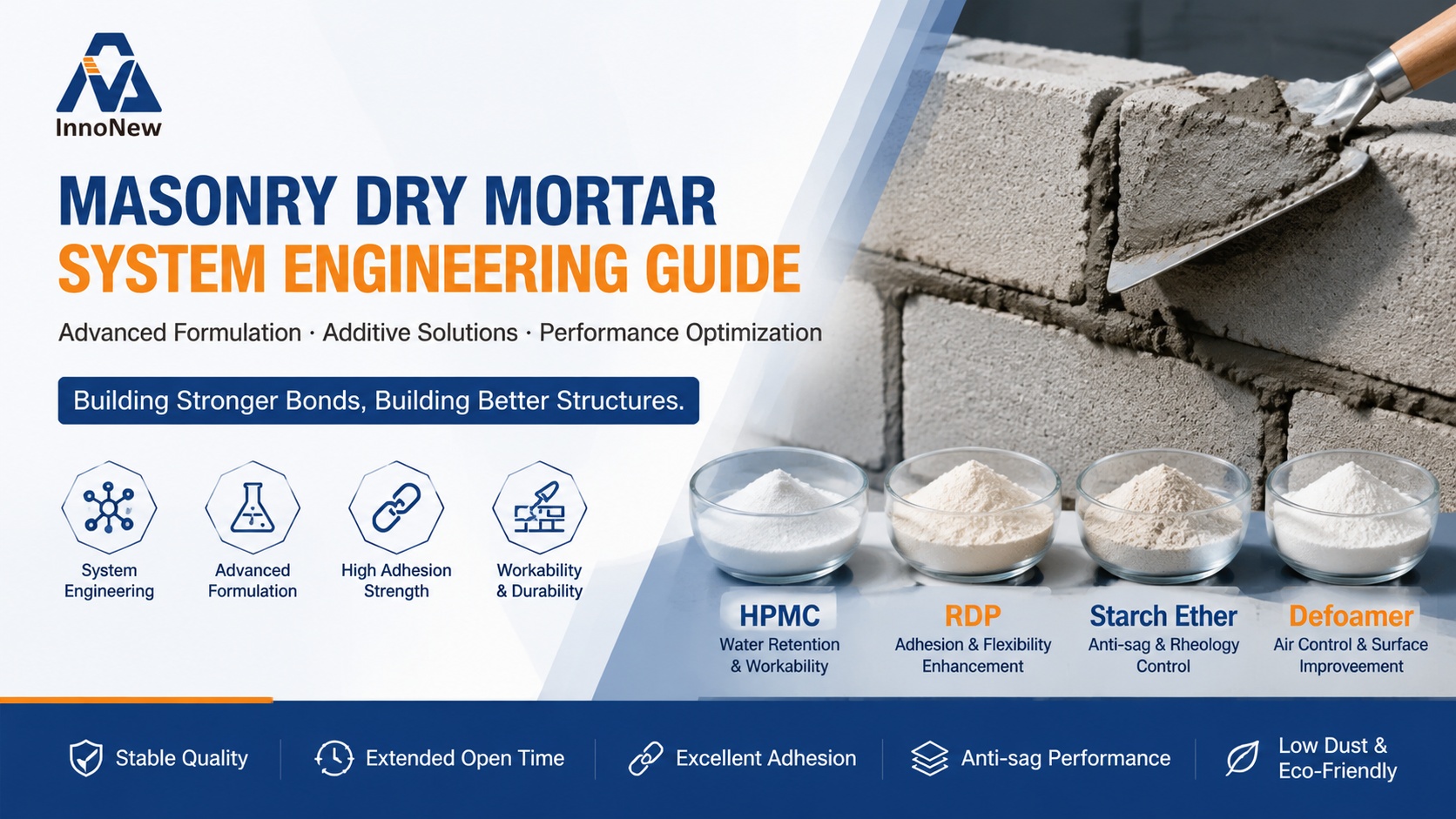
Executive Summary: From Mortar Product to System Industry
The global construction industry is undergoing a structural transformation:
From site-mixed materials → industrial dry-mix mortar systems
Dry-mix mortar is no longer a single product category. It has evolved into a:
Multi-system engineered construction material platform
This platform integrates:
- Masonry systems
- Tile adhesive systems
- Plastering systems
- Self-leveling systems
- Repair mortar systems
Each system is defined not by formulation alone, but by performance engineering requirements and application mechanics.
Dry-Mix Mortar System Architecture
                DRY-MIX MORTAR INDUSTRIAL SYSTEM

┌───────────────────────────────────────────────┐
│              APPLICATION SYSTEMS              │
│  Masonry | Tile Adhesive | Plaster | SLC     │
└───────────────────────────────────────────────┘
                        ↓
┌───────────────────────────────────────────────┐
│           MATERIAL ENGINEERING LAYER          │
│ Cement / Gypsum / Lime / Fillers             │
└───────────────────────────────────────────────┘
                        ↓
┌───────────────────────────────────────────────┐
│        FUNCTIONAL ADDITIVE SYSTEM CORE        │
│ HPMC | RDP | Starch Ether | Defoamer         │
└───────────────────────────────────────────────┘
                        ↓
┌───────────────────────────────────────────────┐
│        RHEOLOGY & HYDRATION CONTROL           │
│ Water retention | viscosity | open time      │
└───────────────────────────────────────────────┘
                        ↓
┌───────────────────────────────────────────────┐
│          INDUSTRIAL PRODUCTION SYSTEM         │
│ Mixing | Packaging | Storage | Transport      │
└───────────────────────────────────────────────┘
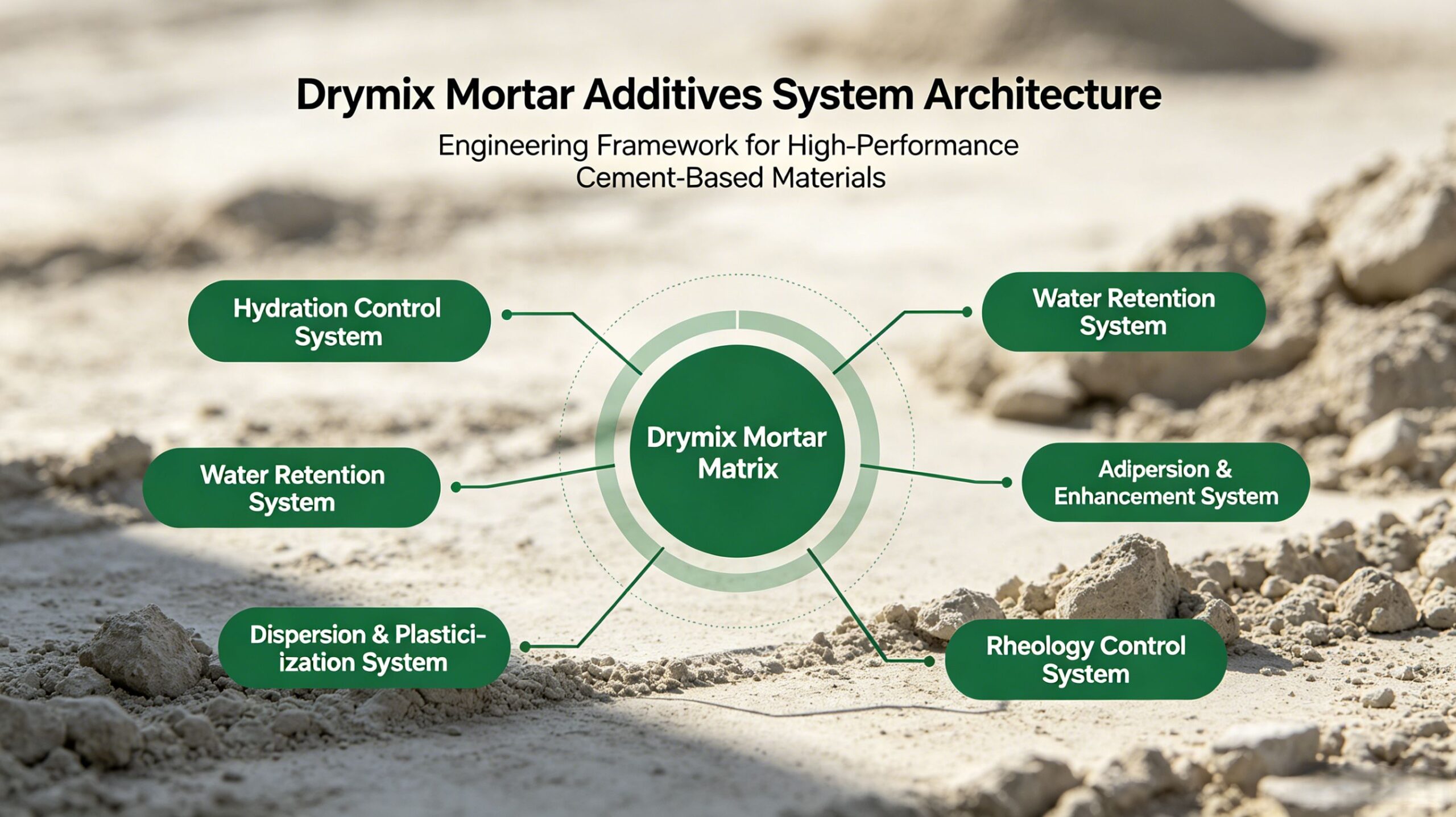
System Classification: Four Core Dry-Mix Mortar Families
1. Masonry Mortar System
- Structural block bonding system
- Load transfer function
- AAC compatibility
2. Tile Adhesive System
- High polymer content system
- Slip resistance + adhesion strength
- Critical for ceramic / porcelain tiles
3. Plastering Mortar System
- Wall leveling system
- Workability-focused formulation
- Crack resistance optimized
4. Self-Leveling Compound System
- Flowable cementitious system
- High precision leveling
- Floor finishing layer
Each system shares the same “additive backbone”, but differs in performance logic design.
Material Engineering Layer
1.Cementitious Binder System
- Portland cement (strength base)
- Gypsum (fast setting systems)
- Lime (plasticity improvement)
Function is not only strength, but reaction kinetics control
2. Aggregate & Filler Engineering
- Quartz sand (strength skeleton)
- Limestone powder (workability)
- Particle grading optimization
Principle:
Maximum packing density = minimum void structure
Functional Additive System
1. INNOCELL™ HPMC – Hydration Control System
Engineering Role:
- Controls water migration
- Extends open time
- Stabilizes vertical applications
System Effect:
- Prevents premature hydration collapse
- Improves construction tolerance window
2. INNOPOLY™ RDP – Polymer Reinforcement Network
Mechanism:
- Film formation after hydration
- Creates flexible bonding matrix
System Function:
- Adhesion enhancement across all substrates
- Crack resistance under thermal stress
3. INNOSTAR™ Hydropropyl Starch Ether – Rheology Control Intelligence
- Controls yield stress
- Anti-sag for vertical systems
- Enhances troweling performance
4. INNODEFOAM™ Powder Defoamer – Microstructure Optimization
- Eliminates entrapped air
- Improves density uniformity
- Enhances compressive reliability
System Cross-Interaction Model
Dry-mix mortar performance is not linear.
It is a multi-variable interaction system:
- HPMC ↔ water retention ↔ hydration rate
- RDP ↔ cement matrix ↔ adhesion strength
- Starch ether ↔ rheology ↔ workability
- Defoamer ↔ air content ↔ density
This creates a 4D performance matrix, not a simple recipe.
Industrial Production System (Factory Perspective)
1. Raw Material Pre-Mixing
- Dry blending of powders
- Controlled humidity (<0.5%)
2. High-Precision Mixing
- Double-shaft mixer / ribbon mixer
- Homogeneity control critical
3. Packaging System
- 25kg bags / bulk bags
- Anti-moisture protection design
4. Storage & Transport
- Temperature stability
- Anti-caking control
Industrial failure is often NOT formulation-related, but process instability
Global Application Environment Engineering
Hot Climate Regions (Middle East / South Asia)
- High evaporation control required
- Increased HPMC retention system
Humid Regions
- Anti-slump + microbial stability focus
- Improved rheology control
Cold Regions
- Anti-freeze hydration control
- Polymer reinforcement increase
System Performance Index Framework
Industrial evaluation is based on:
- Water retention index
- Adhesion strength index
- Rheology stability index
- Open time index
- Shrinkage resistance index
- Construction efficiency index
This is a system-level evaluation model, not a single test result.
Failure Mechanism Analysis (Engineering Diagnostics)
Crack Failure
- Shrinkage stress > tensile capacity
Bond Failure
- Insufficient polymer film formation
Sagging Failure
- Yield stress instability
Dusting Failure
- Poor hydration + air voids
Future Development of Dry-Mix Mortar Systems
- Carbon-reduced cement systems
- AI formulation optimization
- High-polymer low-cement systems
- Prefabricated construction integration
- Smart rheology materials
InnoNew Material System Positioning
INNONEW provides a complete construction chemical system solution platform:
- INNOCELL™ HPMC → hydration & water control
- INNOPOLY™ RDP → adhesion & flexibility
- INNOSTAR™ Starch Ether → rheology control
- INNODEFOAM™ Defoamer → air structure optimization
Designed for global dry-mix mortar manufacturers:
- Tile adhesive factories
- Masonry mortar producers
- Gypsum plaster plants
- Self-leveling compound systems
FAQ
Q1: What is a dry-mix mortar system?
A complete industrial construction material system including masonry, tile adhesive, plaster, and self-leveling products designed for factory production and site application.
Q2: Why is dry-mix mortar considered a system rather than a product?
Because its performance depends on interactions between binder chemistry, polymer modification, particle packing, and rheology control.
Q3: What is the role of HPMC in dry-mix systems?
It controls water retention, hydration speed, and workability across all mortar applications.
Q4: How does RDP improve mortar performance?
It forms a polymer film that enhances adhesion, flexibility, and crack resistance.
Q5: Why is rheology important in dry-mix mortar?
Because it determines application behavior such as sag resistance, flowability, and troweling performance.
Q6: What are the main dry-mix mortar systems in construction?
Masonry mortar, tile adhesive, plaster mortar, and self-leveling compounds.