
Tile Adhesive Formulation Guide: Complete C1/C2 Formula, Raw Materials & Performance Optimization
INTRODUCTION
Tile adhesive is a polymer-modified cementitious bonding material widely used for ceramic tiles, porcelain tiles, marble, stone installation, and large-format tile applications in modern construction systems.
Compared with traditional cement-sand mortar, modern tile adhesive provides:
- Higher bonding strength
- Better flexibility
- Improved water retention
- Extended open time
- Enhanced anti-slip performance
- Superior crack resistance
A high-performance tile adhesive formulation requires a balanced combination of cement, graded sand, cellulose ether, redispersible polymer powder, and functional additives.
This guide explains the complete tile adhesive formulation system, including raw materials, additive selection, manufacturing process, common problems, and performance optimization for professional dry mix mortar production.
What Is Tile Adhesive?
Tile adhesive is a dry mix mortar composed of:
- Cement
- Graded silica sand
- Cellulose ether
- Polymer additives
- Functional performance modifiers
After mixing with water, the adhesive forms a high-strength bonding layer between the substrate and tile surface.
Modern tile adhesive systems are widely used in:
- Ceramic tile installation
- Porcelain tile fixing
- Wall and floor tiling
- Exterior facade systems
- Large-format tile applications
- Underfloor heating systems
Tile Adhesive Classification According to EN12004
The EN12004 standard is the most widely recognized international classification system for cementitious tile adhesives.
| Classification | Description |
|---|---|
| C1 | Standard cementitious tile adhesive |
| C2 | Improved adhesive with higher bond strength |
| S1 | Deformable adhesive |
| S2 | Highly deformable adhesive |
Typical Performance Requirements
| Property | C1 Standard | C2 Standard |
|---|---|---|
| Tensile Adhesion Strength | ≥ 0.5 MPa | ≥ 1.0 MPa |
| Slip Resistance | ≤ 0.5 mm | ≤ 0.5 mm |
| Open Time | ≥ 20 min | ≥ 20 min |
C2 polymer-modified tile adhesive is commonly used for porcelain tiles, exterior walls, and large-format tile applications due to its superior flexibility and bonding performance.
Core Raw Materials in Tile Adhesive Formulation
Cement
Ordinary Portland Cement (OPC) provides the primary hydraulic bonding strength in tile adhesive systems.
Recommended cement grades:
- OPC 42.5
- OPC 52.5
Higher cement quality improves:
- Early strength
- Final bonding strength
- Water resistance
Graded Silica Sand
Quartz sand acts as the structural skeleton of dry mix mortar.
Proper sand grading improves:
- Workability
- Shrinkage control
- Crack resistance
- Mechanical strength
Recommended mesh combinations:
- 40–70 mesh
- 70–120 mesh
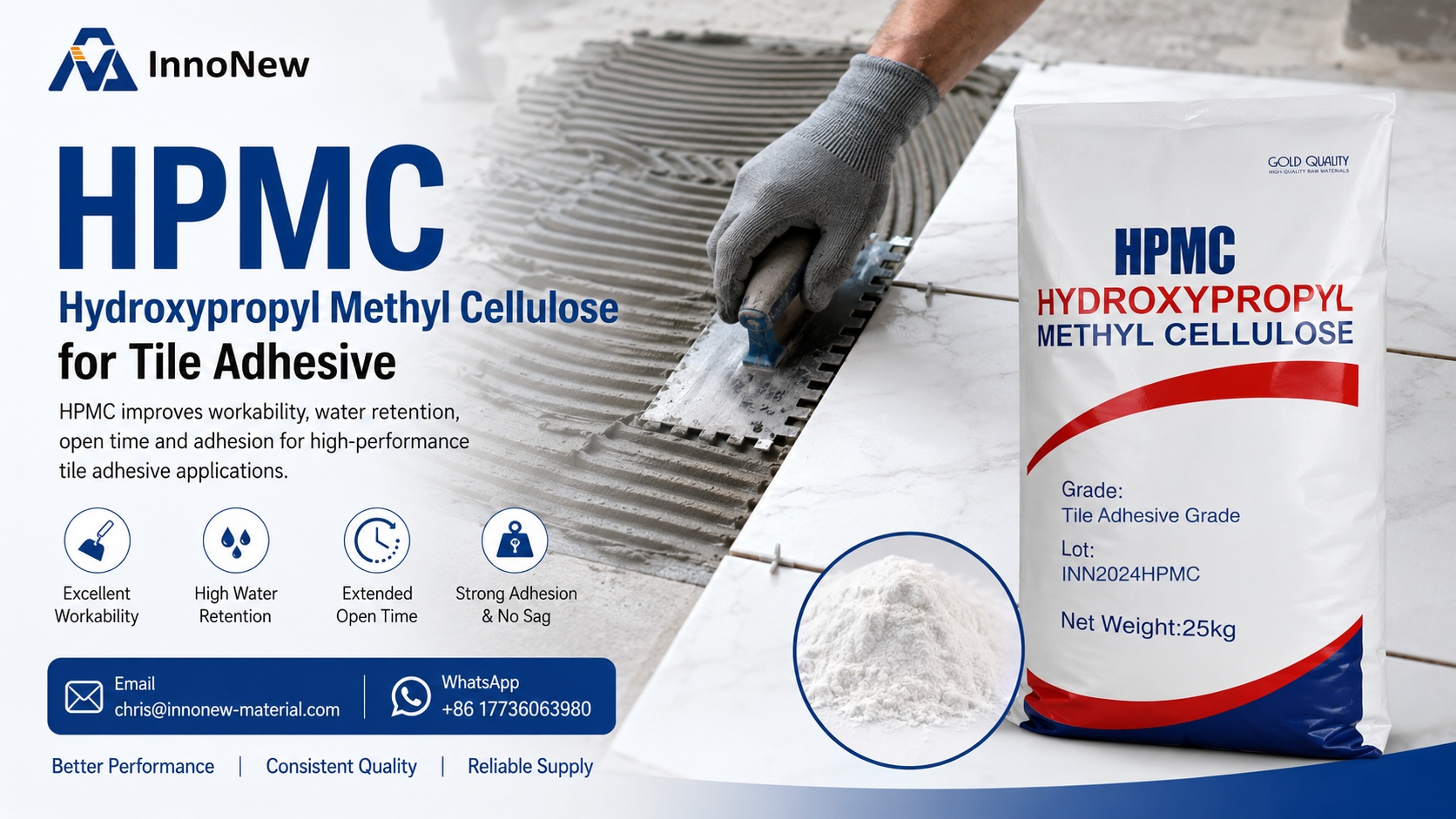
Hydroxypropyl Methyl Cellulose (HPMC)
Hydroxypropyl Methyl Cellulose (HPMC) is the most important water-retention additive in tile adhesive formulations.
Main functions of HPMC:
- Water retention
- Open time extension
- Improved workability
- Enhanced anti-sagging performance
- Better substrate wetting
Typical dosage: 0.3%–0.5%
Higher viscosity HPMC generally provides better sag resistance and water retention performance.
Redispersible Polymer Powder (RDP)
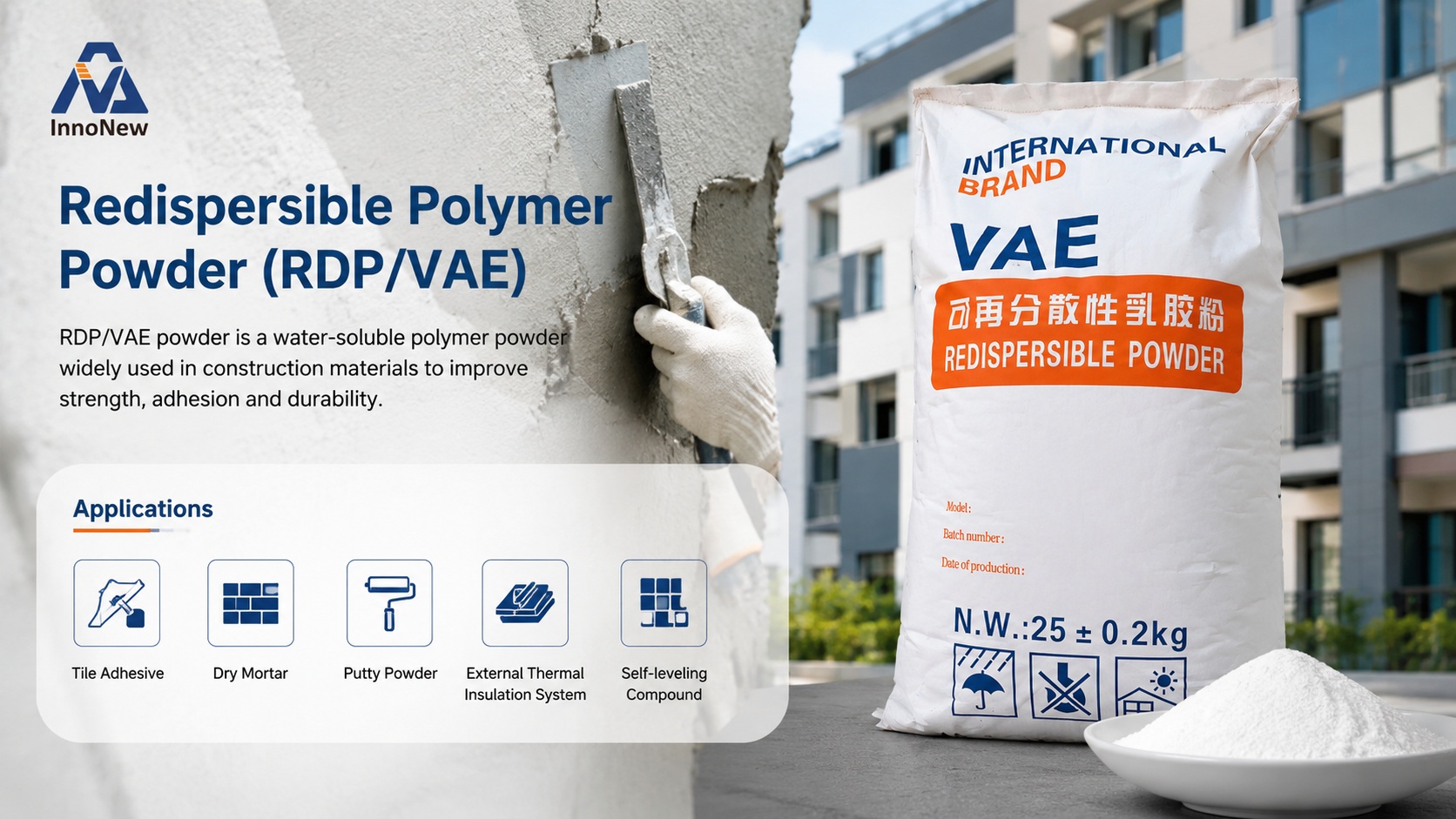
Redispersible Polymer Powder (RDP) plays a decisive role in polymer-modified tile adhesive systems.
After cement hydration and water evaporation, RDP particles redisperse and form a continuous polymer film within the mortar matrix.
This polymer network significantly improves:
- Tensile adhesion strength
- Flexibility
- Impact resistance
- Crack resistance
- Freeze-thaw durability
- Bonding performance on porcelain tiles
Typical dosage: 1%–5%
Higher RDP dosage is recommended for:
- Porcelain tile adhesive
- Exterior tile systems
- Flexible tile adhesive
- Large-format tile installation
Hydroxypropyl Starch Ether (HPS)
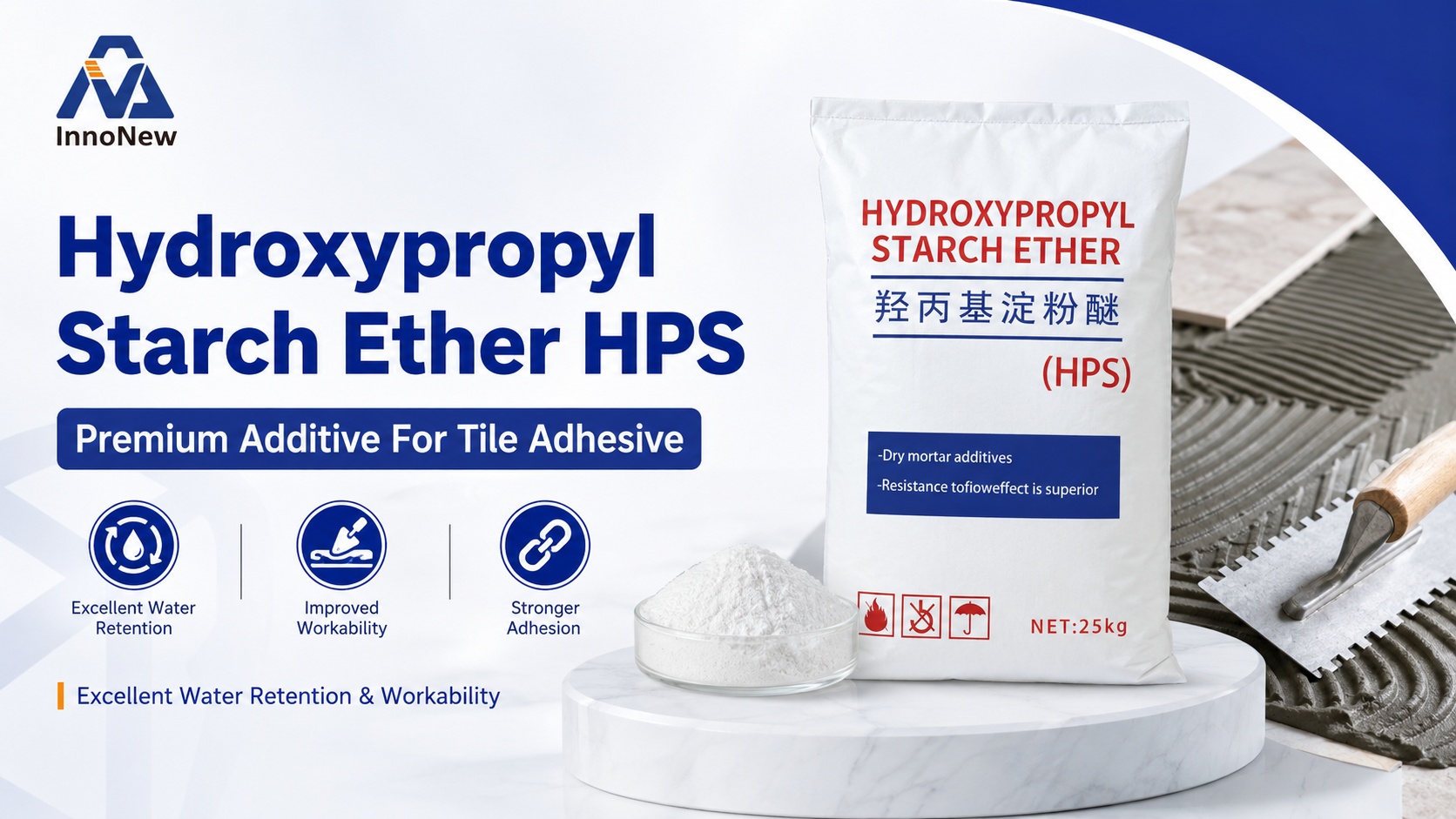
HPS is mainly used to improve rheology and anti-slip performance.
Main functions:
- Enhanced anti-sagging
- Improved smoothness
- Better troweling performance
- Reduced tile slipping
Typical dosage: 0.02%–0.1%
Standard C1 Tile Adhesive Formula
| Raw Material | Percentage (%) |
|---|---|
| OPC Cement | 30–35 |
| Quartz Sand | 60–65 |
| HPMC | 0.3–0.5 |
| RDP | 1–2 |
| HPS | 0.02–0.05 |
Applications:
- Ceramic tiles
- Interior wall tiles
- Standard flooring systems
High-Performance C2 Tile Adhesive Formula
| Raw Material | Percentage (%) |
|---|---|
| OPC Cement | 35–40 |
| Quartz Sand | 50–55 |
| HPMC | 0.35–0.55 |
| RDP | 3–5 |
| HPS | 0.03–0.08 |
Applications:
- Porcelain tiles
- Exterior walls
- Large-format tiles
- Underfloor heating systems
Tile Adhesive Formulation for Porcelain Tiles
Porcelain tiles have extremely low water absorption, making bonding more challenging compared with traditional ceramic tiles.
Therefore, porcelain tile adhesive requires:
- Higher RDP dosage
- Improved flexibility
- Stronger tensile adhesion
- Better wetting performance
Recommended formulation features:
- RDP: 3–5%
- High water-retention HPMC
- Enhanced open time
- Improved deformability
C2 polymer-modified adhesive is strongly recommended for porcelain tile installation.
Tile Adhesive Manufacturing Process
Step 1 — Raw Material Preparation
Ensure all raw materials are dry and accurately weighed.
Step 2 — Dry Mixing
Mix cement, sand, and additives uniformly using a dry powder mixer.
Recommended mixing time:
10–15 minutes
Step 3 — Quality Inspection
Check:
- Powder uniformity
- Bulk density
- Water retention
- Open time
- Adhesion strength
Step 4 — Packaging
Use moisture-proof valve bags or laminated packaging materials.
Standard packaging:
- 25 kg bags
- 40 kg bags
Common Tile Adhesive Problems & Solutions
Poor Bond Strength
Possible Causes
- Low RDP dosage
- Poor cement quality
- Excessive water addition
Recommended Solutions
- Increase RDP dosage
- Use high-grade cement
- Optimize water-to-cement ratio
Tile Slipping on Walls
Possible Causes
- Insufficient HPS dosage
- Low viscosity HPMC
- Poor rheology balance
Recommended Solutions
- Increase HPS dosage
- Use higher viscosity cellulose ether
- Optimize additive compatibility
Short Open Time
Possible Causes
- Poor water retention
- Low HPMC dosage
- Hot climate conditions
Recommended Solutions
- Increase HPMC dosage
- Use high water-retention cellulose ether
- Optimize formulation for tropical climates
How to Reduce Tile Adhesive Production Cost
Manufacturers can optimize production cost through:
- Sand grading optimization
- Efficient polymer dosage control
- Proper additive compatibility
- High-efficiency cellulose ether selection
- Local raw material sourcing
However, excessive cost reduction may negatively affect:
- Bonding strength
- Durability
- Workability
- Crack resistance
Maintaining formulation balance is critical for long-term product performance.
Conclusion
A high-performance tile adhesive formulation requires proper balance between cement, graded sand, cellulose ether, polymer powder, and rheology modifiers.
Among all additives:
- HPMC controls water retention and workability
- RDP improves flexibility and adhesion
- HPS enhances anti-sagging performance
Modern construction systems increasingly require high-performance polymer-modified tile adhesive solutions, especially for porcelain tiles, large-format tiles, and exterior wall applications.
Selecting the correct formulation and additive system is essential for ensuring long-term durability, installation efficiency, and construction quality.
FAQ
What is the best polymer for tile adhesive?
Redispersible Polymer Powder (RDP) is widely considered the most effective polymer additive for improving flexibility, adhesion strength, crack resistance, and durability in cement-based tile adhesive systems.
What is the standard dosage of HPMC in tile adhesive?
The recommended HPMC dosage is typically between 0.3% and 0.5%, depending on water retention requirements, workability, and climate conditions.
Why does tile adhesive slip on walls?
Tile slipping is usually caused by insufficient anti-sagging performance, low HPS dosage, improper rheology balance, or low-viscosity cellulose ether.
Which tile adhesive is suitable for porcelain tiles?
Porcelain tiles generally require C2 polymer-modified tile adhesive with higher RDP dosage because porcelain surfaces have very low water absorption.
What is the difference between C1 and C2 tile adhesive?
C2 tile adhesive provides higher tensile adhesion strength, better flexibility, and improved durability compared with standard C1 adhesive.
How does RDP improve tile adhesive performance?
RDP forms a polymer film inside the cement matrix after hydration, significantly improving flexibility, adhesion, crack resistance, and impact resistance.
What causes poor bonding strength in tile adhesive?
Common causes include insufficient RDP dosage, poor cement quality, excessive water addition, and improper sand grading.
Can tile adhesive be used for large-format tiles?
Yes. Large-format tiles usually require high-performance flexible C2 tile adhesive with increased RDP dosage and improved deformability.