
Top 10 Tile Adhesive Problems: Root Causes, Failure Mechanisms and Professional Solutions
Introduction
Tile adhesive technology has evolved significantly over the past decade. The growing use of porcelain tiles, large-format slabs, heated floors, and exterior façade systems has placed much higher performance requirements on cement-based tile adhesives.
Despite advances in formulation technology, tile failures remain one of the most common issues in construction projects worldwide.
Many contractors assume that poor bonding strength is the primary reason for tile failures. In reality, most failures originate from a combination of material selection, formulation design, substrate conditions, and installation practices.
This article analyzes the ten most common tile adhesive problems from an engineering perspective and provides practical solutions based on modern dry mix mortar technology.
Understanding Tile Adhesive Classification Before Troubleshooting
Before discussing failures, it is important to understand adhesive classifications according to EN 12004.
| Classification | Description |
|---|---|
| C1 | Standard Cementitious Tile Adhesive |
| C2 | Improved Cementitious Tile Adhesive |
| C2T | Reduced Slip Tile Adhesive |
| C2E | Extended Open Time Tile Adhesive |
| C2TE | Reduced Slip + Extended Open Time |
| C2TES1 | Flexible Tile Adhesive |
| C2TES2 | Highly Flexible Tile Adhesive |
Many tile failures occur simply because the adhesive grade selected is not suitable for the application.
For example, using a standard C1 adhesive for large-format porcelain tiles may lead to debonding even when installation quality is acceptable.
Problem 1: Tile Debonding (Tiles Falling Off)
Symptoms
- Tiles detach from walls or floors
- Partial or complete bond failure
- Failure occurs after days, months, or years
Root Causes
- Insufficient cement hydration
- Poor wetting of tile back surface
- Low polymer content
- Inadequate open time
- Incorrect adhesive classification
Failure Mechanism
The adhesive fails to create sufficient mechanical and chemical bonding between the tile and substrate. Porcelain tiles with water absorption below 0.5% are particularly challenging because they offer very limited mechanical anchoring.
Professional Solutions
✓ Increase polymer modification using RDP
✓ Improve water retention using HPMC
✓ Select C2 or C2TES1 adhesive grades
✓ Ensure adequate tile coverage
✓ Apply back buttering for large-format tiles
Problem 2: Hollow Tiles
Symptoms
- Hollow sound when tapped
- Reduced impact resistance
- Future risk of tile detachment
Root Causes
- Incomplete adhesive transfer
- Incorrect trowel selection
- Excessive air entrapment
- Poor mortar rheology
- Adhesive skinning before tile placement
Failure Mechanism
Air voids form beneath the tile, reducing effective bonding area and creating localized stress concentrations.
Coverage Requirements
| Application | Minimum Coverage |
|---|---|
| Interior Floors | ≥80% |
| Exterior Areas | ≥95% |
| Large Format Tiles | ≥95% |
Professional Solutions
✓ Use appropriate notch trowels
✓ Improve mortar transfer efficiency
✓ Control open time
✓ Apply back buttering techniques
✓ Optimize HPMC and starch ether dosage
Problem 3: Tile Slippage on Walls
Symptoms
- Tiles slide downward after installation
- Uneven grout joints
- Alignment issues
Root Causes
- Poor anti-sag performance
- Excessive water addition
- Inadequate rheological control
Failure Mechanism
The adhesive lacks sufficient yield stress to support the tile’s weight before cement hydration develops.
Professional Solutions
✓ Incorporate starch ether
✓ Optimize cellulose ether viscosity
✓ Reduce water demand
✓ Formulate according to EN12004 T classification
Problem 4: Short Open Time
Symptoms
- Adhesive skins rapidly
- Poor tile transfer
- Reduced bonding strength
Root Causes
- High temperature
- Wind exposure
- Low water retention
- Poor cellulose ether performance
Failure Mechanism
Water evaporates before proper wetting and bonding can occur.
Professional Solutions
✓ High-performance HPMC or HEMC
✓ Extended-open-time formulations
✓ Proper site environmental control
✓ Compliance with EN12004 E requirements
Problem 5: Tile Adhesive Cracking
Symptoms
- Surface cracks
- Tile edge cracking
- Localized bond failure
Root Causes
- Excessive shrinkage
- High cement content
- Thermal movement
- Structural deformation
Failure Mechanism
Internal tensile stresses exceed adhesive tensile strength.
Professional Solutions
✓ Use polymer-modified systems
✓ Optimize aggregate grading
✓ Control water-cement ratio
✓ Use flexible C2TES1 or C2TES2 systems
Problem 6: Poor Adhesion to Porcelain Tiles
Symptoms
- Easy tile removal
- Low pull-off strength
- Failure at tile interface
Root Causes
- Low polymer content
- Insufficient wetting
- Inappropriate adhesive grade
Failure Mechanism
Porcelain tiles are nearly non-porous and require enhanced polymer bonding mechanisms.
Professional Solutions
✓ Increase RDP dosage
✓ Improve transfer efficiency
✓ Use C2TES1 adhesive systems
✓ Conduct adhesion testing
Problem 7: Tile Adhesive Powdering
Symptoms
- Weak adhesive layer
- Dust generation
- Low cohesion
Root Causes
- Insufficient cement hydration
- Excessive filler content
- Poor raw material quality
Failure Mechanism
Hydration products fail to form a strong internal matrix.
Professional Solutions
✓ Improve cement quality
✓ Optimize formulation balance
✓ Control water addition
✓ Ensure proper curing
Problem 8: Poor Workability
Symptoms
- Difficult mixing
- Poor spreading
- Rough application
Root Causes
- Inadequate rheology modifiers
- Poor particle size distribution
- Low water retention
Failure Mechanism
Mortar cannot develop a stable and workable rheological structure.
Professional Solutions
✓ Optimize HPMC selection
✓ Improve aggregate grading
✓ Use starch ether for workability enhancement
Problem 9: Efflorescence
Symptoms
- White deposits on tile joints
- Surface discoloration
Root Causes
- Excess moisture movement
- Soluble salts
- Incomplete curing
Failure Mechanism
Water transports dissolved salts to the surface where crystallization occurs.
Professional Solutions
✓ Reduce water ingress
✓ Improve drainage design
✓ Use high-quality raw materials
✓ Maintain proper curing conditions
Problem 10: Failure in Large Format Tile Installations
Symptoms
- Corner lifting
- Edge debonding
- Hollow areas
- Cracking
Root Causes
- Insufficient adhesive coverage
- Tile warpage stress
- Inadequate flexibility
Failure Mechanism
Large-format tiles generate significantly higher internal stress compared with traditional ceramic tiles.
Professional Solutions
✓ Minimum 95% coverage
✓ Back buttering required
✓ Use C2TES1 or C2TES2 systems
✓ Increase polymer modification
✓ Verify substrate flatness before installation
How Modern Tile Adhesive Additives Solve These Problems
A high-performance tile adhesive is not determined solely by cement quality. Modern formulations rely on a carefully balanced additive system.
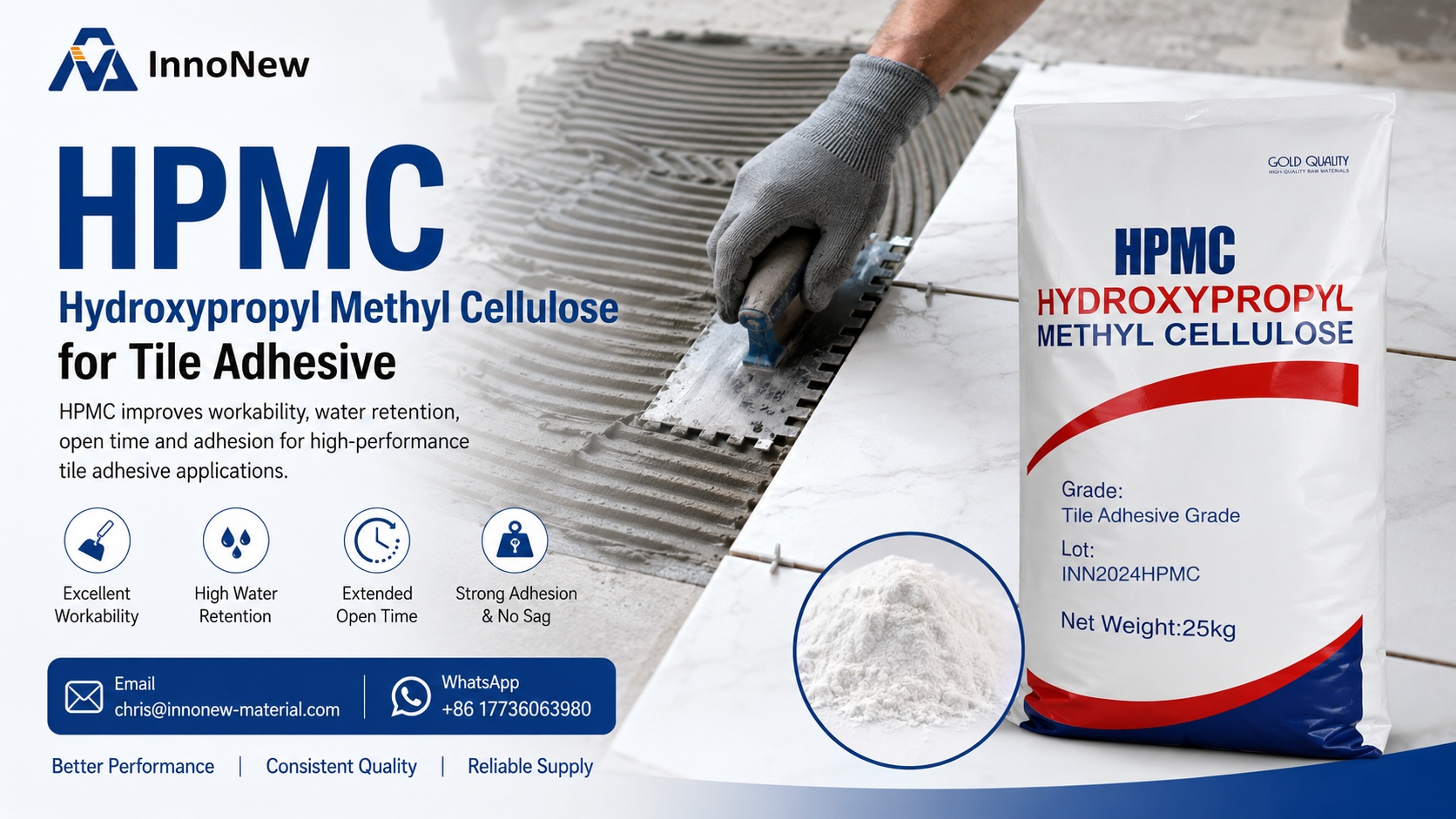
HPMC (Hydroxypropyl Methyl Cellulose)
Primary Functions:
- Water retention
- Open time control
- Workability improvement
- Sag resistance
Typical Dosage: 0.25–0.50%
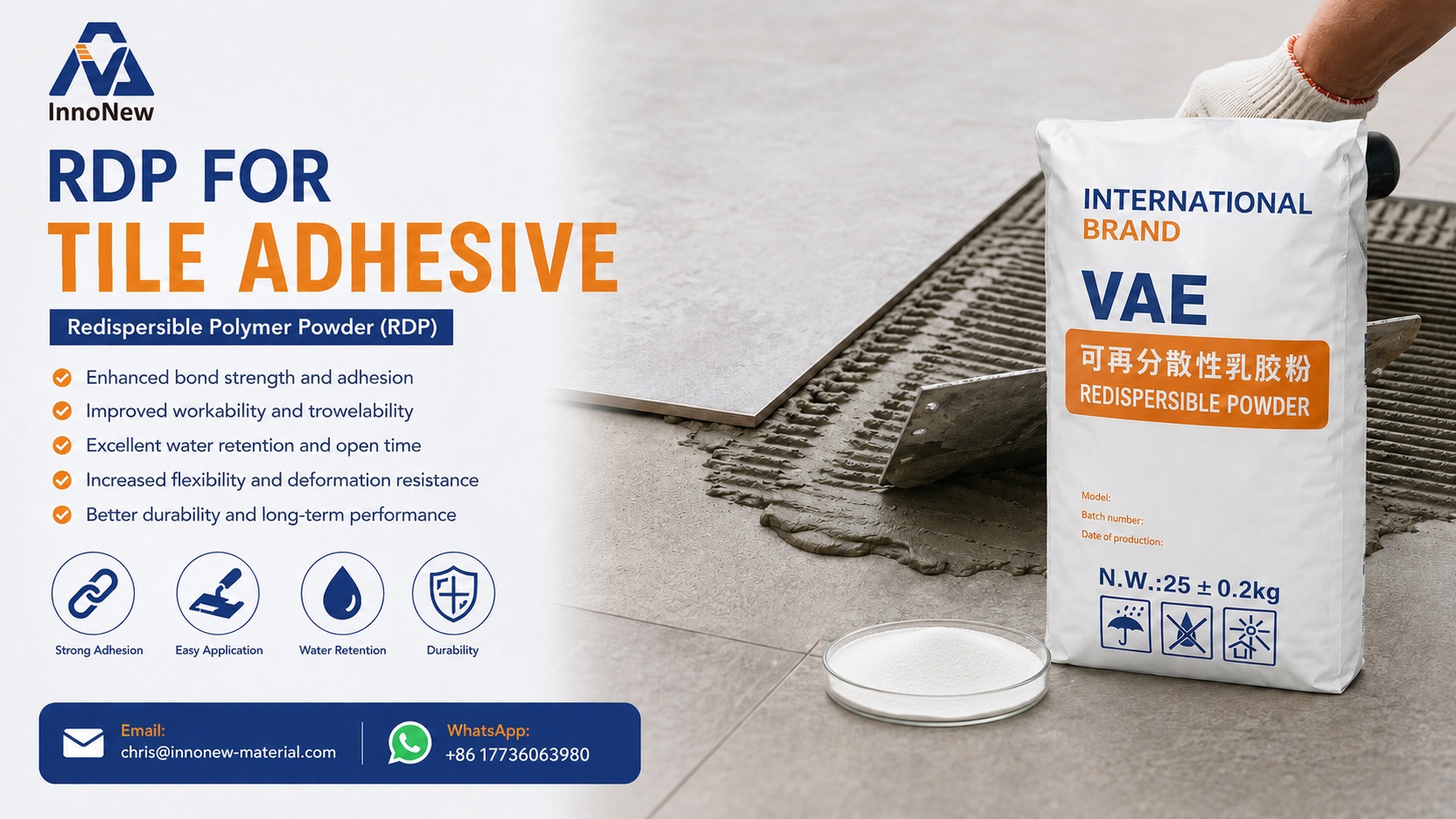
Redispersible Polymer Powder (RDP)
Primary Functions:
- Bond strength enhancement
- Flexibility improvement
- Impact resistance
- Porcelain tile adhesion
Typical Dosage: 1.0–4.0%
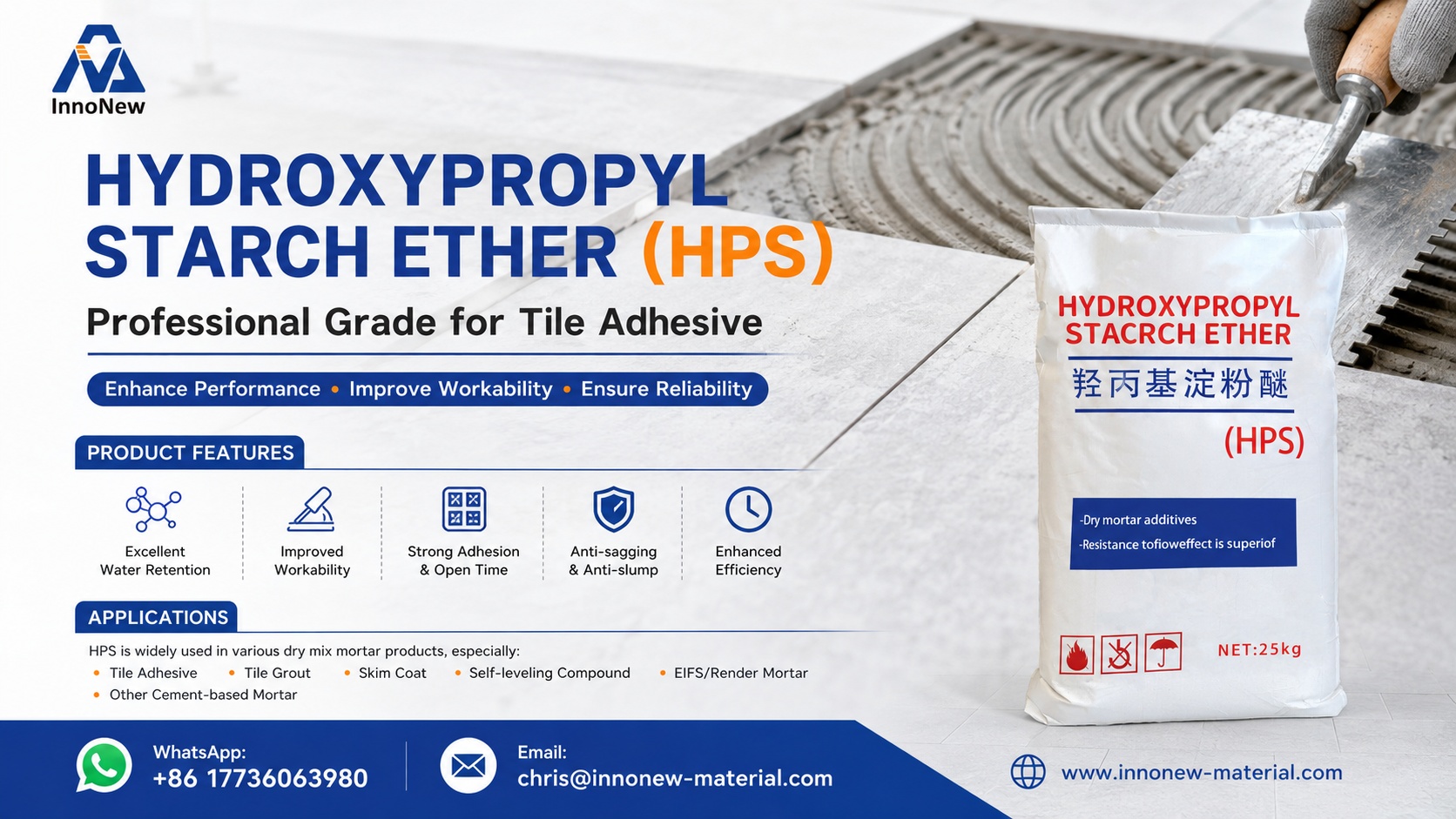
Starch Ether
Primary Functions:
- Anti-slip performance
- Improved application feel
- Reduced tile slippage
Typical Dosage: 0.02–0.08%
Example Tile Adhesive Formulation for Large Format Porcelain Tiles
| Raw Material | Dosage (%) |
|---|---|
| Ordinary Portland Cement | 35.0 |
| Quartz Sand | 60.0 |
| Limestone Powder | 2.0 |
| RDP | 2.0 |
| HPMC | 0.35-1% |
| Starch Ether | 0.1 |
| Additives | Balance |
Typical Performance
- Extended Open Time
- Excellent Slip Resistance
- High Tensile Adhesion
- Suitable for Porcelain Tiles
- Suitable for Large Format Tiles
Why Even Good Tile Adhesives Still Fail on Site
Many tile failures are unrelated to adhesive quality.
Common installation errors include:
- Incorrect water dosage
- Using expired adhesive
- Installing over weak substrates
- Insufficient adhesive coverage
- Lack of back buttering
- Ignoring open time limits
- Installing on uncured concrete
Even the highest-quality tile adhesive cannot compensate for poor installation practices.
For this reason, successful tile installation requires both proper formulation and professional application techniques.
Conclusion
Tile adhesive failures are rarely caused by a single factor. Most issues result from a combination of formulation design, material selection, substrate preparation, environmental conditions, and installation practices.
Understanding the root causes and failure mechanisms behind tile debonding, hollow tiles, slippage, cracking, and large-format tile failures enables manufacturers and contractors to develop more reliable tile adhesive systems.
As tile sizes continue to increase and construction standards become more demanding, modern polymer-modified tile adhesives incorporating HPMC, RDP, and starch ether will remain essential for achieving long-term performance and durability.
FAQ
What is the most common cause of tile adhesive failure?
Insufficient adhesive coverage, poor substrate preparation, and incorrect adhesive selection are the most common causes of tile installation failures.
Why do porcelain tiles require special tile adhesives?
Porcelain tiles have extremely low water absorption and require polymer-modified adhesives with higher bonding performance.
How much RDP is typically used in tile adhesive formulations?
Most formulations use between 1.0% and 4.0% RDP depending on performance requirements and adhesive classification.
What is the purpose of HPMC in tile adhesive?
HPMC improves water retention, open time, workability, and overall installation performance.
Is back buttering necessary for large-format tiles?
Yes. Large-format porcelain tiles generally require back buttering to achieve the minimum 95% adhesive coverage recommended by industry standards.