Warning: Undefined array key "url" in /www/wwwroot/innonew-material.com/wp-content/plugins/seo-by-rank-math/includes/modules/schema/snippets/class-author.php on line 41
+86-17736063980 ✉️ chris@innonew-material.com

admin

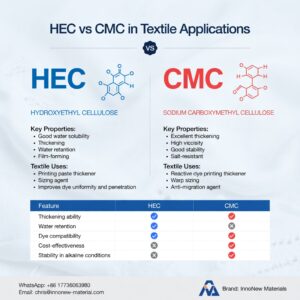
HEC vs CMC textile printing thickener comparison chart

HEC vs CMC: Which is Better for Textile Printing Thickener? (Cost vs Performance Guide)

HEC vs CMC: Complete Comparison for Textile Printing Applications In cost-sensitive textile markets, selecting the right thickener is not just a technical decision—it is a profit-driven strategy. Two of the most widely used options are: HEC (Hydroxyethyl Cellulose) → performance-oriented CMC (Carboxymethyl Cellulose) → cost-driven But the real question is: 👉 Can CMC replace HEC […]

HEC vs CMC: Which is Better for Textile Printing Thickener? (Cost vs Performance Guide) Read More »

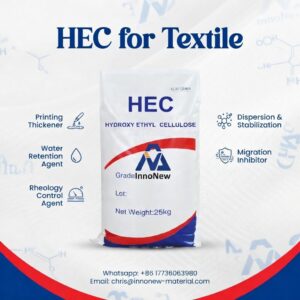
- Hydroxyethyl Cellulose HEC powder for textile printing and sizing (CAS 9004-62-0)

HEC vs Sodium Alginate: Which is the Best Textile Printing Thickener? (Complete Comparison Guide)

HEC vs Sodium Alginate: Complete Technical Comparison for Textile Printing In textile printing, selecting the right thickener directly impacts: Print sharpness Color yield Production stability Overall cost Among all available options, Hydroxyethyl Cellulsoe (HEC) and Sodium Alginate are the two most widely used thickeners for reactive dye printing systems. But which one is better? This

HEC vs Sodium Alginate: Which is the Best Textile Printing Thickener? (Complete Comparison Guide) Read More »

- Hydroxyethyl Cellulose HEC powder for textile printing and sizing (CAS 9004-62-0)

Textile Printing Thickener: Complete Guide to Types, Selection & Best Performance Optimization

Textile Printing Thickener: The Complete Industry Guide Introduction In textile printing, achieving sharp patterns, uniform color distribution, and stable production performance depends heavily on one critical component: the textile printing thickener. A well-selected thickener ensures: Controlled viscosity Proper dye fixation Clean pattern edges Stable processing under industrial conditions However, with multiple options available—HEC, PVA, sodium

Textile Printing Thickener: Complete Guide to Types, Selection & Best Performance Optimization Read More »

HPMC for Capsules: Vegan, Stable & High-Quality Excipient

HPMC for Vegetarian Capsules: Complete Technical & Supplier Guide

HPMC for Vegetarian Capsules: Complete Technical & Supplier Guide HPMC capsules are no longer a niche alternative to gelatin. They have become a global standard in pharmaceutical and nutraceutical delivery systems due to their superior environmental stability, chemical compatibility, and regulatory acceptance in vegetarian, vegan, halal, and kosher markets. The transition from gelatin to HPMC

HPMC for Vegetarian Capsules: Complete Technical & Supplier Guide Read More »

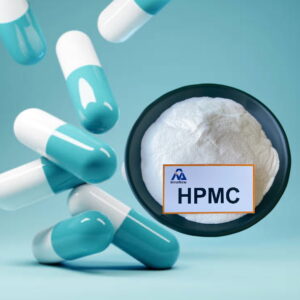
HPMC for Capsules: Vegan, Stable & High-Quality Excipient

Best HPMC for Vegetarian Capsules: Grade, Viscosity & Supplier Guide

Best HPMC for Vegetarian Capsules: Complete Buyer’s & Technical Guide Choosing the best HPMC for vegetarian capsules is critical for achieving consistent shell strength, fast dissolution, and stable production performance. As global demand for plant-based capsules continues to grow, manufacturers are shifting from gelatin to Hydroxypropyl Methylcellulose (HPMC / E464) due to its: Vegan-friendly composition

Best HPMC for Vegetarian Capsules: Grade, Viscosity & Supplier Guide Read More »

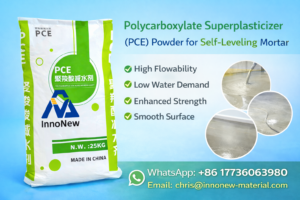
PCE powder for self leveling mortar, polycarboxylate superplasticizer powder

Why Self-Leveling Mortar Is Not Flowing? 7 Common Problems & Proven Solutions

Why Self-Leveling Mortar Is Not Flowing? 7 Common Problems & Proven Solutions Self-leveling mortar is designed to flow smoothly and level itself without manual spreading. But in real production and application, many manufacturers face a frustrating issue: 👉 The mortar does not flow properly,👉 It becomes thick, uneven, or difficult to spread. This not only

Why Self-Leveling Mortar Is Not Flowing? 7 Common Problems & Proven Solutions Read More »

High-Range Water Reducer Polycarboxylate Ether Based PCE Superplasticizer

PCE Powder vs SNF: Which is Better for Self-Leveling Mortar?

PCE Powder vs SNF: Which is Better for Self-Leveling Mortar? Choosing the right superplasticizer is critical for achieving optimal performance in self-leveling mortar. Many manufacturers still use traditional SNF (naphthalene-based superplasticizer) due to lower cost — but modern high-performance systems increasingly rely on PCE powder (polycarboxylate superplasticizer). So which one is actually better? This guide

PCE Powder vs SNF: Which is Better for Self-Leveling Mortar? Read More »

Polycarboxylate Ether PCE Powder Superplasticizer for Self-leveling Cement Mortar, High Flow Concrete Admixture Raw Material

The Complete Self-Leveling Mortar Formulation and Performance Optimization Guide

The Complete Self-Leveling Mortar Formulation and Performance Optimization Guide Introduction Self-leveling flooring is widely used in commercial, industrial, and residential projects due to its efficiency, smooth finish, and long-term durability. Despite its popularity, achieving a truly defect-free floor is challenging because self-leveling mortar must simultaneously meet multiple requirements: High fluidity Zero segregation Long open time

The Complete Self-Leveling Mortar Formulation and Performance Optimization Guide Read More »

How to Reduce Foam in Metalworking Fluids

How to Reduce Foam in Metalworking Fluids: Complete Industrial Guide Foaming is one of the most common and costly problems in metalworking fluids. It reduces cooling efficiency, causes overflow, and increases maintenance costs. 1. Why Foam Occurs Excess surfactants High-pressure systems TEA-based formulations 2. Impact of Foam Reduced heat transfer Tool wear Machine downtime 3.

How to Reduce Foam in Metalworking Fluids Read More »

Triisopropanolamine (TIPA) - High-Performance Additive for Metalworking Fluids

What is Metalworking Fluid? Types, Functions & Industrial Applications

What is Metalworking Fluid? Complete Guide for Industrial Machining Metalworking fluid (MWF) is a critical component in machining processes, used to cool, lubricate, and protect metal surfaces during cutting, grinding, and forming operations. Key Functions Cooling (heat dissipation) Lubrication (reduce friction) Corrosion protection Chip removal Types of Metalworking Fluids Straight oils Soluble oils Semi-synthetic fluids

What is Metalworking Fluid? Types, Functions & Industrial Applications Read More »

Scroll to Top