Warning: Undefined array key "url" in /www/wwwroot/innonew-material.com/wp-content/plugins/seo-by-rank-math/includes/modules/schema/snippets/class-author.php on line 41
+86-17736063980 ✉️ chris@innonew-material.com

admin

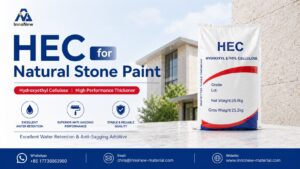
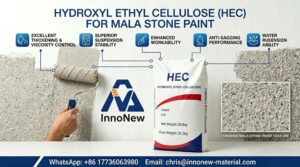
Cellulose Ether HEC for Mala stone paint

HEC Hydroxyethyl Cellulose: Essential Thickener for Mala Color Stone Coating

Why HEC is Critical in Mala Color Stone Coating Mala color stone coating (real stone paint) is widely used in exterior wall decoration due to its natural granite-like appearance and excellent durability. However, achieving stable viscosity, uniform suspension, and smooth application remains a key formulation challenge. Hydroxyethyl Cellulose (HEC) is an essential cellulose ether that […]

HEC Hydroxyethyl Cellulose: Essential Thickener for Mala Color Stone Coating Read More »

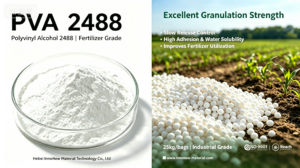
Eco-Friendly PVA 2488 Binder for Fertilizer Granulation, High-Solubility Polyvinyl Alcohol

PVA para Fertilizantes | Aglutinante e Revestimento de Liberação Controlada no Brasil

O que é PVA em fertilizantes? O álcool polivinílico (PVA) é um polímero solúvel em água usado como aglutinante, agente de revestimento e modificador de liberação controlada na produção de fertilizantes. Por que usar PVA no Brasil? Reduz perdas de nutrientes (chuvas intensas no Brasil) Melhora resistência dos grânulos Ideal para fertilizantes NPK Compatível com

PVA para Fertilizantes | Aglutinante e Revestimento de Liberação Controlada no Brasil Read More »

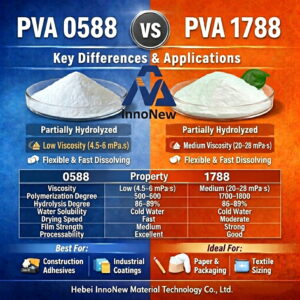
PVA 0588 vs PVA 1788 - Viscosity and Application Comparison of Polyvinyl Alcohol Grades

PVA 0588 vs PVA 1788: Key Differences, Applications & How to Choose

PVA 0588 vs PVA 1788: What’s the Difference and Which One Should You Choose? Introduction  Polyvinyl Alcohol (PVA) is widely used in adhesives, textile sizing, paper coating, and construction materials. Among various grades, PVA 0588 and PVA 1788 are two of the most commonly used—but they serve very different purposes. If you are selecting raw

PVA 0588 vs PVA 1788: Key Differences, Applications & How to Choose Read More »

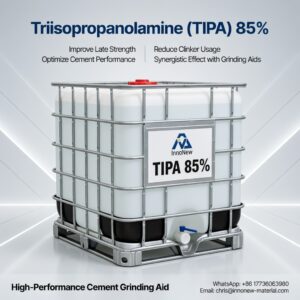
Triisopropanolamine TIPA 85 cement grinding aid

TIPA Supplier in Vietnam | Triisopropanolamine for Cement Industry

TIPA Supplier in Vietnam | Triisopropanolamine for Cement Industry What is Triisopropanolamine TIPA? Triisopropanolamine (TIPA) is a high-efficiency alkanolamine grinding aid and strength enhancer widely used in cement and concrete production in Vietnam. It reduces particle agglomeration, improves grinding efficiency, lowers energy consumption, and significantly boosts 7-day and 28-day compressive strength, especially for slag, fly

TIPA Supplier in Vietnam | Triisopropanolamine for Cement Industry Read More »

TIPA cement grinding aid

TIPA Supplier in Thailand | Triisopropanolamine for Cement & Concrete

TIPA Supplier in Thailand for Cement, Concrete & Agrochemical Industry TIPA Market Demand in Thailand Thailand is a rapidly developing construction and infrastructure market in Southeast Asia. The demand for high-performance cement and concrete continues to grow, driving the need for efficient additives like Triisopropanolamine (TIPA). TIPA is widely used in cement grinding aids and

TIPA Supplier in Thailand | Triisopropanolamine for Cement & Concrete Read More »

Polyvinyl Alcohol (PVA) | High-Quality Industrial Water-Soluble Polymer

PVA 2488 vs PVA 2688: Key Differences, Applications & How to Choose (Expert Guide)

PVA 2488 vs PVA 2688: What’s the Difference and Which One Should You Choose? Introduction to PVA Grades Polyvinyl Alcohol (PVA), also known as PVOH, is a water-soluble polymer widely used in adhesives, films, coatings, and construction materials. Among the most commercially significant grades, PVA 2488 and PVA 2688 are frequently compared due to their

PVA 2488 vs PVA 2688: Key Differences, Applications & How to Choose (Expert Guide) Read More »

RDP for tile adhesive improving bonding strength and flexibility in dry mix mortar

Why Combining HPMC and RDP is the Key to High-Performance Mortars in Construction

Why Combining HPMC and RDP is the Key to High-Performance Mortars in Construction In the fast-evolving construction industry, achieving high-performance mortars that offer durability, flexibility, and strong adhesion is crucial. Two ingredients that play a pivotal role in achieving these goals are Hydroxypropyl Methyl Cellulose (HPMC) and Redispersible Polymer Powder (RDP). These additives are integral

Why Combining HPMC and RDP is the Key to High-Performance Mortars in Construction Read More »

Food Grade CMC Powder, Sodium Carboxymethyl Cellulose Food Additive, High Viscosity Cellulose Gum E466 for Food Industry

Is CMC Safe for Food? Complete Guide to Carboxymethyl Cellulose Safety

Is CMC Safe for Food? Introduction Carboxymethyl Cellulose (CMC), also known as sodium carboxymethyl cellulose, is widely used in the food industry as a thickener, stabilizer, and emulsifier. One of the most common questions among manufacturers and consumers is whether CMC is safe for food use. The short answer is: Yes, food grade CMC is

Is CMC Safe for Food? Complete Guide to Carboxymethyl Cellulose Safety Read More »

High Purity Sodium Carboxymethyl Cellulose (CMC) Thickener

CMC vs Xanthan Gum: Which Thickener is Better for Your Application?

Carboxymethyl Cellulose (CMC) vs Xanthan Gum Carboxymethyl Cellulose (CMC) and Xanthan Gum are two widely used water-soluble polymers that function as thickeners, stabilizers, and rheology modifiers. While both improve viscosity and product stability, they differ significantly in performance, cost, compatibility, and application suitability. Choosing between CMC and Xanthan Gum depends on your specific formulation requirements,

CMC vs Xanthan Gum: Which Thickener is Better for Your Application? Read More »

Compare HPS, PAC & CMC polysaccharide polymers for oil drilling fluids. Learn their differences in filtration control, salt tolerance, viscosity, cost & best applications for drilling mud systems.

How to Reduce Fluid Loss in Drilling | Complete Guide to Filtration Control (2026)

How to Reduce Fluid Loss in Drilling Fluids Why Fluid Loss Is a Critical Problem  Fluid loss is one of the most common and costly issues in drilling operations. When drilling fluid invades the formation, it leads to: Formation damage Wellbore instability Reduced drilling efficiency Increased operational cost 👉 Effective filtration control is essential to

How to Reduce Fluid Loss in Drilling | Complete Guide to Filtration Control (2026) Read More »

Scroll to Top