admin

Best PVA for textile yarn sizing 2026, high-performance polyvinyl alcohol warp sizing agent

Best PVA for Textile Yarn Sizing in 2026: Top Grades, Performance & Buying Guide

In the modern textile weaving industry, yarn sizing is a critical process that directly determines weaving efficiency, yarn breakage rate, and final fabric quality. As one of the most widely used sizing agents, polyvinyl alcohol (PVA) stands out for its exceptional film-forming ability, strong adhesion, good fluidity, and easy desizing performance. With the upgrading of […]

Best PVA for Textile Yarn Sizing in 2026: Top Grades, Performance & Buying Guide Read More »

PVA vs Starch for textile yarn sizing

PVA vs Starch for Textile Yarn Sizing: Full Comparison, Pros & Cons

PVA vs Starch for Textile Yarn Sizing In textile manufacturing, yarn sizing is the critical preparatory step that boosts warp yarn strength, reduces hairiness, cuts loom breakage rates, and ensures stable high-speed weaving. Two of the most widely used sizing agents globally are PVA (polyvinyl alcohol) and starch. Choosing between PVA vs starch for textile

PVA vs Starch for Textile Yarn Sizing: Full Comparison, Pros & Cons Read More »

Hydroxyethyl Cellulose HEC for Oil drilling fluid

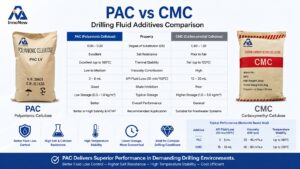
HEC vs PAC in Drilling Fluids – Complete Comparison Guide for Oilfield Applications

HEC vs PAC in Drilling Fluid: Which Additive is Better? In oilfield drilling operations, selecting the right drilling fluid additive is critical for achieving optimal performance, reducing operational risks, and controlling overall costs. Among the most widely used additives in water-based drilling fluids are HEC (Hydroxyethyl Cellulose) and PAC (Polyanionic Cellulose). Both materials play essential

HEC vs PAC in Drilling Fluids – Complete Comparison Guide for Oilfield Applications Read More »

HEC for oil drilling fluid viscosity and fluid loss control

How HEC Enhances Drilling Fluid Efficiency and Stability

How HEC Enhances Drilling Fluid Efficiency and Stability In oilfield drilling operations, the performance of drilling fluids directly influences operational safety, drilling speed, and cost efficiency. As drilling conditions become more complex, the demand for high-performance additives continues to increase. Among these, HEC for oil drilling has emerged as a reliable and efficient solution for

How HEC Enhances Drilling Fluid Efficiency and Stability Read More »

HPMC for concrete improving workability and water retention

How HPMC Improves Concrete Workability (Complete Technical Guide)

How HPMC Improves Concrete Workability In modern construction, achieving optimal concrete workability is essential for ensuring efficient placement, uniform structure, and long-term durability. One of the most effective additives used today is HPMC for concrete, a versatile cellulose ether that significantly enhances fresh mix performance. At Hebei InnoNew Material Technology Co., Ltd., we provide high-quality HPMC

How HPMC Improves Concrete Workability (Complete Technical Guide) Read More »

How to Thicken Liquid Detergent with HPMC: Complete Guide

How to Thicken Liquid Detergent with HPMC In modern detergent formulation, achieving the right viscosity is essential for both product performance and consumer experience. At Hebei InnoNew Material Technology Co., Ltd., we provide high-quality HPMC solutions that help manufacturers create stable and premium liquid detergents. Why Viscosity Matters in Liquid Detergent Viscosity directly affects pouring

How to Thicken Liquid Detergent with HPMC: Complete Guide Read More »

Choose Right Methyl Hydroxyethyl Cellulose (MHEC) Viscosity for Construction

How to Choose the Right MHEC Viscosity for Construction Application

High Viscosity MHEC for Construction  Selecting the correct MHEC (Methyl Hydroxyethyl Cellulose) viscosity is a key factor in optimizing construction formulations. Whether you are producing tile adhesive, dry mix mortar, or wall putty, the performance of mhec powder directly impacts workability, water retention, and overall product quality. Selecting the correct Methyl Hydroxyethyl Cellulose MHEC viscosity

How to Choose the Right MHEC Viscosity for Construction Application Read More »

HEMC VS HPMC | Cellulose Ether Difference

HEMC vs HPMC: Which Cellulose Ether is Better for Mortar and Tile Adhesive?

HEMC vs HPMC: Whick Cellulose Ether is Better for Mortar and Tile Adhesive? In construction chemical formulations, selecting the right Cellulose ether is critical to achieving optimal performance. Two of the most widely used materials are hydroxyethyl methyl cellulose (HEMC) and HPMC. For manufacturers sourcing from a reliable HEMC supplier or evaluating options from a

HEMC vs HPMC: Which Cellulose Ether is Better for Mortar and Tile Adhesive? Read More »

Specially formulated HEMC powder for tile adhesive, improving construction efficiency, reducing cracking and ensuring long-lasting adhesion for floor and wall tiling applications.

How Hydroxyethyl Methyl Cellulose (HEMC) Improves Tile Adhesive Performance

How HEMC Improves Tile Adhesive Performance In modern construction, tile adhesive performance directly affects bonding strength, durability, and application efficiency. One of the most critical additives used today is Hydroxyethyl Methyl Cellulose (HEMC), also known as MHEC powder, a high-performance Cellulose ether. Whether you are sourcing from a reliable HEMC supplier or working with a

How Hydroxyethyl Methyl Cellulose (HEMC) Improves Tile Adhesive Performance Read More »

HEC Enhances Paint Flow and Leveling: Hydroxyethyl Cellulose for Smooth Coatings

How HEC Enhances Paint Flow and Leveling: Hydroxyethyl Cellulose for Smooth Coatings

HEC Enhances Paint Fow and Leveling: Hydroxyethyl Cellulose for Smooth Coatings One of the key benefits of HEC for paint is its ability to improve flow properties. By modifying the paint’s rheology, HEC ensures that coatings spread evenly on surfaces, reducing brush and roller marks. This is especially import In water-based coatings, achieving smooth flow

How HEC Enhances Paint Flow and Leveling: Hydroxyethyl Cellulose for Smooth Coatings Read More »

Scroll to Top